Photo: Wikipedia
Demographics of San Diego County
Affluence Level in San Diego County
An upper-middle-class area. Household wealth, education levels, and homeownership run ahead of national benchmarks.
People of San Diego County
San Diego County today is home to 3.28 million people, a population defined by its military presence, its border proximity, and a demographic balance where no single ethnic group holds a majority. The county is 43.2% white, 34.3% Hispanic, 10.4% East and Southeast Asian, 4.4% Black, and 1.5% Indian, with 42.1% of adults holding a college degree. Its character is a blend of coastal affluence, inland suburban sprawl, and a deep-rooted military and aerospace economy, creating a region that is politically moderate-leaning but culturally diverse and increasingly expensive.
Settlement & growth (pre-1960)
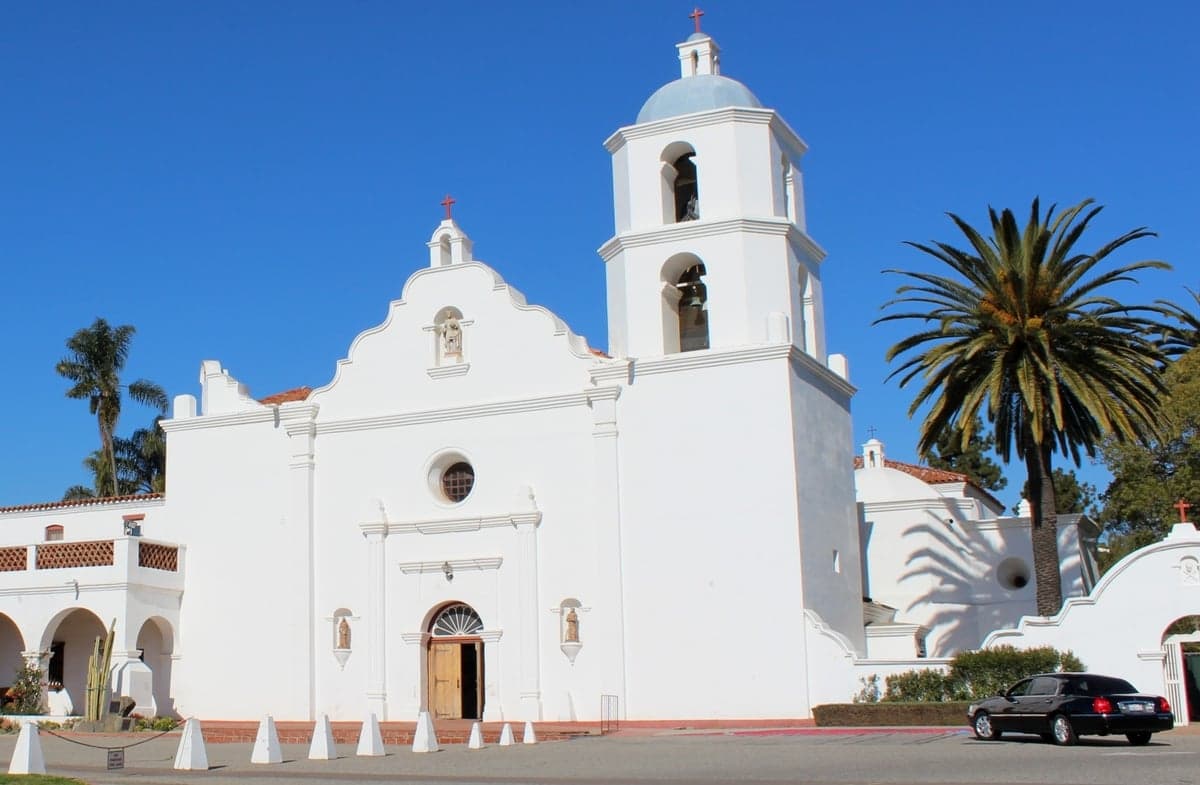
Long before European contact, the Kumeyaay people inhabited what is now San Diego County, living in seasonal villages across the region from the coast to the desert. Spanish colonization began in 1769 with the establishment of Mission San Diego de Alcalá in present-day San Diego, the first of the California missions. The Spanish and later Mexican periods saw the creation of vast ranchos, but the non-Native population remained sparse—fewer than 500 settlers by the time of the U.S.-Mexico War in 1846.
American settlement accelerated after California statehood in 1850. The discovery of gold in Julian in 1870 drew a small but lasting wave of Anglo-American miners and merchants, while the arrival of the transcontinental railroad in 1885 triggered a land boom that brought Midwestern farmers and speculators to Escondido and Oceanside. By 1900, the county’s population was overwhelmingly white and native-born, with small enclaves of Chinese and Japanese laborers who had worked on railroads and in agriculture.
The early 20th century saw two transformative forces. The U.S. Navy established a major presence in San Diego Bay during World War I, expanding dramatically through World War II and creating a permanent base economy that drew servicemen and civilian workers from across the country. Simultaneously, the aerospace industry took root, with companies like Convair and Ryan Aeronautical hiring engineers and skilled tradesmen. This period also brought Dust Bowl migrants from Oklahoma and Texas, who settled in agricultural areas like Fallbrook and Vista, working in citrus and avocado groves. By 1950, the county’s population had reached 556,000, still 90% white, but now anchored by the military-industrial complex that remains its economic backbone.
Modern era (post-1965)
The 1965 Hart-Cellar Immigration Act fundamentally reshaped San Diego County. The law eliminated national-origin quotas, opening the door to large-scale immigration from Asia and Latin America. The most immediate impact was a surge of Mexican immigration, driven by both legal channels and the county’s 60-mile border with Tijuana. San Ysidro, the busiest land border crossing in the Western Hemisphere, became the entry point for generations of Mexican and Central American families, who settled in neighborhoods like Barrio Logan and National City, creating a dense, Spanish-speaking corridor along the border.
Asian immigration followed a different pattern. Filipino immigrants, many with U.S. Navy connections, established large communities in Mira Mesa and National City starting in the 1970s. Vietnamese refugees arrived after 1975, concentrating in City Heights and later spreading to San Diego’s Linda Vista neighborhood. Chinese, Korean, and Japanese immigrants, often settled directly in suburban communities like Carmel Valley and Rancho Peñasquitos, drawn by the county’s tech and biotech sectors. The Indian population, though smaller at 1.5%, grew rapidly after 2000, clustering in Scripps Ranch and 4S Ranch, where many work in software engineering and pharmaceuticals.
Domestic migration also accelerated after 1965. The county’s mild climate and defense-sector jobs attracted retirees and military veterans from the Midwest and Northeast, fueling suburban expansion into Poway, Santee, and Carlsbad. This wave was predominantly white and middle-class, creating a sharp geographic divide: the coastal and northern suburbs remained heavily white and affluent, while the southern and central areas became increasingly Hispanic and Asian. By 2020, the county had become a “majority-minority” region, with non-Hispanic whites falling below 50% for the first time.
The future
San Diego County’s demographic trajectory points toward continued diversification, but not toward a single melting-pot identity. The Hispanic population, already 34.3%, is projected to grow steadily through both immigration and higher birth rates, solidifying its presence in the South Bay and inland communities like Chula Vista and El Cajon. The East and Southeast Asian population, at 10.4%, is likely to plateau as immigration from the Philippines and Vietnam slows, though the Indian population (1.5%) may continue its rapid growth if the biotech and software sectors remain strong.
The white population, concentrated in the older coastal suburbs and the rural backcountry around Ramona and Julian, is aging and declining in share, but remains economically dominant. The county is not tribalizing into hostile enclaves, but it is sorting by income and ethnicity into distinct zones: affluent, highly educated whites and Asians in the north; working-class Hispanics and Filipinos in the south; and a mixed, younger population in the urban core. The military presence acts as a stabilizing force, bringing in a transient but diverse population from across the country.
For a conservative-leaning newcomer, San Diego County offers a complex picture. The region’s politics are moderate, with a strong libertarian streak in the suburbs and a more progressive tilt in the city. The cost of living is high, driven by housing scarcity and a tech-driven economy, but the job market remains robust. The cultural identity is not being erased by immigration but is being layered: English remains the dominant language of commerce and public life, while Spanish and Tagalog are common in daily interactions. The next decade will likely see continued growth in the Indian and East Asian professional class, a slow decline in the white share, and a Hispanic population that becomes increasingly suburban and middle-class.
San Diego County is becoming a region where demographic change is real but gradual, and where economic opportunity—not ethnic tension—drives the daily reality. For someone moving in now, the key decision is not whether to embrace diversity, but which of the county’s distinct subregions best matches their priorities: the military-friendly suburbs of the north, the border-adjacent communities of the south, or the urban core’s mix of old and new. The county’s future is not a single story, but a collection of them, each shaped by the waves of migration that have landed here over the past century.

* Values derived from national, state, county, city and local statistics and may differ in a specific area. Last updated: 2026-05-17T12:01:21.000Z
Narrative content on this page is AI-generated and may contain mistakes. Verify any details that matter before acting on them.
ReloMaps may earn a commission from affiliate links at no extra cost to you.

