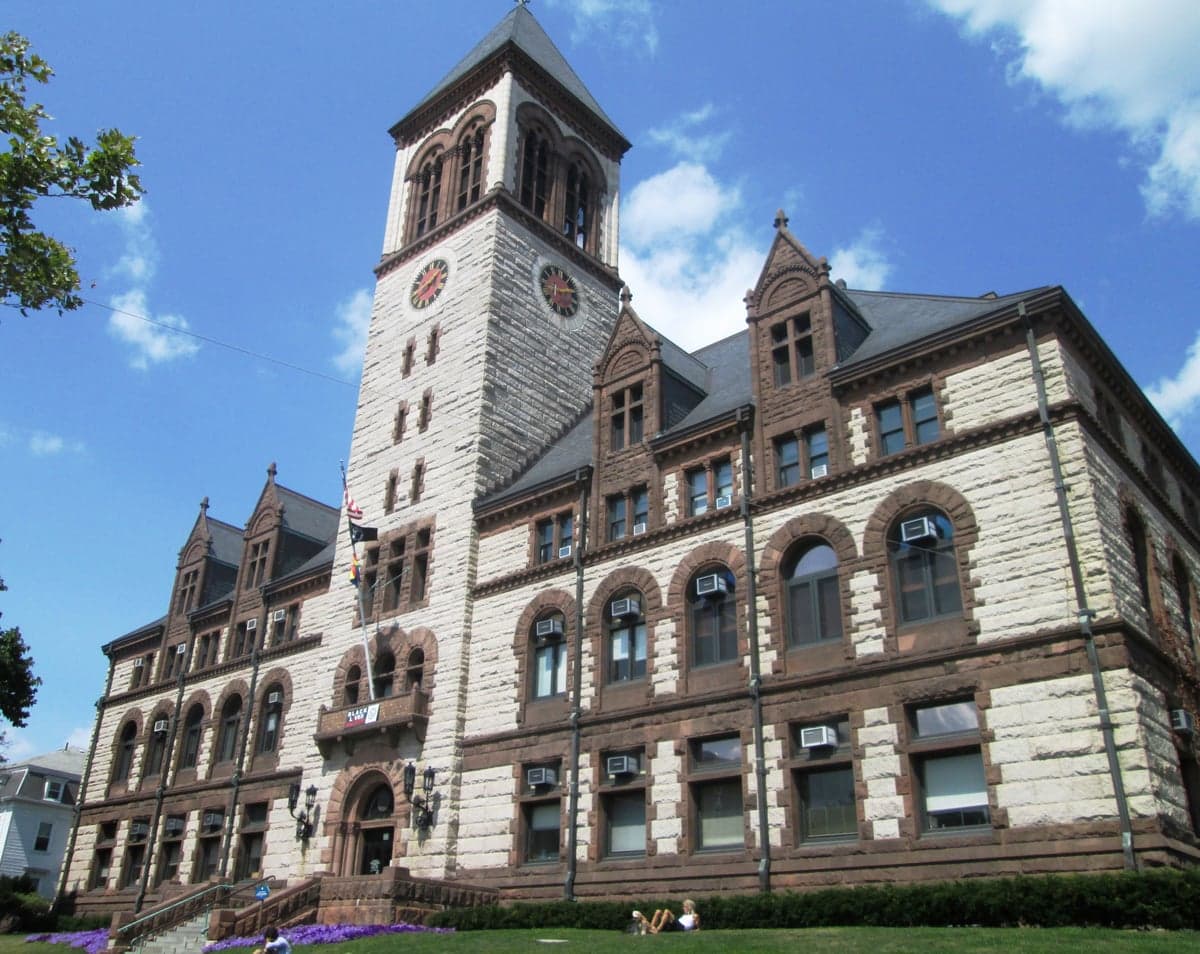
Photo: Wikipedia
Demographics of Cambridge, MA
Affluence Level in Cambridge, MA
An upper-middle-class area. Household wealth, education levels, and homeownership run ahead of national benchmarks.
People of Cambridge, MA
The people of Cambridge, MA today form one of the most densely concentrated, highly educated urban populations in the United States. With 117,794 residents packed into just over six square miles, the city is 55.0% White, 13.9% East/Southeast Asian, 10.2% Black, 9.0% Hispanic, and 5.7% Indian (subcontinent), while a striking 80.2% of adults hold a bachelor’s degree or higher. The city’s identity is defined by its twin anchors—Harvard University and MIT—which draw a global professional class, yet Cambridge retains distinct working-class and immigrant neighborhoods that resist full gentrification. This is a place where a Nobel laureate and a third-generation Portuguese-American roofer might share the same block, but where housing costs increasingly filter who can stay.
How the city was settled and grew
Cambridge was founded in 1630 as a Puritan settlement on the Charles River, originally called Newtowne. The first wave of English colonists arrived as part of the Massachusetts Bay Colony, drawn by religious freedom and land grants along the river. By 1636, Harvard College was established, making Cambridge the intellectual center of the colony. The city grew slowly through the 18th century as a farming and market town, with its first distinct neighborhood—Harvard Square—emerging around the college. The 19th century brought two transformative waves: Irish immigrants fleeing the Great Famine (1845–1852) settled in Cambridgeport and East Cambridge, working in the city’s new glassworks, soap factories, and foundries. A second wave of French-Canadians arrived after 1860, taking mill and factory jobs in North Cambridge, where they built St. John’s Church and established a tight-knit community that still holds an annual Franco-American festival. By 1900, Cambridge was a dense industrial city of over 90,000, with distinct ethnic enclaves: Irish in East Cambridge, French-Canadians in North Cambridge, and a small but influential German Jewish community around Inman Square.
Modern era (post-1965)
The 1965 Hart-Celler Act reshaped Cambridge’s population dramatically. The city’s existing research universities and growing biotech sector—anchored by MIT’s Kendall Square—began attracting highly skilled immigrants from East and Southeast Asia. Chinese and Korean professionals settled in Porter Square and along Massachusetts Avenue, creating a corridor of Asian-owned restaurants, markets, and language schools. The Indian (subcontinent) population grew later, accelerating after 2000 as tech and pharmaceutical firms expanded; today’s 5.7% Indian share is concentrated near Kendall Square and in the Avon Hill area, where many work at Biogen, Novartis, or Google’s Cambridge office. Meanwhile, domestic in-migration of young professionals from across the U.S. has reshaped formerly working-class neighborhoods. East Cambridge, once solidly Irish and Portuguese, saw its White non-Hispanic share drop from 85% in 1980 to 55% today, replaced by a mix of Asian, Indian, and Hispanic newcomers. The Black population (10.2%) is older and more established, concentrated in Area 4 (the Port) and Riverside, though gentrification has pushed many Black families to nearby Somerville and Everett. The Hispanic share (9.0%) is predominantly Puerto Rican and Dominican, centered in East Cambridge and Wellington-Harrington, where rents remain slightly below the city’s punishing median of $2,800 for a one-bedroom.
The future
Cambridge’s population is trending toward a bifurcated future: a highly educated, high-income core of professionals (largely White, East/Southeast Asian, and Indian) coexisting with a shrinking but persistent working-class base of Hispanic, Black, and Portuguese-American families. The foreign-born share (17.2%) is plateauing after decades of growth, as housing costs push new immigrants to gateway suburbs like Malden, Quincy, and Lowell. The East/Southeast Asian population (13.9%) is the fastest-growing major group, driven by Chinese and Korean graduate students and tech workers who often stay after graduation. The Indian subcontinent population (5.7%) is also growing, but more slowly, as many families move to Lexington or Acton for better schools and larger homes. The White share (55.0%) is stable but aging—many are long-term homeowners in West Cambridge and Shady Hill who are unlikely to leave. The Black and Hispanic shares are declining slightly as displacement continues, though city rent-control and inclusionary zoning policies have slowed the pace. Over the next 10–20 years, Cambridge will likely become even more stratified by education and income, with its immigrant communities either assimilating into the professional class or being pushed to the urban fringe.
For someone moving in now, Cambridge offers a dense, walkable, intellectually vibrant environment with world-class transit and amenities—but at a steep price. The city is becoming a place where a high income and advanced degree are nearly prerequisites for entry, and where the historic working-class and immigrant character is preserved more in memory than in daily life. New arrivals should expect a community that values education, diversity, and progressive politics, but where economic homogeneity increasingly defines who gets to call Cambridge home.

* Values derived from national, state, county, city and local statistics and may differ in a specific area. Last updated: 2026-04-15T23:38:45.000Z
Narrative content on this page is AI-generated and may contain mistakes. Verify any details that matter before acting on them.
ReloMaps may earn a commission from affiliate links at no extra cost to you.

