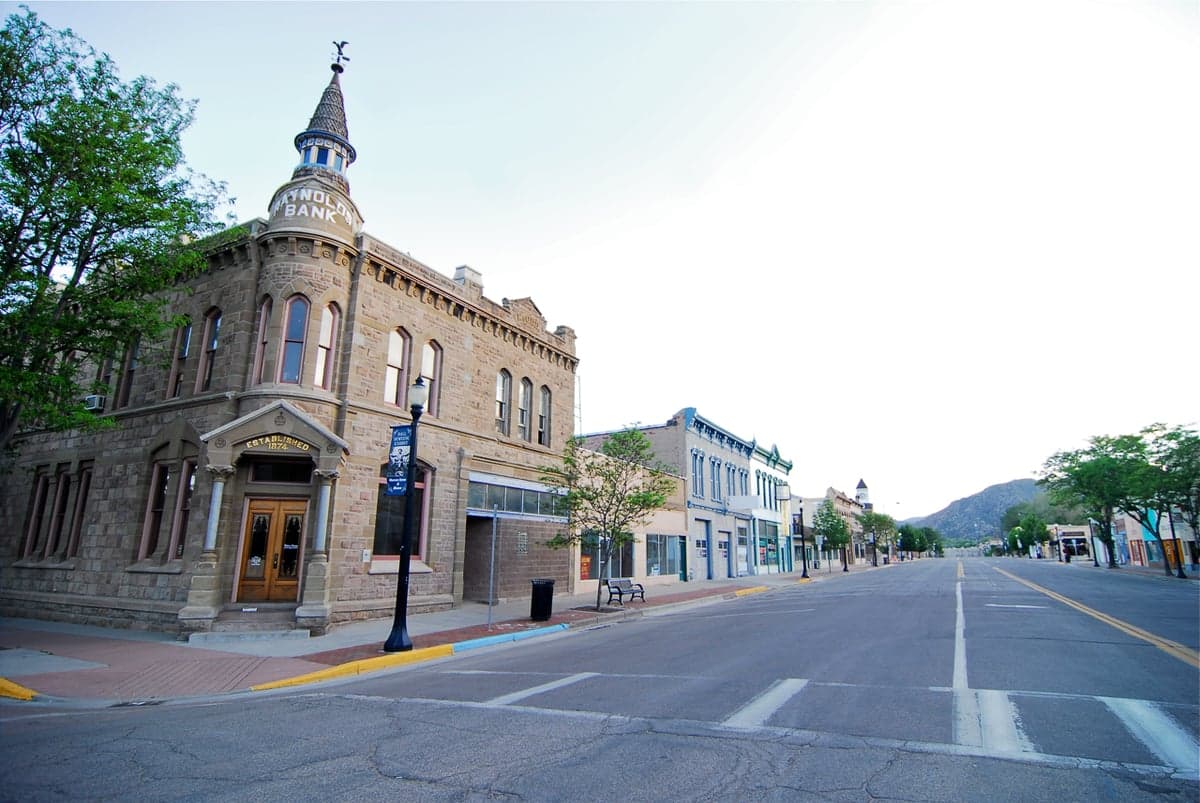
Photo: Wikipedia
Demographics of Canon City, CO
Affluence Level in Canon City, CO
An upper-middle-class area. Household wealth, education levels, and homeownership run ahead of national benchmarks.
People of Canon City, CO
Canon City, Colorado, is a predominantly white, working-class community of 17,098 residents, characterized by a strong sense of local heritage and a deeply conservative political lean. With a foreign-born population of just 0.2% and a Hispanic share of 11.9%, the city remains one of the least ethnically diverse in Fremont County, reflecting its historical roots as a destination for Anglo-American settlers and, later, domestic migrants seeking affordable living. The city’s identity is shaped by its prison-industry economy, outdoor recreation, and a population that is older and less college-educated (27.3%) than the state average, creating a stable but slowly aging demographic profile.
How the city was settled and grew
Canon City’s human history begins with the Ute and Comanche peoples, who used the Arkansas River corridor for seasonal hunting. The first permanent Anglo settlers arrived during the Colorado Gold Rush of 1859, when prospectors and merchants established a supply camp at the confluence of the Arkansas River and Grape Creek. The city was formally founded in 1860 by a group of investors led by Anson Rudd, who saw potential in the fertile river valley rather than the goldfields. The original population was overwhelmingly native-born white Americans from the Midwest and Upper South, drawn by land grants and the promise of irrigated agriculture. The historic South Canon neighborhood, along the river south of Main Street, became the initial settlement cluster, with simple frame houses and small farms. By the 1870s, the arrival of the Denver & Rio Grande Railroad spurred a second wave of Anglo-American migrants, including skilled tradesmen and railroad workers, who built homes in the North Canon district near the depot. The construction of the Colorado Territorial Correctional Facility in 1871 brought a third wave: guards, administrators, and their families, who settled in the Prison Hill area east of downtown. A small number of Italian and Irish immigrants arrived as laborers during this period, but they quickly assimilated into the white majority. The Hispanic population, which today stands at 11.9%, has deeper roots in the region’s Spanish colonial and Mexican-era past, but in Canon City itself, Hispanic families were historically concentrated in the East Canon neighborhood, near the railroad yards and agricultural fields, where they worked as farmhands and railroad laborers through the early 20th century.
Modern era (post-1965)
After the 1965 Hart-Cellar Act, Canon City saw virtually no new immigration. The foreign-born share remained below 1%, and the city’s demographic changes were driven entirely by domestic migration. The 1970s and 1980s brought an influx of retirees and working-class families from the Front Range, attracted by low housing costs and the area’s mild climate. These new residents settled primarily in newer subdivisions on the city’s western edge, such as Skyline Drive and Fremont Drive, which expanded the city’s footprint into former ranchland. The Hispanic population grew modestly from about 8% in 1990 to 11.9% today, driven by natural increase and some in-migration from southern Colorado’s San Luis Valley. However, Hispanic residents remain residentially concentrated in the East Canon and South Canon neighborhoods, where older, more affordable housing stock is located. The Black population (1.1%) and East/Southeast Asian population (0.4%) are tiny and dispersed, with no distinct ethnic enclaves. The Indian subcontinent population is effectively zero. The city’s college-educated share (27.3%) is well below the Colorado average of roughly 40%, reflecting a workforce heavily employed in corrections, manufacturing, and retail rather than professional services.
The future
Canon City’s population is projected to remain stable or grow slowly, with continued homogenization rather than diversification. The Hispanic share may inch upward to 13-14% by 2040 through natural increase, but the city is unlikely to attract significant immigrant populations due to its limited job base and remote location. The white population will continue to age in place, with younger adults often leaving for college or Front Range employment. The South Canon and East Canon neighborhoods may see modest Hispanic growth, while newer developments west of town will remain overwhelmingly white. The city is not tribalizing into distinct enclaves; rather, it is slowly becoming slightly more Hispanic while remaining overwhelmingly Anglo. For a conservative-leaning mover, Canon City offers a stable, low-crime, culturally familiar environment with minimal demographic flux.
For someone moving in now, Canon City is a place where the population is aging, staying put, and changing very slowly. The city’s character is defined by its prison-industry stability, its outdoor recreation access, and a social fabric that remains overwhelmingly white and working-class. New residents will find a community that values self-reliance, low taxes, and a slower pace of life, with little of the ethnic or cultural churn seen in Colorado’s Front Range cities.

* Values derived from national, state, county, city and local statistics and may differ in a specific area. Last updated: 2026-09-21T19:02:37.000Z
Narrative content on this page is AI-generated and may contain mistakes. Verify any details that matter before acting on them.
ReloMaps may earn a commission from affiliate links at no extra cost to you.

