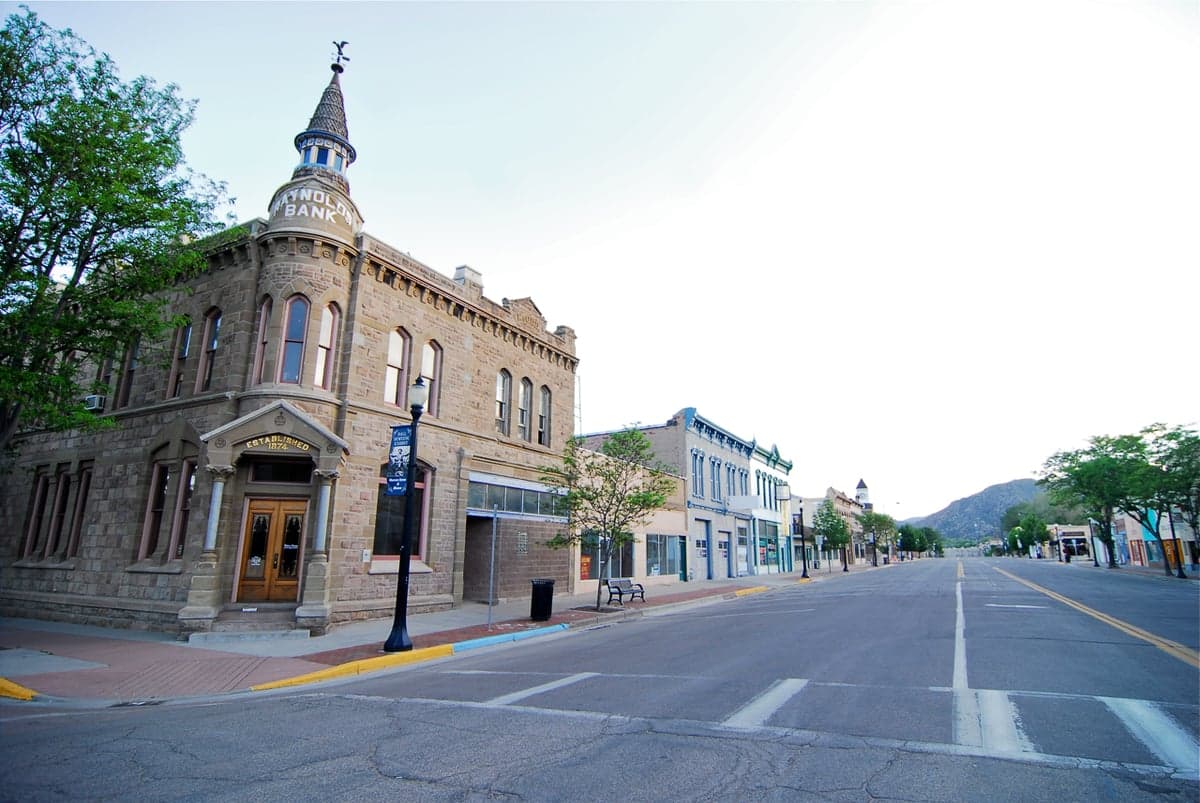
Photo: Wikipedia
Political ClimatePolitical Climate in Canon City, CO
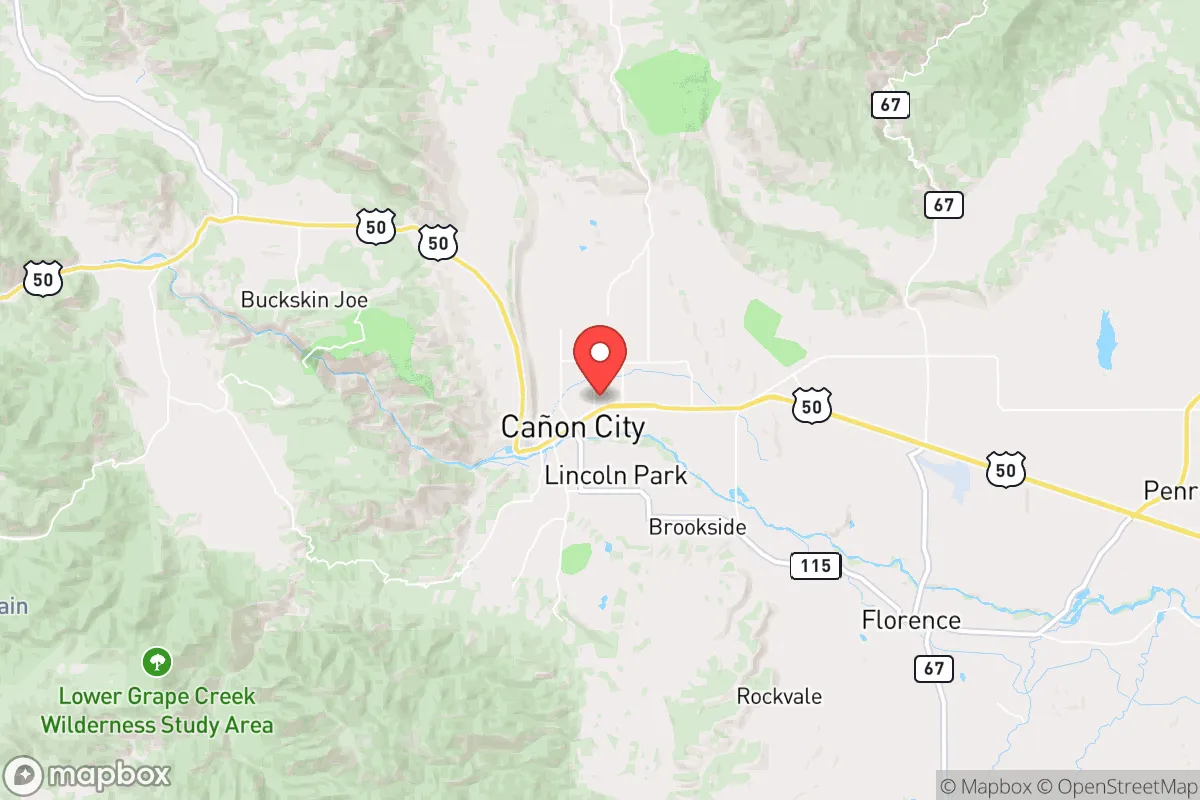
District shown is the primary district for this city’s centroid. Cities may span multiple districts.
Local Political AnalysisPolitical Analysis of Canon City, CO
Canon City, Colorado, has a political climate that’s shifting in ways that should give any freedom-loving resident pause. While the area has historically been a conservative stronghold in Fremont County, the Cook PVI rating of D+8 tells you the state-level winds are blowing hard left, and that pressure is starting to seep into local politics. You’ll still find plenty of folks who value personal liberty, low taxes, and the Second Amendment, but the progressive influence from places like Pueblo and Colorado Springs is creeping in, especially on county boards and school policies. The trajectory here isn’t a sudden flip—it’s a slow, steady erosion of the independent spirit that used to define this town.
How it compares
If you drive 45 minutes north to Colorado Springs, you’re in a reliably conservative area, but even there, the city council has been flirting with progressive zoning and green-energy mandates. Head south to Pueblo, and you’re in a deep-blue stronghold where government overreach is practically a hobby. Canon City sits in the middle, but it’s not immune. Fremont County itself still leans red—Trump won it by about 20 points in 2020—but the city proper is seeing an influx of retirees and remote workers from Denver and Boulder who bring their big-government ideas with them. These newcomers often push for “sustainability” initiatives and diversity programs that sound nice but usually mean more regulations and less personal freedom. The contrast is stark: drive 20 minutes west to Florence, and you’ll find a town that’s still fighting to keep its conservative roots, while Canon City’s leadership seems more willing to compromise.
What this means for residents
For those of us who’ve lived here a while, the biggest concern is how these political shifts affect daily life. Property taxes are creeping up, partly because state mandates force local governments to fund programs that many residents didn’t vote for. You’ll also see more restrictions on land use—things like building permits taking longer, or new rules about what you can do on your own property. The school board has become a battleground, with some members pushing for curriculum changes that downplay American history and emphasize social justice. That’s a red flag for anyone who believes parents should have the final say in their kids’ education. On the plus side, the local sheriff’s office still respects the Second Amendment, and you won’t find any “sanctuary city” nonsense here—yet. But if the progressive trend continues, expect more pressure on gun rights and more tax-funded programs that shrink your wallet and your freedoms.
Culturally, Canon City still holds onto its Western, self-reliant character—rodeos, hunting, and church potlucks are still the norm. But you can feel the tension at city council meetings, where debates over mask mandates, housing density, and “equity” policies are becoming more common. The long-term outlook depends on whether enough locals stay engaged and vote in local elections. If the pattern holds, the next decade could see Canon City drift further from its roots, mirroring the state’s leftward slide. For now, it’s a place where you can still live free, but you’ve got to keep one eye on the ballot box and the other on the horizon.

State Political ClimatePolitical Climate in Colorado
State Political AnalysisPolitical Environment in the State
Colorado has shifted from a classic purple swing state to a solidly blue-leaning one over the past two decades, with Democrats now controlling the governorship, both U.S. Senate seats, and both chambers of the state legislature. The state voted for Hillary Clinton by 5 points in 2016 and Joe Biden by 13 points in 2020, a dramatic leftward lurch that accelerated after 2018. While the Front Range urban corridor drives this trend, the rest of the state—particularly the Eastern Plains and Western Slope—remains deeply conservative, creating one of the sharpest urban-rural political divides in the country.
Urban vs. rural divide
The political map of Colorado is essentially a story of two Colorados. The Denver metro area, including Denver County, Adams County, and Jefferson County, is the Democratic engine, with Denver County routinely voting 80%+ Democratic in presidential elections. Boulder County is even more progressive, while Colorado Springs (El Paso County) remains the state's largest conservative stronghold, though even there, the city proper is slowly trending left as tech and defense workers move in. The rural Eastern Plains—counties like Yuma, Kit Carson, and Prowers—vote Republican by margins of 70-80%, but their populations are tiny and shrinking. The Western Slope, including Mesa County (Grand Junction) and Montrose County, is reliably red, but the resort towns of Pitkin County (Aspen), Eagle County (Vail), and Summit County (Breckenridge) have become liberal enclaves driven by wealthy second-home owners and service workers. The key battlegrounds are the suburban swing counties: Arapahoe, Douglas, and Larimer. Douglas County, once a Republican fortress, flipped to Biden in 2020 by 4 points, a seismic shift that signals the Front Range suburbs are moving left fast.
Policy environment
Colorado's policy environment is a mixed bag for conservatives, but the trend is unmistakably progressive. The state income tax is a flat 4.4%, relatively low, but the state sales tax is 2.9% with local add-ons that can push it over 10% in some cities. Property taxes are among the lowest in the nation thanks to the Gallagher Amendment (repealed in 2020) and TABOR (Taxpayer Bill of Rights), which still limits revenue growth and requires voter approval for tax increases—a rare bright spot for fiscal conservatives. However, the state has aggressively expanded government: the 2021 "Family and Medical Leave Insurance" (FAMLI) program imposes a mandatory payroll tax for paid leave, and the 2020 "Public Option" health insurance law created a state-run plan that critics say will drive up costs. Education policy is a flashpoint: the state has adopted comprehensive sex education standards and allows transgender students to use bathrooms matching their identity, while school choice remains strong thanks to charter schools and open enrollment. Election laws have moved left: Colorado now has universal mail-in voting, same-day registration, and automatic voter registration, which Republicans argue erodes ballot security. The state also has a "red flag" law (2019) allowing temporary firearm seizure, and in 2023, it banned the sale of "assault weapons" to anyone under 21—a move that faces legal challenges.
Trajectory & freedom
Colorado is becoming less free by any objective measure, especially for conservatives who value gun rights, parental authority, and limited government. The 2019 red flag law (HB19-1177) was the first major gun restriction, followed by the 2023 age-based ban and a 2024 law requiring a 10-day waiting period for all firearm purchases. Parental rights took a hit with the 2023 "Protect Our Youth" law, which prohibits schools from notifying parents if a student changes their gender identity or pronouns—a direct assault on family autonomy. On the medical freedom front, Colorado legalized assisted suicide in 2016 and has become a sanctuary state for abortion, with the 2022 Reproductive Health Equity Act codifying abortion access and protecting providers from out-of-state lawsuits. Property rights are under pressure: the 2021 "Right to Rest" act effectively decriminalized homeless camping on public property, leading to tent cities in Denver and Colorado Springs that have sparked backlash. The only bright spot for liberty-minded residents is the continued strength of TABOR, which forces any tax increase to a public vote—though Democrats have found workarounds by referring measures like the 2022 school funding tax increase (Proposition EE) that voters approved.
Civil unrest & political movements
Colorado has seen its share of political flashpoints. The 2020 George Floyd protests in Denver turned violent, with property damage and clashes with police that led to a $14 million settlement for injured protesters. The "Defund the Police" movement gained traction in Denver, where the city council cut $8 million from the police budget in 2020, though most of that was later restored. On the right, the "Colorado Springs Freedom Rally" in 2020 drew thousands protesting COVID restrictions, and the "Weld County secession" movement—a long-running effort to form a 51st state called "North Colorado"—gained renewed energy after the 2020 election, though it remains symbolic. Immigration is a hot-button issue: Denver has declared itself a sanctuary city, and the state's "Colorado Road and Community Safety Act" (2013) allows undocumented immigrants to get driver's licenses. In 2023, the state saw a surge of migrant buses from Texas, overwhelming Denver's shelter system and sparking tensions between the city and the state. Election integrity remains a concern for conservatives: the 2020 election in Colorado was marred by a minor ballot harvesting scandal in Mesa County, where a clerk was indicted for allegedly allowing unauthorized access to voting machines—a case that has become a rallying cry for election skeptics.
Projection
Over the next 5-10 years, Colorado will likely continue its leftward drift, driven by in-migration from blue states like California and New York. The Denver metro area is expected to add another 500,000 residents by 2030, most of them young, college-educated, and progressive. The rural counties will continue to lose population and political influence, making it nearly impossible for Republicans to win statewide office. The state's tax burden will likely increase as Democrats push for a progressive income tax (currently blocked by TABOR) and expand government programs like universal preschool and paid leave. Gun rights will face further restrictions, and parental rights battles will intensify as the state doubles down on transgender policies. The only wild card is a potential backlash: the 2023 homeless camping crisis and the migrant surge have already shifted some suburban voters to the right, as seen in the 2023 Colorado Springs mayoral election where a moderate Republican won. But for now, the trajectory is clear: Colorado is becoming a deep-blue state, and conservatives moving here should expect to be a permanent minority in state politics.
Bottom line for new residents: If you're a conservative considering Colorado, you need to be honest with yourself. The state offers incredible outdoor recreation, a strong economy, and relatively low property taxes, but you will be living under a government that is actively hostile to gun rights, parental authority, and fiscal conservatism. The best bet for like-minded community is Colorado Springs, Douglas County (Castle Rock), or the Western Slope towns like Grand Junction and Montrose. But even those areas are slowly changing. Colorado is not the purple swing state it was 20 years ago—it's a blue state with red pockets, and that gap is only widening.
* Values derived from national, state, county, city and local statistics and may differ in a specific area. Last updated: 2026-09-21T19:02:37.000Z
Narrative content on this page is AI-generated and may contain mistakes. Verify any details that matter before acting on them.
ReloMaps may earn a commission from affiliate links at no extra cost to you.

