Photo: Wikipedia
Demographics of Carteret, NJ
Affluence Level in Carteret, NJ
A middle-class area roughly in line with national averages across income, home values, education, and employment.
People of Carteret, NJ
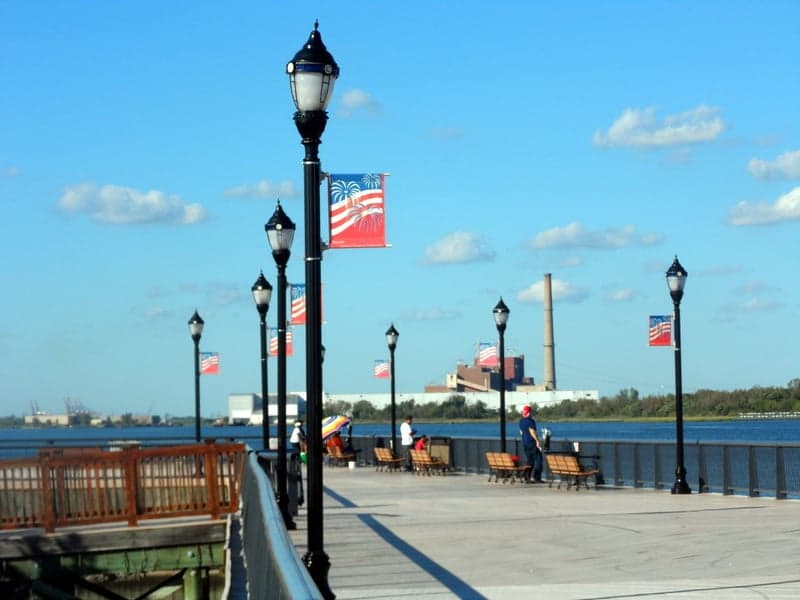
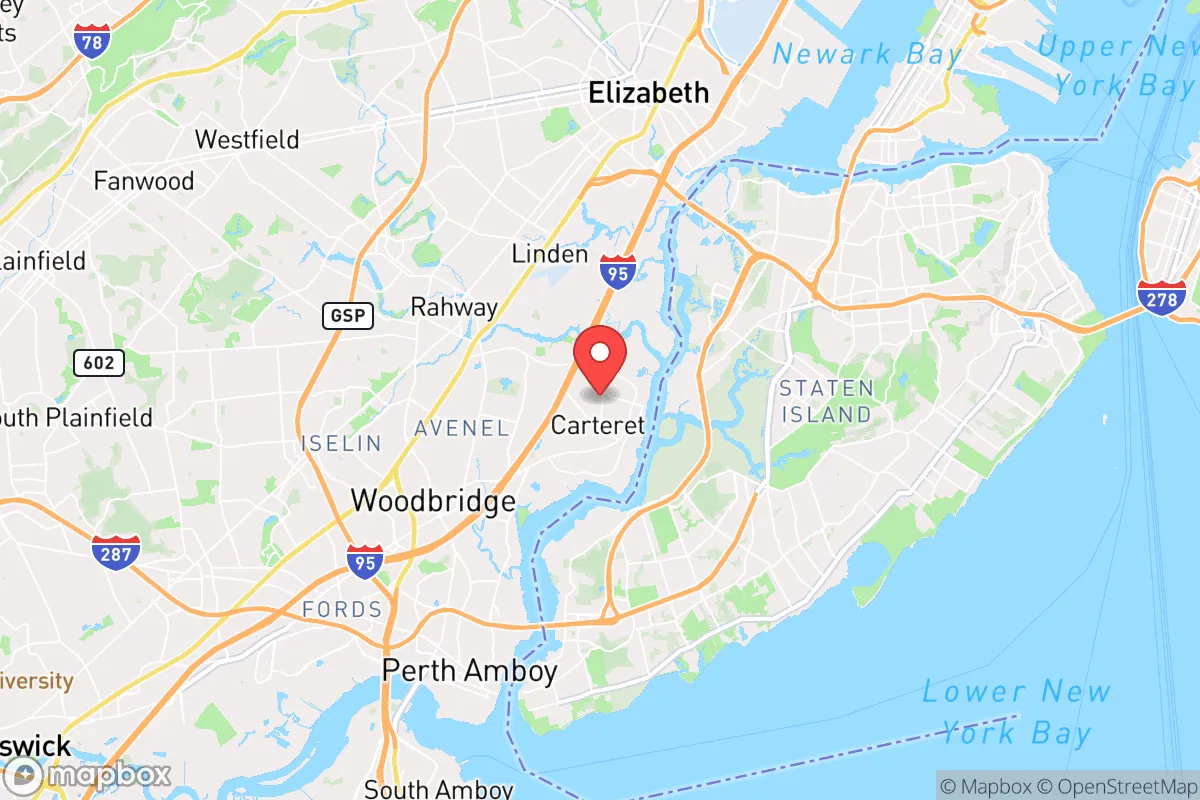
The people of Carteret, New Jersey, today form a dense, working-class community of 25,187 residents characterized by extraordinary ethnic diversity and a strong immigrant presence. The city is a majority-minority population where no single group holds a numerical majority: Hispanic residents make up 34.0%, Indian-subcontinent residents 20.4%, Black residents 16.6%, and non-Hispanic White residents 22.4%. With 12.9% foreign-born and only 27.7% college-educated, Carteret remains a classic blue-collar gateway town where successive waves of newcomers have layered their cultures atop one another, creating a distinctively polyglot, family-oriented city along the Arthur Kill waterfront.
How the city was settled and grew
Carteret’s human history begins with the Lenni-Lenape people, who inhabited the tidal marshlands along the Arthur Kill for centuries before European contact. The area was part of the 1664 Elizabethtown Purchase, and early colonial settlers—primarily English and Dutch farmers—established small homesteads on the fertile lowlands. The city’s modern identity, however, was forged in the late 19th and early 20th centuries when industrialization transformed the waterfront. The arrival of the Central Railroad of New Jersey and the construction of massive oil refineries, chemical plants, and shipping terminals drew a first major wave of immigrants: Polish, Slovak, and Italian laborers who settled in the Chrome neighborhood (named after the chrome-plating plant that once dominated the area) and the Washington Park district. These European ethnic groups built the city’s original Catholic parishes, union halls, and corner taverns, and their descendants remained the majority through the 1950s. A smaller but significant wave of African American families arrived during the Great Migration (1910–1940), finding work in the refineries and settling primarily in the South Carteret area near the waterfront, where a tight-knit Black community developed around the Mount Calvary Baptist Church.
Modern era (post-1965)
The 1965 Immigration and Nationality Act fundamentally reshaped Carteret’s population. The first major post-1965 group was Hispanic immigrants, predominantly from Puerto Rico and the Dominican Republic, who began arriving in the 1970s and 1980s. They concentrated in the Roosevelt Avenue corridor and the West Carteret neighborhood, establishing bodegas, Pentecostal churches, and Spanish-language businesses. By 2000, the Hispanic share had risen to roughly 30%, and it has since stabilized at 34.0%. The most dramatic recent shift has been the surge of Indian-subcontinent immigrants, primarily from Gujarat and Punjab, who began arriving in significant numbers after 2000. They have clustered heavily in the East Carteret neighborhood—the area east of Route 9 near the Woodbridge border—where Indian grocery stores, jewelry shops, and Hindu temples now anchor a thriving ethnic enclave. This group now constitutes 20.4% of the city’s population, making Carteret one of the most Indian-concentrated municipalities in Middlesex County. Meanwhile, the East/Southeast Asian community (4.0%)—primarily Filipino and Vietnamese families—settled more diffusely, with a small concentration near the Chrome district. The non-Hispanic White population, which was over 85% in 1970, has fallen to 22.4%, with most remaining White families living in the older Washington Park and Chrome neighborhoods. The Black population (16.6%) has remained relatively stable, with families spread across South Carteret and newer subdivisions near the Carteret–Woodbridge line.
The future
Carteret’s population is trending toward further diversification, but the pattern is one of distinct ethnic enclaves rather than wholesale blending. The Indian-subcontinent community is the fastest-growing segment, driven by chain migration and the availability of modestly priced housing stock compared to nearby Edison and Iselin. This group is likely to approach 25–30% of the population within the next decade, with East Carteret becoming an even more pronounced Indian-majority district. The Hispanic population appears to be plateauing near 34–36%, with some second- and third-generation families moving outward to suburbs like Perth Amboy or Old Bridge. The non-Hispanic White population continues a slow decline, aging in place in Washington Park and Chrome, with few young White families moving in. The Black population is stable but aging, with limited new in-migration. The city’s ongoing waterfront redevelopment—including new luxury apartments along the Arthur Kill—may attract younger, more college-educated residents, but the high property taxes and industrial character of the city will likely limit gentrification. Carteret is becoming a more tribalized city, where distinct ethnic neighborhoods coexist but do not fully integrate, and where the public schools reflect the diversity: over 50 languages are spoken in the district.
For a conservative-leaning individual or family considering relocation, Carteret offers a genuinely diverse, working-class environment where immigrant ambition is visible daily. The city is not homogenizing; it is becoming a mosaic of distinct ethnic enclaves—Indian in the east, Hispanic in the west, Black and White in the older core—each with its own institutions and identity. The trade-off is clear: low housing costs and strong community networks versus high property taxes and a city that remains industrial and blue-collar. Carteret is a place where the American immigrant story is still being written, neighborhood by neighborhood.

* Values derived from national, state, county, city and local statistics and may differ in a specific area. Last updated: 2026-04-24T20:23:10.000Z
Narrative content on this page is AI-generated and may contain mistakes. Verify any details that matter before acting on them.
ReloMaps may earn a commission from affiliate links at no extra cost to you.

