Photo: Wikipedia
Demographics of Chambersburg, PA
Affluence Level in Chambersburg, PA
A middle-class area roughly in line with national averages across income, home values, education, and employment.
People of Chambersburg, PA
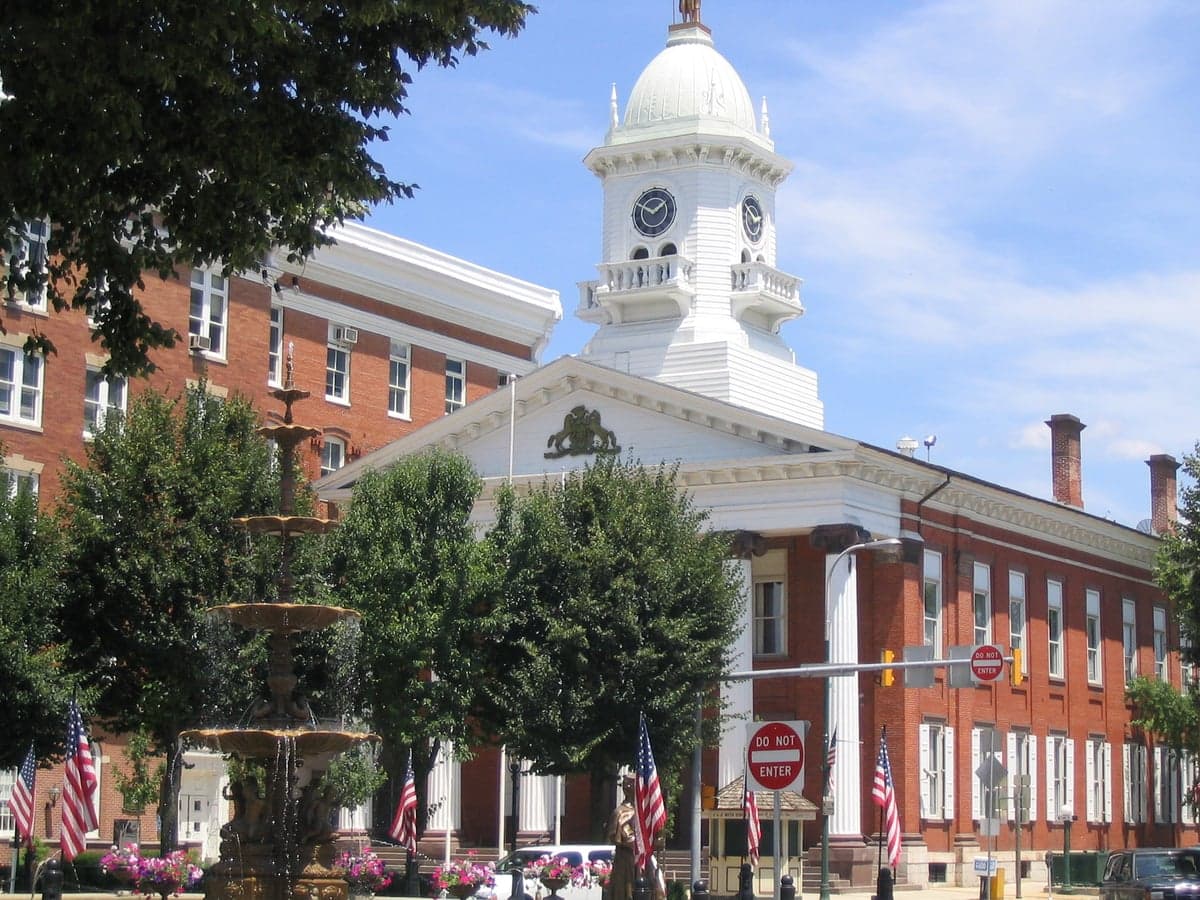
Chambersburg, Pennsylvania, is a city of 22,051 residents that retains a strong historic character as a majority-white community with a growing Hispanic population, now at 19.9%. The city’s identity is shaped by its deep German and Scots-Irish roots, a mid-20th-century industrial base, and a more recent wave of Hispanic immigration that is visibly reshaping neighborhoods. With a foreign-born share of 5.3% and a college-educated rate of 26.7%, Chambersburg is a moderately diverse, working-to-middle-class community where distinct ethnic enclaves are emerging alongside older, established white neighborhoods.
How the city was settled and grew
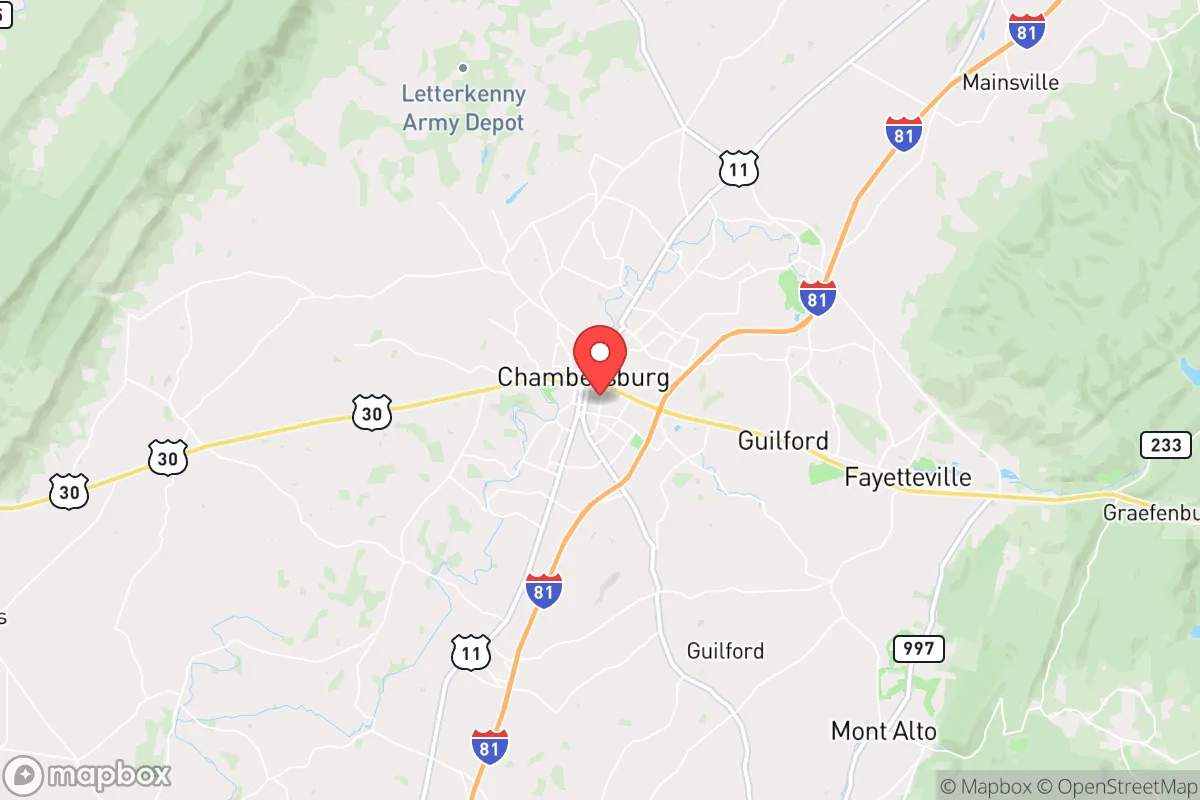
Chambersburg was founded in 1734 by Benjamin Chambers, a Scots-Irish settler who built a mill and fort along the Conococheague Creek. The earliest population was overwhelmingly Scots-Irish and German, drawn by fertile farmland and the promise of religious freedom. The town was laid out in 1764 and quickly became a regional market center. By the early 1800s, German farmers and craftsmen dominated the area, building the sturdy brick homes and churches that still line the Historic District around Main and King Streets. The arrival of the Cumberland Valley Railroad in 1837 spurred growth, attracting English and Irish laborers who settled in the Mill Creek area near the rail yards. The Civil War brought destruction—Confederate forces burned much of the town in 1864—but reconstruction drew new waves of German and Irish immigrants who rebuilt the downtown. Through the early 1900s, Chambersburg remained a predominantly white, Protestant community with a small Black population descended from free and formerly enslaved families who settled in the West End near the railroad corridor. The post-World War II era saw growth from Appalachian migrants seeking factory work at companies like the Chambersburg Shoe Company and the Letterkenny Army Depot, which opened in 1942 and drew workers from across the region into neighborhoods like Norland and Scotland Village.
Modern era (post-1965)
The 1965 Immigration and Nationality Act had a modest direct effect on Chambersburg compared to larger cities, but it opened the door for the city’s most significant demographic shift: Hispanic immigration. Starting in the 1990s, Mexican and Central American workers were recruited by the region’s fruit orchards, mushroom farms, and food-processing plants. These families settled primarily in the Southgate and East End neighborhoods, where older housing stock and lower rents created an entry point. By 2020, the Hispanic share of the city’s population had risen to 19.9%, making it the largest minority group. The Black population, at 9.1%, is concentrated in the West End and parts of central Chambersburg, reflecting historic settlement patterns. East/Southeast Asian residents (0.8%) and Indian-subcontinent residents (0.6%) are small but visible, with families often drawn by professional jobs at the local hospital (WellSpan Chambersburg Hospital) or the Letterkenny Army Depot. White residents, now 66.3% of the population, remain dominant in the Historic District, Norland, and newer subdivisions on the northern and western edges of the city. The college-educated share of 26.7% is below the national average, reflecting the city’s blue-collar industrial heritage, though a growing number of remote workers and retirees are moving into the Historic District for its walkability and lower cost of living.
The future
Chambersburg’s population is trending toward greater ethnic diversity, driven primarily by Hispanic family formation and continued immigration. The Hispanic population is young—median age around 26—and growing through both births and new arrivals, while the white population is older and aging in place. The city is not homogenizing; instead, it is tribalizing into distinct enclaves. The Historic District and Norland remain overwhelmingly white and older, while Southgate and the East End are becoming majority-Hispanic. The West End retains its historic Black identity but is seeing some Hispanic in-migration. East/Southeast Asian and Indian communities are too small to form distinct neighborhoods and are dispersed, often near the hospital or the depot. Over the next 10-20 years, Chambersburg will likely become a majority-minority city, with Hispanics approaching 30-35% of the population, while the white share continues to decline. The Black share is stable, and Asian and Indian communities may grow slowly as professionals are attracted by lower housing costs. The city’s future is one of increasing diversity but also of spatial separation, where newcomers and long-time residents live in different parts of town with limited daily interaction.
For someone moving to Chambersburg now, the city offers a clear choice: the historic, walkable core of the Historic District for those seeking a traditional small-town feel, or the more affordable, family-oriented Southgate and East End neighborhoods where Hispanic culture is vibrant and growing. The city is becoming more diverse and younger, but it remains a place where neighborhoods define experience, and where the old German and Scots-Irish heritage still anchors the civic identity even as the population shifts.

* Values derived from national, state, county, city and local statistics and may differ in a specific area. Last updated: 2026-05-01T12:52:37.000Z
Narrative content on this page is AI-generated and may contain mistakes. Verify any details that matter before acting on them.
ReloMaps may earn a commission from affiliate links at no extra cost to you.

