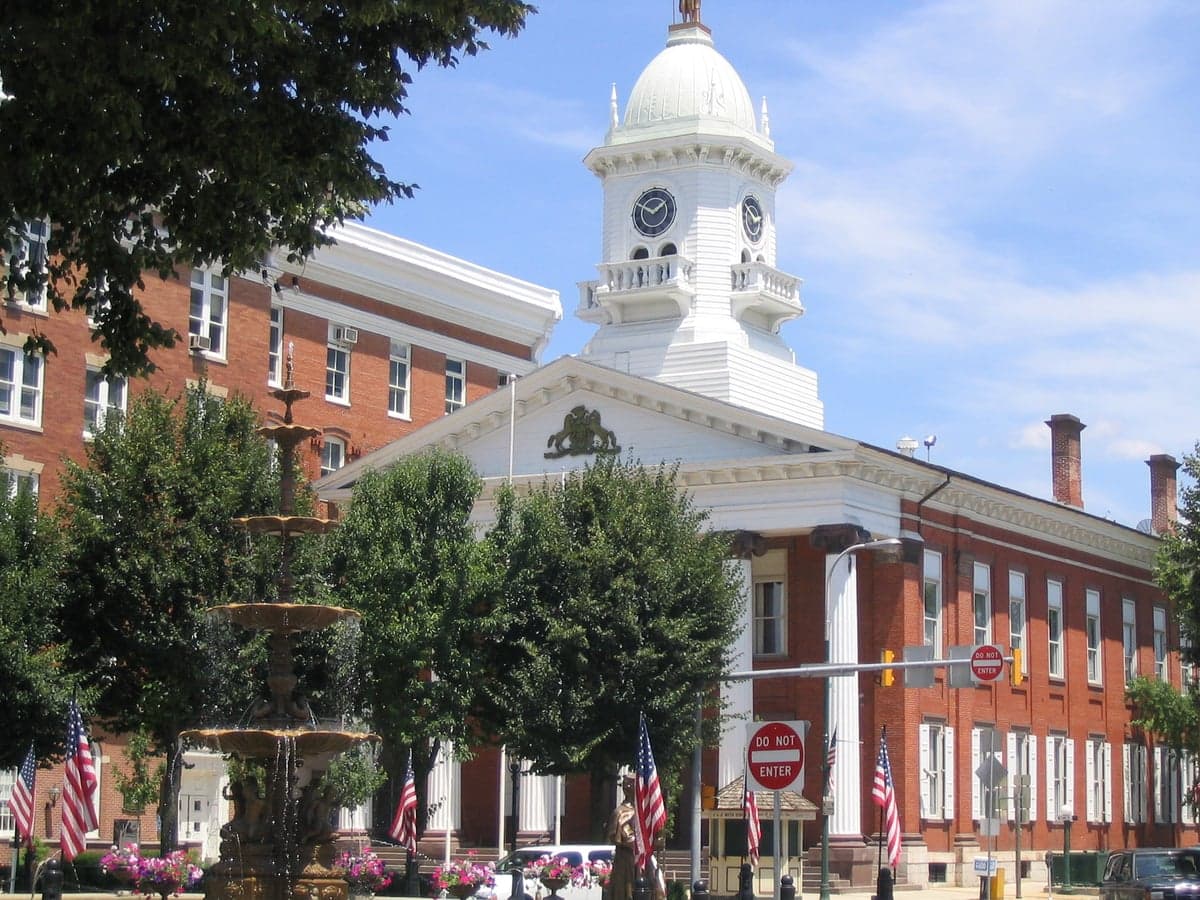
Photo: Wikipedia
Personal Sovereignty in Chambersburg, PA
Strong independent fundamentals that actively favor personal liberty and low regulation.
What does Personal Sovereignty tell us?
Personal Sovereignty measures your capacity for self-reliance and independence with minimal government friction. Higher scores mean fewer barriers between you and the way you want to live... but it assumes you have the space you need and good neighbors.
What does this tell us?
Personal Sovereignty measures your capacity for self-reliance and independence with minimal government friction. Higher scores mean fewer barriers between you and the way you want to live... but it assumes you have the space you need and good neighbors.
State Policy
Energy independence: Net exporter (150% of energy produced in-state)
Personal Liberty
Homesteading

Personal Liberty Analysis
For the liberty-minded individual or family evaluating Chambersburg, Pennsylvania as a relocation target, the personal sovereignty picture is a mixed but promising one. Nestled in the Cumberland Valley, this Franklin County seat offers a notably lower regulatory footprint than the coastal or deep-blue metros many are fleeing, yet it remains subject to the broader constraints of a state that has trended toward centralized control in recent years. The key question for a survivalist or prepper is whether Chambersburg provides enough breathing room to live by your own rules—on taxes, self-defense, land use, and family autonomy—without constant government friction. The short answer is yes, with important caveats that demand careful due diligence on zoning, local ordinances, and the trajectory of Harrisburg politics.
Tax burden and regulatory posture: How Chambersburg compares to the Northeast corridor
Pennsylvania’s tax structure is a double-edged sword for those seeking maximum financial sovereignty. The state levies a flat 3.07% personal income tax—one of the lowest flat rates in the nation—and does not tax retirement income, including Social Security, pensions, or 401(k) withdrawals. This is a significant advantage for preppers looking to minimize dependency on government checks. However, the local tax picture in Chambersburg adds layers: Franklin County imposes a 0.5% county earned income tax, and the Chambersburg Area School District adds roughly 1.5% earned income tax plus a millage rate around 22 mills on property. For a $250,000 home, that’s about $5,500 annually in school property taxes alone—steep by national standards, though typical for Pennsylvania. On the regulatory side, Chambersburg operates under a home rule charter that gives it some flexibility, but the state’s Uniform Construction Code (UCC) means building codes are enforced uniformly, limiting the ability to build off-grid structures without permits. The borough’s zoning code is moderately restrictive: residential lots in the R-1 district require a minimum of 7,500 square feet, and accessory dwelling units are allowed only by special exception. For those wanting to operate a home-based business or keep livestock, the borough’s zoning is more permissive than Philadelphia or Pittsburgh but less so than unincorporated areas of the county. The regulatory posture here is best described as “pragmatic but not libertarian”—you won’t face the hostility of a coastal city, but you also won’t get the free rein of a rural Montana county.
Self-defense and gun law specifics: What the Second Sanctuary movement means here
Chambersburg sits in a region where the Second Amendment is taken seriously, but Pennsylvania’s state-level framework imposes some friction. The good news: Pennsylvania is a shall-issue state for concealed carry, meaning the Franklin County Sheriff’s Office must issue a License to Carry Firearms (LTCF) to any qualified applicant—no discretion, no “good cause” requirement. The process is straightforward: apply online, pay $20, and receive the permit in about two weeks. Open carry is legal without a permit, except in Philadelphia, and Chambersburg has no local ordinances restricting it. The state also preempts local gun laws, so you won’t find the patchwork of bans that plague places like Colorado or New York. However, there are notable limits: Pennsylvania requires a background check for all private firearm sales (long guns included) through the PICS system, and the state has a three-day waiting period for handgun purchases. Magazine capacity is not restricted, and there is no assault weapons ban at the state level. Franklin County itself declared itself a Second Amendment Sanctuary County in 2020, a symbolic but meaningful stance that signals local law enforcement’s reluctance to enforce future state-level gun restrictions. For the prepper, this means you can stockpile, train, and carry with minimal government interference—but you must stay on top of state-level legislative threats, as Harrisburg has seen periodic pushes for universal background checks and red flag laws. The local sheriff’s office is known for being pro-2A, and the community’s culture strongly supports self-defense as a personal responsibility.
Self-reliance and homesteading viability: Lot sizes, zoning, and off-grid feasibility
For those serious about self-reliance, Chambersburg proper is a compromise. The borough’s zoning limits agricultural activities: keeping chickens is allowed on lots of at least 7,500 square feet, but only up to six hens (no roosters), and beekeeping requires a permit. Larger livestock like goats or pigs are prohibited within borough limits. The minimum lot size for a single-family home is 5,000 square feet in most residential zones, which is tight for serious homesteading. The real opportunity lies in the surrounding Franklin County townships—Greene, Guilford, and Hamilton townships, all within a 10-minute drive of downtown Chambersburg. There, lot sizes of 1 to 5 acres are common and affordable, with many properties under $10,000 per acre. Zoning in these townships is far more permissive: chickens, goats, and even small-scale livestock are generally allowed without special permits, and accessory buildings for workshops or storage are easier to approve. Off-grid feasibility is mixed: Pennsylvania’s Uniform Construction Code requires grid-tied electrical connections for new dwellings, but solar panels with battery backup are legal and increasingly common. Rainwater collection is unrestricted for outdoor use, but potable rainwater systems must meet DEP standards. Composting toilets are allowed under the state’s on-lot sewage system regulations, but you’ll need a permit and periodic inspection. The biggest hurdle for off-grid living is the lack of explicit “right to farm” protections for small-scale homesteaders—if a neighbor complains about noise or odor, the township can enforce nuisance ordinances. For the prepper who wants to be left alone, the best strategy is to buy in a rural township with at least 5 acres, maintain good relations with neighbors, and keep a low profile on any unconventional systems.
Personal liberties: Parental rights, medical autonomy, speech, and property
On the broader spectrum of personal liberties, Chambersburg offers a relatively friendly environment for conservative values. Parental rights are strong in Pennsylvania: the state’s compulsory attendance law allows for homeschooling with a simple notarized affidavit, and there are no curriculum mandates, standardized testing requirements, or home visits. The Chambersburg Area School District has a reputation for being accommodating to homeschoolers, and there are active co-ops and support groups in the area. Medical autonomy is more constrained: Pennsylvania has not passed any broad medical freedom legislation, and vaccine mandates for school attendance remain in place for standard childhood immunizations (though religious exemptions are available). The state’s emergency powers law was reformed in 2022 to limit the governor’s ability to issue indefinite emergency orders, but the legislature remains divided on further medical liberty bills. Free speech is robust—Chambersburg has no local hate speech ordinances or content-based restrictions, and public protests are common at the Franklin County Courthouse. Property rights are protected by Pennsylvania’s eminent domain laws, which require just compensation and a public purpose, but the state does not have a strong private property rights act like Texas or Florida. The biggest property concern for preppers is the lack of a state-level preemption on short-term rentals—Chambersburg has its own regulations that limit Airbnb-style operations in residential zones. Overall, the liberty environment here is best described as “live and let live” with a conservative tilt, but you must be proactive about knowing your rights and engaging with local government when necessary.
In the final analysis, Chambersburg offers a solid foundation for personal sovereignty relative to the Northeast corridor, but it is not a libertarian paradise. The tax burden is moderate, the gun laws are favorable with local sanctuary support, and the surrounding rural townships provide genuine homesteading opportunities. The main threats to sovereignty here are the same as anywhere in Pennsylvania: the potential for state-level overreach on gun control, vaccine mandates, and property regulations. For the strategic relocator, Chambersburg represents a strong “B+” on the sovereignty scale—better than 80% of the Northeast, but not as free as the Mountain West or the Deep South. The smart move is to buy in a rural township, get involved with the local Republican committee, and build relationships with like-minded neighbors. The community’s culture of self-reliance and its proximity to hunting land, outdoor ranges, and Mennonite farm supply stores make it a viable base for a prepared lifestyle. Just keep one eye on Harrisburg and the other on your property line.

* Values derived from national, state, county, city and local statistics and may differ in a specific area. Last updated: 2026-05-01T12:52:37.000Z
Narrative content on this page is AI-generated and may contain mistakes. Verify any details that matter before acting on them.
ReloMaps may earn a commission from affiliate links at no extra cost to you.

