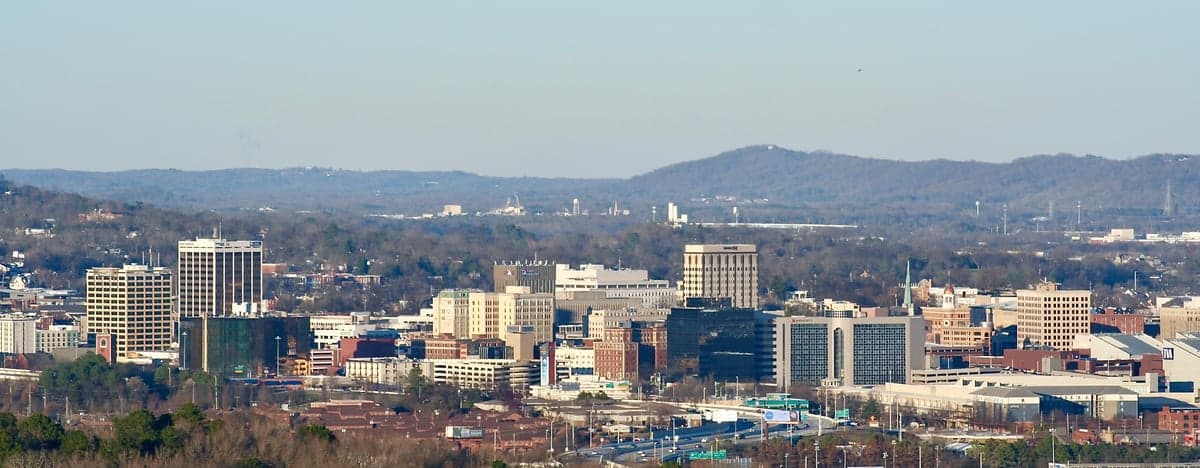
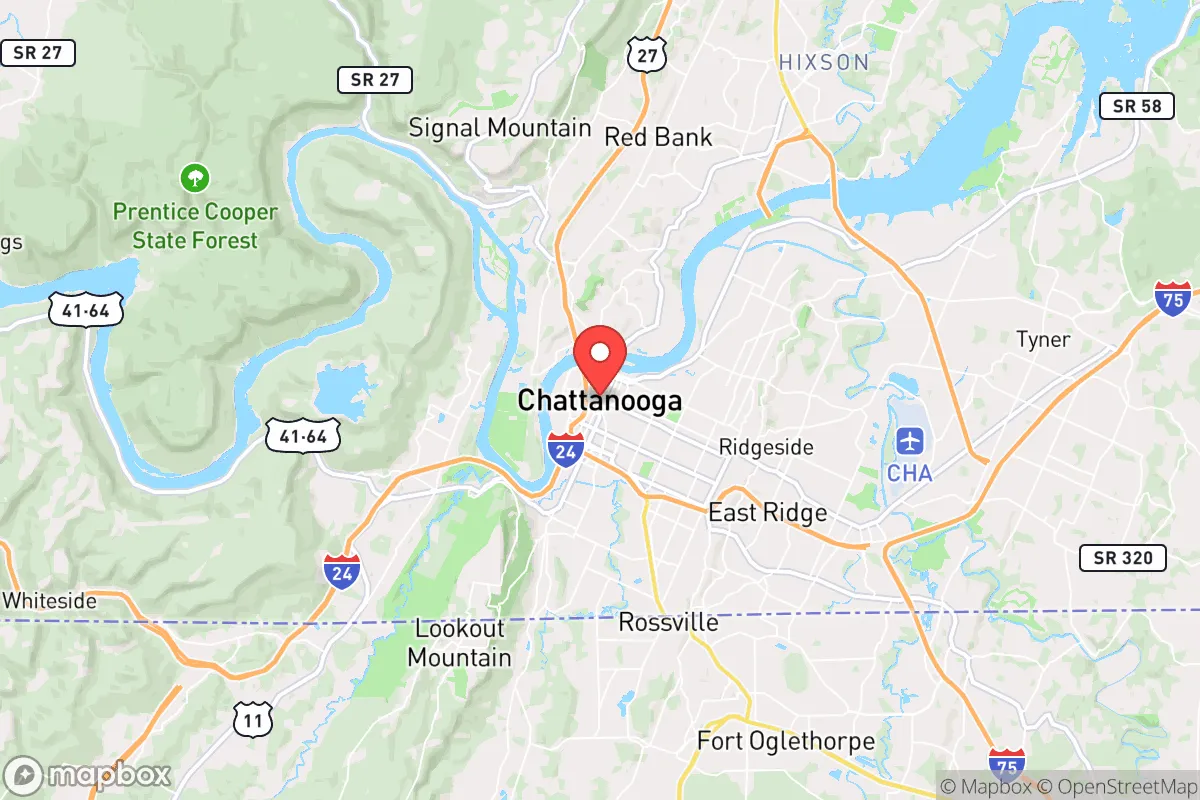
Photo: Wikipedia
Demographics of Chattanooga, TN
Affluence Level in Chattanooga, TN
A middle-class area roughly in line with national averages across income, home values, education, and employment.
People of Chattanooga, TN
Chattanooga’s 182,832 residents today form a city that is 55.8% White, 28.4% Black, 9.3% Hispanic, 1.2% East/Southeast Asian, and 1.2% Indian (subcontinent), with a foreign-born share of 5.1% and a college-educated rate of 35.5%. The population is notably more diverse than the surrounding region, yet remains anchored by a historic Black community and a growing Hispanic presence, concentrated in distinct neighborhoods that trace back to the city’s industrial boom. This is a mid-sized Southern city with a strong manufacturing and logistics heritage, now attracting young professionals and remote workers drawn to the riverfront and outdoor amenities, while longtime residents maintain deep roots in established enclaves. The character is pragmatic and community-oriented, with a visible tension between revitalized downtown districts and older, more segregated residential areas.
How the city was settled and grew
Chattanooga was founded in 1839 as a railroad hub, with the Western & Atlantic Railroad terminus drawing a mix of White Appalachian settlers, Irish laborers, and free Black workers. The city’s explosive growth came after the Civil War, when the iron and steel industries—fueled by nearby coal and iron ore—attracted waves of European immigrants, particularly Germans and Italians, who settled in North Chattanooga and the Southside. By 1900, the Black population had grown significantly, concentrated in the Bushnell and St. Elmo neighborhoods, working in foundries and on the railroads. The early 20th century saw a second wave of Black migration from rural Tennessee and Alabama during the Great Migration, doubling the Black share to roughly 35% by 1950. White working-class families moved into East Brainerd and Hixson as streetcar suburbs expanded. The city’s population peaked at 130,000 in 1960, with a manufacturing base that included Combustion Engineering, DuPont, and the Chattanooga Choo Choo terminal.
Modern era (post-1965)
After the 1965 Hart-Cellar Act, Chattanooga saw modest immigration: a small Vietnamese community arrived in the 1970s, settling in East Ridge and the Highland Park area, while Indian professionals began arriving in the 1990s, clustering in Signal Mountain and Lookout Mountain suburbs. The larger demographic shift was domestic: White flight accelerated in the 1970s and 1980s, with middle-class families moving to Ooltewah and Collegedale, leaving the city core—especially Alton Park and Clifton Hills—predominantly Black and lower-income. Hispanic growth began in the 1990s, driven by construction and landscaping jobs, with Mexican and Central American families settling in Rossville Boulevard corridor and East Lake. By 2020, the Hispanic share had reached 9.3%, making it the fastest-growing demographic. The Black population declined from 35% in 1970 to 28.4% today, as some families moved to suburbs or out of state. The Asian and Indian populations remain small but professional, concentrated in the North Shore and downtown condos. The foreign-born share of 5.1% is below the national average of 13.7%, reflecting Chattanooga’s limited immigration history.
The future
The population is heading toward greater diversity, but through distinct enclaves rather than full integration. Hispanic growth is projected to continue, potentially reaching 12-14% by 2040, driven by family reunification and service-sector jobs, with East Lake and Rossville likely becoming majority-Hispanic. The White population is stabilizing after decades of decline, buoyed by young professionals moving into Downtown and Southside condos, but the city’s overall growth rate is slow (0.3% annually). The Black population is aging and slightly declining, with younger Black residents moving to Ooltewah or Atlanta. East/Southeast Asian and Indian communities are likely to remain small but grow slowly, as Chattanooga lacks the tech or academic magnets that draw larger Asian populations. The city is not homogenizing—neighborhoods are becoming more ethnically distinct, with North Chattanooga remaining predominantly White and affluent, Alton Park heavily Black, and East Lake increasingly Hispanic. For a newcomer, this means choosing a neighborhood that aligns with their demographic and lifestyle preferences, as the city offers distinct cultural pockets rather than a blended whole.
Chattanooga is becoming a more diverse but still segmented Southern city, where the historic Black community remains the largest minority group, Hispanic growth is reshaping the south side, and White professionals are reclaiming the downtown core. For a conservative-leaning mover, the city offers a stable, family-oriented environment with low crime in the northern suburbs, but the central neighborhoods reflect the economic and racial divides common in post-industrial cities. The next decade will likely see continued Hispanic expansion and downtown gentrification, while the Black and White populations hold steady—a slow evolution rather than a dramatic transformation.

* Values derived from national, state, county, city and local statistics and may differ in a specific area. Last updated: 2026-04-15T23:51:52.000Z
Narrative content on this page is AI-generated and may contain mistakes. Verify any details that matter before acting on them.
ReloMaps may earn a commission from affiliate links at no extra cost to you.

