
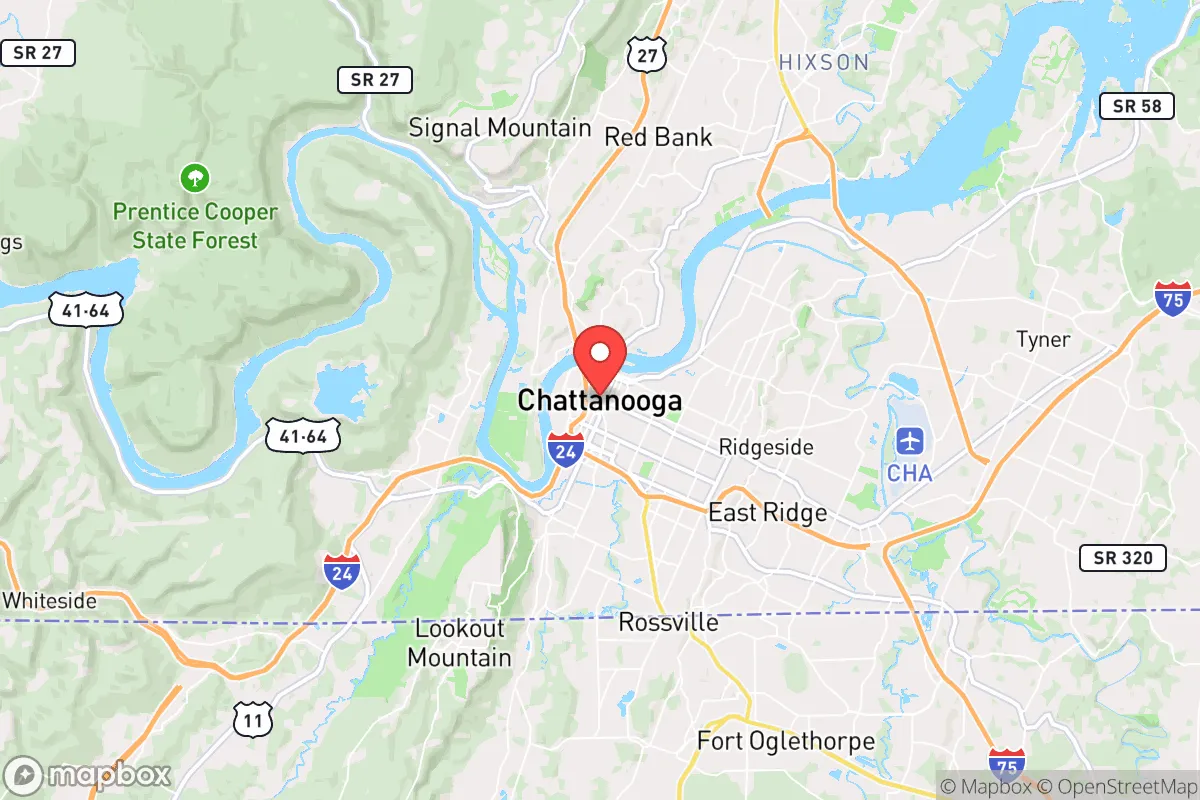
Photo: Wikipedia
Personal Sovereignty in Chattanooga, TN
Viable for self-reliance. Generally workable, though some barriers may limit total independence.
What does Personal Sovereignty tell us?
Personal Sovereignty measures your capacity for self-reliance and independence with minimal government friction. Higher scores mean fewer barriers between you and the way you want to live... but it assumes you have the space you need and good neighbors.
What does this tell us?
Personal Sovereignty measures your capacity for self-reliance and independence with minimal government friction. Higher scores mean fewer barriers between you and the way you want to live... but it assumes you have the space you need and good neighbors.
State Policy
Energy independence: Importer (25% of energy produced in-state)
Personal Liberty
Homesteading

Personal Liberty Analysis
Chattanooga offers a notably high degree of personal sovereignty compared to many urban centers in the United States, largely because Tennessee’s state-level legal framework actively limits local government overreach. For individuals and families operating from a survivalist or prepper mindset, the city sits within a state that has consistently pushed back against federal mandates, from COVID-era restrictions to environmental regulations. While Chattanooga itself is a growing mid-sized city with some progressive leanings in its core, the surrounding Hamilton County and the state as a whole provide a legal and cultural buffer that preserves a wide latitude for self-directed living. This analysis examines the specific pillars of autonomy—tax burden, self-defense law, homesteading feasibility, and personal liberties—that make Chattanooga a strategic relocation option for those prioritizing freedom from government intrusion.
Tax burden and regulatory posture in Tennessee
Tennessee’s tax structure is one of the most favorable in the nation for those seeking to minimize state-level financial control over their lives. The state has no personal income tax on wages, and as of 2021, it fully eliminated the Hall tax on investment income, meaning residents keep 100% of their earnings and capital gains. Property taxes in Hamilton County are moderate, with an effective rate around 0.7% of assessed value, significantly lower than the national average. Sales tax is relatively high at 9.25% in Chattanooga, but this is a consumption-based tax that allows residents to control their liability through spending habits. From a regulatory standpoint, Tennessee is a right-to-work state with minimal business licensing hurdles, and it has no state-level gun or magazine registration requirements. The state legislature has also preempted local governments from enacting stricter ordinances on firearms, short-term rentals, and landlord-tenant laws, meaning Chattanooga cannot unilaterally impose the kind of overreach seen in cities like Nashville or Memphis. For a prepper concerned with government confiscation or punitive taxation, Tennessee’s posture is a clear strategic advantage.
Self-defense and gun law specifics in Chattanooga
Tennessee is a constitutional carry state, meaning no permit is required to carry a concealed or openly carried firearm for any law-abiding adult 21 or older. This went into full effect in 2021, and Chattanooga has not attempted to create local restrictions, thanks to state preemption laws. The state also has a "stand your ground" statute with no duty to retreat in any place where a person is lawfully present, and Castle Doctrine protections extend to vehicles and occupied structures. For those building a defensive capability, Tennessee allows private firearm sales without background checks, and there are no restrictions on magazine capacity, bump stocks, or specific weapon features like pistol grips or flash suppressors. The only notable limitation is a 10-day waiting period for handgun purchases from licensed dealers, though long guns are immediate. Chattanooga’s violent crime rate is higher than the national average—particularly in certain downtown and southern corridors—which makes the ability to defend oneself without bureaucratic delay a practical necessity. The local sheriff’s office and police department have generally been supportive of Second Amendment rights, and there are multiple gun ranges and training facilities within a 30-minute drive, including the Chattanooga Rifle Club and private outdoor ranges in nearby Soddy-Daisy.
Self-reliance and homesteading viability in the Chattanooga area
For those seeking to reduce dependence on fragile supply chains and government systems, Chattanooga’s surrounding rural and exurban areas offer strong homesteading potential. Within Hamilton County, unincorporated areas and towns like Ooltewah, Harrison, and Sale Creek have minimum lot sizes of 1 to 5 acres in many zoning districts, allowing for substantial gardens, small livestock, and rainwater collection. The city itself has more restrictive zoning, but the county’s agricultural zoning permits chickens, goats, and even cattle on parcels as small as 2 acres. Tennessee has no state-level ban on rainwater harvesting, and the Tennessee Department of Environment and Conservation encourages it for non-potable uses. Off-grid feasibility is moderate: while the Tennessee Valley Authority (TVA) provides reliable grid power, solar installation is legal and net metering is available, though the state lacks strong solar access laws. Septic systems are permitted in most rural zones, and well drilling is straightforward with a permit from the Hamilton County Health Department. The growing season is long (April to October), and the region’s clay-loam soil is workable for most vegetables and fruit trees. For a prepper looking to establish a retreat with food security and water independence, the areas just outside Chattanooga’s urban growth boundary are among the most accessible in the Southeast.
Personal liberties: parental rights, medical autonomy, speech, and property
Tennessee has been aggressive in asserting parental rights, passing the "Parental Bill of Rights" in 2022, which requires schools to obtain parental consent before administering any medical or mental health services and mandates transparency in curriculum materials. Chattanooga’s Hamilton County Schools have largely complied, though some parents report friction over library content and gender-related policies. Medical autonomy is strong: Tennessee has no state vaccine mandate for adults, and while COVID-era mandates were enforced by some private employers, the state government did not impose a universal requirement. The state also has a broad religious exemption for vaccinations. On property rights, Tennessee is a "fee simple" state with no state-level rent control, and eminent domain is limited to public use projects with fair compensation. Free speech protections are robust, with no state-level hate speech laws that could be used to suppress political or religious expression. The city of Chattanooga has occasionally attempted to regulate public gatherings, but state preemption on firearms and local ordinances has kept most speech-related conflicts at the level of permit requirements for large events. For those concerned about government overreach into family decisions, medical choices, or property use, Tennessee’s legal environment provides a strong baseline that Chattanooga cannot easily erode.
Overall, Chattanooga represents a strategic middle ground for those prioritizing personal sovereignty. It offers the economic and social amenities of a mid-sized city—healthcare infrastructure, job diversity, and cultural resources—while sitting within a state that has consistently defended individual rights against federal and local encroachment. Compared to cities in the Northeast, West Coast, or even parts of the Midwest, Chattanooga’s combination of no income tax, constitutional carry, homesteading-friendly zoning, and strong parental rights places it in the top tier of U.S. cities for autonomy-minded relocators. The primary trade-offs are the higher-than-average violent crime rate in certain neighborhoods and the presence of TVA as a quasi-federal utility, but for a prepper or survivalist who values legal freedom over absolute isolation, Chattanooga is a compelling option that does not require sacrificing all urban convenience.

* Values derived from national, state, county, city and local statistics and may differ in a specific area. Last updated: 2026-04-15T23:51:52.000Z
Narrative content on this page is AI-generated and may contain mistakes. Verify any details that matter before acting on them.
ReloMaps may earn a commission from affiliate links at no extra cost to you.

