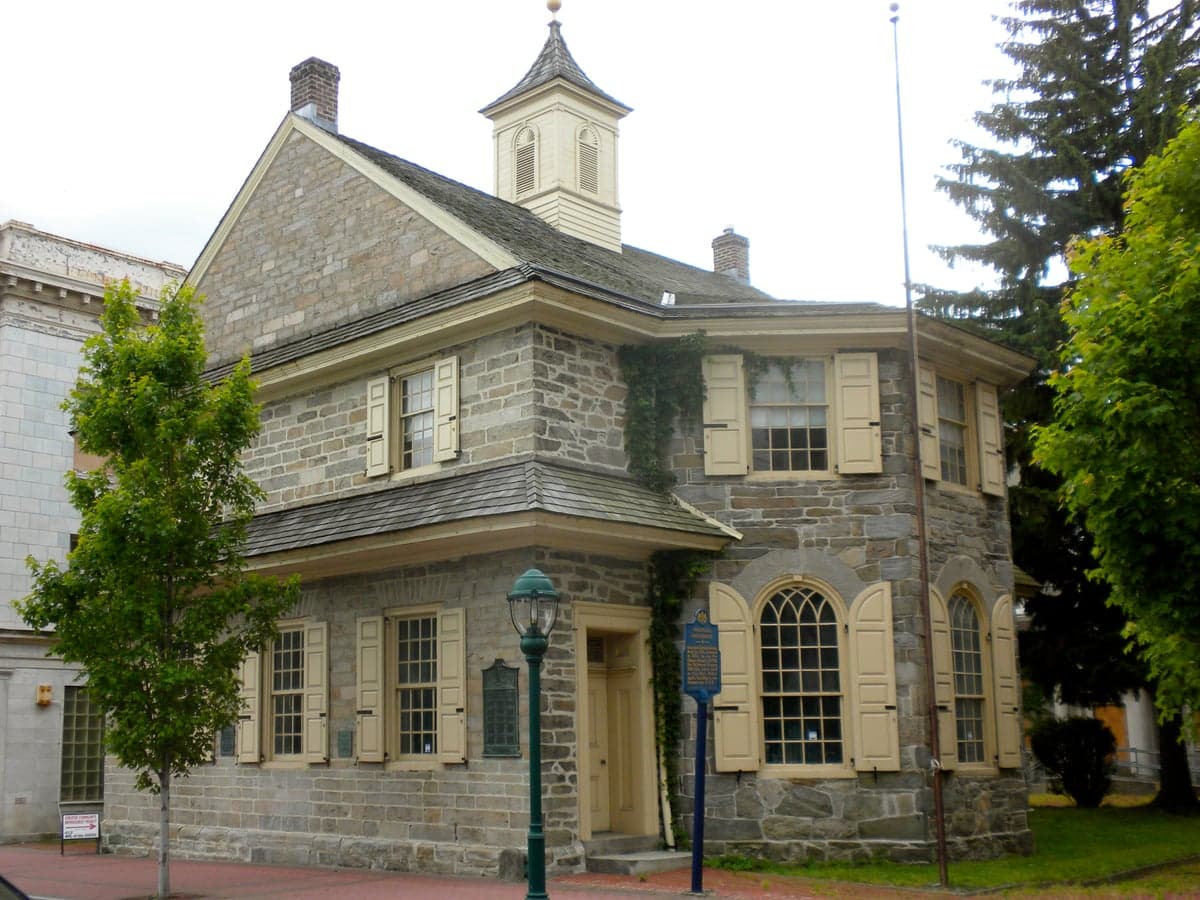
Photo: Wikipedia
Personal Sovereignty in Chester, PA
Strong independent fundamentals that actively favor personal liberty and low regulation.
What does Personal Sovereignty tell us?
Personal Sovereignty measures your capacity for self-reliance and independence with minimal government friction. Higher scores mean fewer barriers between you and the way you want to live... but it assumes you have the space you need and good neighbors.
What does this tell us?
Personal Sovereignty measures your capacity for self-reliance and independence with minimal government friction. Higher scores mean fewer barriers between you and the way you want to live... but it assumes you have the space you need and good neighbors.
State Policy
Energy independence: Net exporter (150% of energy produced in-state)
Personal Liberty
Homesteading

Personal Liberty Analysis
Chester, Pennsylvania, presents a challenging environment for personal sovereignty, where the promise of low property costs is heavily offset by a dense regulatory climate and a state-level political structure that consistently prioritizes collective mandates over individual autonomy. For the survivalist or prepper seeking a base of operations, this city demands a clear-eyed assessment: you are trading affordability for a significant degree of government oversight, particularly in the realms of taxation, self-defense, and medical freedom. While the city itself is economically depressed, offering cheap land and a certain degree of anonymity, the legal framework of Pennsylvania and Delaware County creates a web of restrictions that will test anyone committed to a truly self-reliant lifestyle.
Tax burden and regulatory posture for the self-reliant individual
Pennsylvania’s tax structure is a mixed bag, but the net effect for a Chester resident is a moderate-to-high burden that eats into prepping budgets. The state levies a flat 3.07% personal income tax, which is reasonable compared to neighboring states like New Jersey, but there is no local wage tax relief in Chester—the city imposes its own 3.2% earned income tax on residents, bringing the combined rate to over 6%. Property taxes are a more serious concern: Delaware County’s average effective rate hovers around 1.5% of assessed value, and Chester’s older housing stock often carries inflated assessments relative to market value. For a prepper, this means a $100,000 property could cost $1,500 annually in school and county taxes alone, with no homestead exemption to soften the blow. The regulatory posture is distinctly unfriendly to autonomy. Pennsylvania is a home rule state, meaning Chester has broad zoning and code enforcement powers. The city’s building codes are strict, and any attempt to modify a property for off-grid living—such as installing a composting toilet, rainwater catchment system, or solar array—will likely require permits and inspections that invite government scrutiny. The state’s Uniform Construction Code is aggressively enforced in urban areas, making unpermitted work a risky proposition. For the survivalist, this is a significant drag: you cannot quietly harden a property without bureaucratic entanglement.
Self-defense and gun law specifics in Delaware County
Pennsylvania is generally considered a “shall-issue” state for concealed carry, but the practical reality in Chester is more restrictive. The state requires a License to Carry Firearms (LTCF) for concealed carry, and while the sheriff’s office in Delaware County is legally obligated to issue it to qualified applicants, the process involves a background check and a wait of up to 45 days. Open carry is legal without a permit, but only outside of Philadelphia—and Chester is close enough that travel into the city (where open carry is banned) is a legal minefield. For the prepper, the key concern is the lack of constitutional carry; you cannot legally carry a concealed firearm without a license, even in your vehicle. Magazine capacity is not restricted, and there is no state-level assault weapons ban, but Chester’s high crime rate means that any defensive use of a firearm will be subject to intense scrutiny by the Delaware County District Attorney’s office, which has a reputation for aggressive prosecution. Stand-your-ground laws exist in Pennsylvania, but the burden of proof for self-defense in a high-crime urban area is heavier than in rural counties. For the survivalist, this means you can own the tools of self-reliance, but using them carries significant legal risk. The Castle Doctrine does apply to your home and vehicle, offering some protection, but it is not absolute—especially if you are involved in any altercation outside your immediate dwelling.
Self-reliance and homesteading viability in an urban setting
Chester’s urban density and zoning laws make traditional homesteading nearly impossible. The city’s R-1 and R-2 residential zones typically require minimum lot sizes of 3,000 to 5,000 square feet, but most properties are row homes or small detached houses on lots under 2,500 square feet. Raising livestock is effectively banned—no chickens, goats, or bees are permitted within city limits without a special exception that is rarely granted. Gardening is allowed, but the city’s soil contamination history (industrial legacy from shipbuilding and manufacturing) means that growing food in the ground is risky without raised beds and imported soil. Off-grid feasibility is extremely low. The city requires connection to municipal water and sewer; disconnecting from these systems is illegal. Solar panels are permitted but must comply with building codes and utility interconnection agreements, and net metering is available but subject to state regulations that limit system size. Rainwater collection is not explicitly banned, but the state’s Department of Environmental Protection regulates it as a water source, and any system over 1,000 gallons requires a permit. For the prepper seeking true self-reliance, Chester is a poor fit. The best strategy is to use the city as a low-cost base for income generation while maintaining a separate rural property for actual homesteading. The Chester Water Authority has a history of rate hikes and service disruptions, which actually makes a backup water storage plan essential—but storing more than a few hundred gallons in a city home will likely violate fire codes.
Personal liberties: parental rights, medical autonomy, and speech
Pennsylvania’s state-level policies are a major concern for those prioritizing parental rights and medical autonomy. The state has mandatory vaccination laws for school attendance, with only medical exemptions recognized—no religious or philosophical exemptions are allowed. This is a hard line for parents who want to make their own healthcare decisions. Medical autonomy is further constrained by the state’s prescription drug monitoring program, which tracks all controlled substances, and by the lack of any state-level protection for alternative or holistic medicine. For the prepper, stockpiling antibiotics or other medications without a prescription is illegal, and the state’s pharmacy board actively enforces this. Free speech is protected under the First Amendment, but Pennsylvania has a hate crimes statute that can enhance penalties for speech deemed to incite violence, and local ordinances in Chester restrict public gatherings and noise—potentially limiting the ability to hold community meetings or training sessions without a permit. Property rights are the brightest spot: Pennsylvania has strong eminent domain protections compared to some states, and the Agricultural Area Security Law offers some protection for farmland, but this is irrelevant in Chester’s urban grid. The city’s blight remediation laws give the government broad power to seize abandoned properties, which could be a risk if you own a vacant lot you plan to use for prepping. Overall, personal liberties in Chester are constrained by a state government that views individual autonomy as secondary to public health and safety mandates.
In the broader context of the Northeast, Chester offers a low-cost entry point for those willing to navigate a dense regulatory environment, but it ranks poorly for personal sovereignty compared to rural Pennsylvania counties like Bradford or Tioga, where zoning is lax, taxes are lower, and gun laws are more permissive. For the survivalist or conservative prepper, Chester is a strategic compromise: it provides cheap real estate and proximity to Philadelphia’s resources, but it demands constant vigilance against government overreach. If your priority is maximum autonomy with minimal interference, look north or west. If you need a base in the urban corridor and can afford the legal overhead, Chester can work—but only with a lawyer on retainer and a bug-out plan ready.

* Values derived from national, state, county, city and local statistics and may differ in a specific area. Last updated: 2026-05-01T12:32:20.000Z
Narrative content on this page is AI-generated and may contain mistakes. Verify any details that matter before acting on them.
ReloMaps may earn a commission from affiliate links at no extra cost to you.

