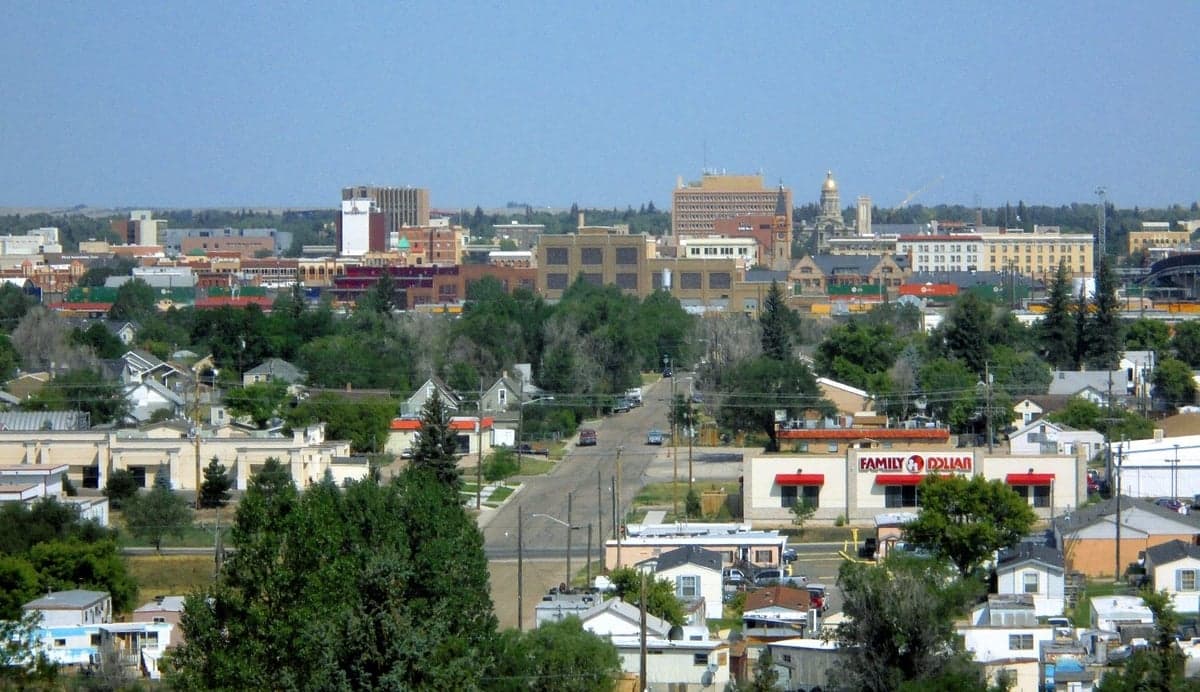
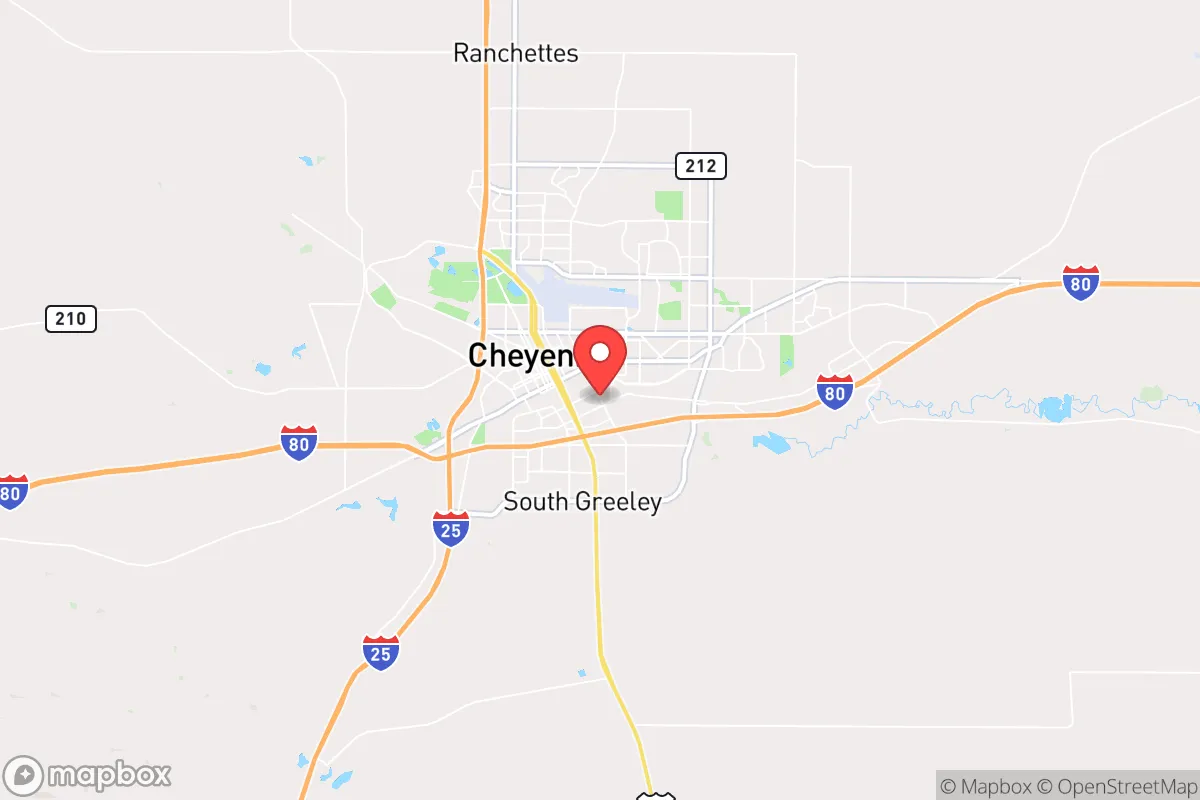
Photo: Wikipedia
Demographics of Cheyenne, WY
Affluence Level in Cheyenne, WY
A middle-class area roughly in line with national averages across income, home values, education, and employment.
People of Cheyenne, WY
The people of Cheyenne, Wyoming, today number 64,976 and form a predominantly white (75.0%) and politically conservative community with a strong Western identity rooted in railroad, military, and ranching heritage. The city is notably less diverse than the national average, with a foreign-born population of just 1.3%, though a growing Hispanic community (16.0%) is reshaping parts of the city. Cheyenne retains a small-town feel despite being the state capital, with a population density of roughly 2,200 people per square mile and a character defined by the annual Cheyenne Frontier Days rodeo, a robust state government workforce, and the presence of F.E. Warren Air Force Base. For a conservative-leaning single or parent considering relocation, Cheyenne offers a stable, family-oriented environment with low crime relative to similarly sized cities, but with limited racial and cultural diversity.
How the city was settled and grew
Cheyenne was founded in 1867 as a Union Pacific Railroad construction camp, exploding from a tent city into a permanent settlement almost overnight. The original population was overwhelmingly white and male—railroad workers, surveyors, and merchants drawn by the transcontinental railroad's westward push. The city was named after the Cheyenne Native American tribe, though the tribe itself was forcibly displaced from the area during the Plains Wars of the 1860s and 1870s. By the 1880s, Cheyenne had become a cattle-shipping hub and territorial capital, attracting ranchers, lawyers, and politicians. The historic Rainsford Historic District, with its Victorian-era homes, was built by this early elite class of cattle barons and railroad executives. A second major wave came with the establishment of Fort D.A. Russell (later F.E. Warren Air Force Base) in 1867, which brought a steady military population—mostly white officers and enlisted men from across the country—who settled in neighborhoods like South Cheyenne and the Warren Estates area near the base. The city's population grew steadily through the early 20th century, reaching 22,000 by 1940, driven by state government expansion and the Union Pacific's maintenance shops. No significant immigrant enclaves formed during this period; the city remained overwhelmingly native-born white, with a small Black population (mostly railroad porters and soldiers) concentrated near the West Side along the railroad tracks.
Modern era (post-1965)
After the 1965 Hart-Cellar Act, Cheyenne saw minimal immigration compared to coastal cities. The foreign-born share has never exceeded 2%, and the city's growth has come almost entirely from domestic migration—primarily white retirees from Colorado and California seeking lower taxes, and military families rotating through F.E. Warren Air Force Base. The Hispanic population, however, has grown steadily from about 5% in 1990 to 16.0% today, driven by agricultural and construction labor demand in the broader Laramie County area. This community is concentrated in the Southwest Cheyenne neighborhoods around Dell Range Boulevard and the Fox Farm area, where newer subdivisions and apartment complexes have attracted working-class Hispanic families. The Black population remains small at 2.8%, largely tied to the military base and concentrated in Warren Estates and the East Side near the base's main gate. East and Southeast Asian residents (1.0%) are mostly military-affiliated families from the Philippines, Korea, and Japan, living in base housing or the Buffalo Ridge neighborhood. The Indian-subcontinent population (0.1%) is negligible, consisting of a handful of medical professionals at Cheyenne Regional Medical Center. The city's college-educated share (32.9%) is below the national average, reflecting a workforce heavy in government, retail, and trades rather than tech or professional services.
The future
Cheyenne's population is projected to grow modestly—perhaps 5-10% over the next decade—driven by continued domestic in-migration from high-cost Western states like Colorado and California. The Hispanic share is likely to rise gradually, potentially reaching 20-22% by 2035, as younger Hispanic families have higher birth rates and continue to fill construction, service, and agricultural roles. However, the city is not experiencing the rapid ethnic diversification seen in many Western cities; the white population will remain the large majority. The city is homogenizing in the sense that new subdivisions on the North Side and Pioneer Park area are attracting mostly white, middle-class families from out of state, while the Hispanic community remains somewhat geographically concentrated in the southwest. There is little evidence of tribalization into distinct ethnic enclaves—Cheyenne is too small and too culturally conservative for that pattern. The immigrant communities that exist (mostly Hispanic and Asian military families) are assimilating into the broader culture, with English proficiency high and intermarriage common. The biggest demographic wildcard is F.E. Warren Air Force Base, which could expand or contract with national defense priorities, directly affecting the city's racial composition and population size.
For someone moving in now, Cheyenne is becoming a slightly more diverse but still overwhelmingly white, conservative, and stable small city. The population is not fragmenting into ethnic enclaves but is instead absorbing new arrivals into a cohesive, low-diversity Western identity. The trade-off is clear: Cheyenne offers safety, affordability, and community cohesion, but at the cost of the cultural variety and global connections found in larger, more immigrant-rich cities. A family or single moving here should expect a place where most neighbors share a similar background and political outlook, and where the biggest changes will come from domestic migration rather than international immigration.

* Values derived from national, state, county, city and local statistics and may differ in a specific area. Last updated: 2026-04-21T11:37:47.000Z
Narrative content on this page is AI-generated and may contain mistakes. Verify any details that matter before acting on them.
ReloMaps may earn a commission from affiliate links at no extra cost to you.

