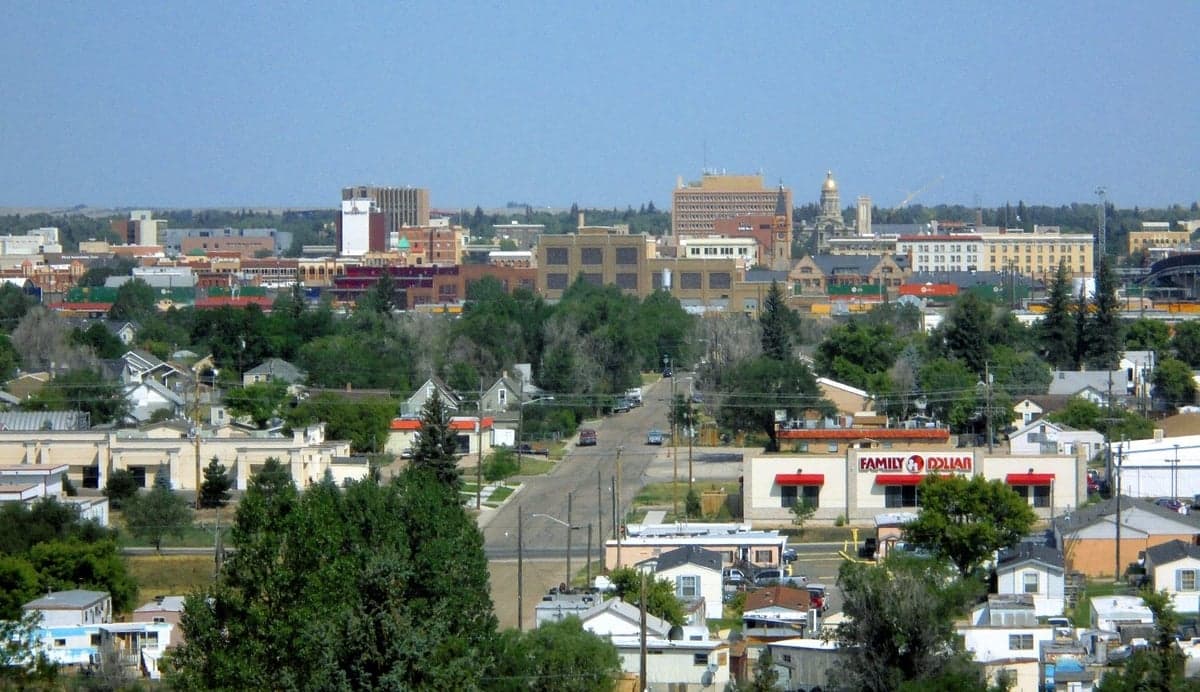
Photo: Wikipedia
Political ClimatePolitical Climate in Cheyenne, WY
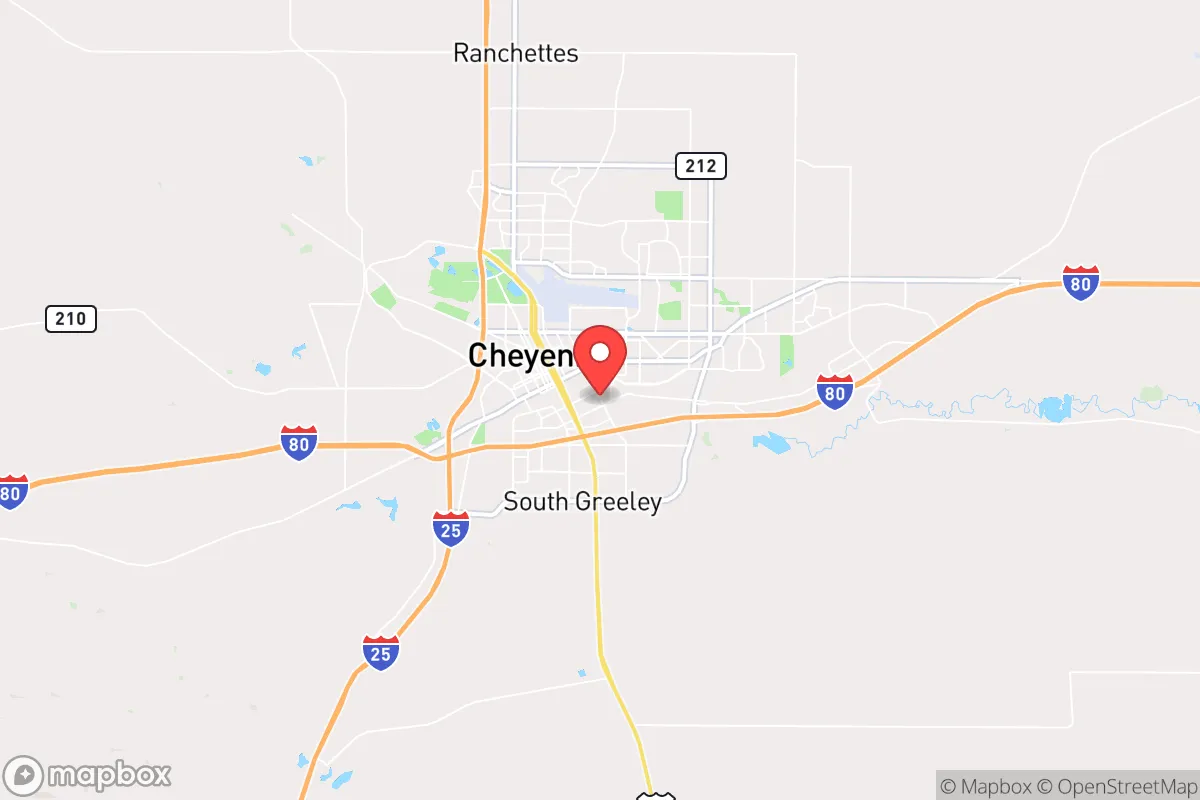
District shown is the primary district for this city’s centroid. Cities may span multiple districts.
Inherited from parent state — no local data available.
Local Political AnalysisPolitical Analysis of Cheyenne, WY
Cheyenne is about as solidly conservative as it gets in Wyoming, and that's not changing anytime soon. The city sits in Laramie County, which has a Cook PVI of R+23, meaning it votes nearly 25 points more Republican than the national average. In the 2024 presidential election, Laramie County went for the Republican candidate by a margin of roughly 67% to 30%, a spread that's been consistent for decades. You don't see the kind of political whiplash here that you get in places like Denver or even Fort Collins, Colorado, just 45 minutes south. The trajectory is stable—if anything, the local GOP has gotten more assertive on issues like property rights and gun laws, not less.
How it compares
Drive an hour south to Fort Collins, and you're in a different world—Larimer County, Colorado, voted for the Democratic candidate in 2024 by about 55% to 42%. That's a 30-point swing from Cheyenne in just 60 miles. Even within Wyoming, Cheyenne is actually the most moderate of the state's major cities; Laramie (home to the University of Wyoming) and Jackson Hole lean more left, while towns like Gillette and Casper are even redder. But don't mistake "moderate" for "liberal." Cheyenne's city council is nonpartisan, but the mayor and most elected officials are openly conservative. The contrast with Colorado's Front Range is stark—you can feel the difference in the air the second you cross the state line. No one here is apologizing for the Second Amendment or for wanting lower taxes, and that's a big reason people move here from places like California or Colorado.
What this means for residents
For the people who live here, the political climate means less government meddling in daily life. Wyoming has no state income tax, and Cheyenne's property taxes are among the lowest in the nation—about 0.6% of assessed value, compared to Colorado's average of 0.8% or Texas's 1.7%. You don't need a permit to carry a concealed firearm, and the state legislature has repeatedly blocked efforts to impose red-flag laws or stricter zoning. That said, there's been a slow creep of progressive influence, mostly from newcomers who bring big-city ideas about "sustainability" and "equity." The city's 2024 comprehensive plan included language about "climate resilience" and "inclusive housing," which raised eyebrows among longtime residents who see it as a foot in the door for overreach. So far, those proposals have been mostly symbolic, but you can feel the tension at city council meetings when someone brings up bike lanes or density bonuses.
On the cultural side, Cheyenne is still a place where Frontier Days isn't just a festival—it's an identity. The rodeo, the parades, the cowboy heritage—these aren't performative; they're how people actually live. You'll see more pickup trucks than Teslas, and the local news covers county commission meetings more closely than national politics. The biggest policy fights in recent years have been over land use (ranchers vs. developers) and energy (coal vs. wind), not social issues. That's the thing about Cheyenne: it's conservative in a practical, live-and-let-live way, not a culture-war way. But if you're worried about government overreach, keep an eye on the city's planning department. The push for "complete streets" and "transit-oriented development" sounds harmless, but it's how zoning restrictions and higher fees start to creep in. For now, though, Cheyenne remains a place where your rights are respected and your business is your own—and that's exactly how most folks here want to keep it.

State Political ClimatePolitical Climate in Wyoming
State Political AnalysisPolitical Environment in the State
Wyoming is, and has long been, one of the most reliably Republican states in the nation, with a partisan lean that makes Texas look like a swing state. The Cowboy State hasn’t voted for a Democratic presidential candidate since 1964, and in 2024, Donald Trump carried it by over 40 points. The dominant coalition is a blend of traditional Western libertarians, fiscal conservatives, and a growing contingent of freedom-minded transplants fleeing blue states. Over the last 20 years, the state has actually shifted further right, driven by an exodus of moderate Democrats and an influx of conservatives from Colorado and California, while the small pockets of blue in Teton County and Laramie have become more isolated and less influential.
Urban vs. rural divide
The political map of Wyoming is a study in stark contrasts. The vast, open plains and mountain valleys are deep red, while the state’s two small urban centers—Jackson in Teton County and Laramie in Albany County—vote reliably blue. Teton County, home to Jackson Hole’s ultra-wealthy and its tourism-driven economy, is the state’s most Democratic stronghold, often voting +30 points for the left. Laramie, home to the University of Wyoming, follows a similar pattern, with a younger, more transient population pushing it left. Meanwhile, the rest of the state is overwhelmingly conservative. Casper (Natrona County) and Cheyenne (Laramie County) are solidly Republican, but the real firepower comes from the rural counties like Sublette, Lincoln, and Park, which routinely vote 80%+ Republican. The divide isn’t just cultural—it’s economic. The urban blue areas rely on tourism and government jobs, while the rural red areas are tied to energy, agriculture, and ranching. This split means that while the state legislature is supermajority Republican, the few Democratic seats are concentrated in these two counties, giving them outsized influence on issues like land use and environmental regulation.
Policy environment
Wyoming’s policy environment is a dream for those seeking limited government. There is no state income tax, and the sales tax is a low 4% (with local options pushing it to around 6% in some towns). Property taxes are among the lowest in the nation, though recent assessments have caused some sticker shock for newcomers. The regulatory posture is aggressively pro-business and pro-energy, with the state actively fighting federal overreach on coal, oil, and gas development. Education policy is a mixed bag: the state funds schools well through mineral revenues, but there’s a strong push for school choice and parental rights, with a 2023 law allowing parents to opt their children out of any curriculum they find objectionable. Healthcare is a perennial issue—Wyoming is one of the few states that hasn’t expanded Medicaid, and the state’s rural hospitals struggle with funding. Election laws are solid: voter ID is required, and the state has resisted mail-in ballot expansions. The legislature recently passed a law banning ranked-choice voting and requiring all ballots to be hand-counted in smaller precincts, a move that drew national attention but was popular locally.
Trajectory & freedom
Wyoming is becoming more free, not less, and that’s a big part of its appeal. The state has been on a tear of liberty-expanding legislation over the last five years. In 2021, Wyoming became a Second Amendment Sanctuary State, and in 2023, it passed a permitless carry law, allowing any adult to carry a concealed firearm without a license. Parental rights got a major boost with the 2023 “Parents’ Bill of Rights,” which requires schools to notify parents about any medical or mental health services offered to their children and bans transgender medical procedures for minors. On medical freedom, the state passed a law in 2022 prohibiting vaccine mandates by private employers and government entities. Property rights were strengthened with a 2023 law limiting the use of eminent domain for carbon pipelines. The only area where freedom has arguably contracted is on abortion: a near-total ban was enacted in 2022, with exceptions only for rape, incest, and the life of the mother. For the conservative audience, this is a feature, not a bug. The trajectory is clear: Wyoming is doubling down on individual liberty, gun rights, and local control, while pushing back against federal mandates and corporate wokeism.
Civil unrest & political movements
Wyoming is not a hotbed of civil unrest, but there are distinct political movements that shape the atmosphere. The most visible is the “Freedom Caucus” wing of the state legislature, which has been increasingly assertive in pushing back against the more establishment Republicans. This faction, centered in towns like Gillette and Worland, has been behind the most aggressive liberty bills and has clashed with the governor over budget priorities. On the left, the main flashpoint is Jackson, where progressive activists have pushed for sanctuary city policies and affordable housing mandates, creating a cultural war with the rest of the state. Immigration politics are relatively quiet—Wyoming has a very small foreign-born population, and the state passed a law in 2023 requiring all law enforcement to cooperate with federal immigration authorities. Election integrity controversies have been minimal, though the 2020 election saw some grassroots calls for audits, which led to the hand-counting law. There’s also a small but vocal secessionist movement in some rural counties, with talk of forming a “State of Lincoln” or joining Idaho, though this remains fringe. Overall, the political temperature is low compared to states like Oregon or Pennsylvania, but the divide between the Jackson/Laramie bubble and the rest of the state is real and growing.
Projection
Over the next 5-10 years, Wyoming is likely to become even more conservative, but with a twist. The in-migration from blue states—particularly from Colorado and California—is accelerating, and while many of these newcomers are freedom-minded, they also bring higher expectations for services and a different cultural sensibility. Towns like Sheridan and Buffalo are seeing an influx of remote workers and retirees, which is driving up housing costs and creating tension with longtime residents. The energy transition is the wild card: as coal declines, the state’s budget will face pressure, potentially forcing a debate over diversifying the economy or cutting services. The Freedom Caucus is likely to grow in influence, pushing for even more aggressive tax cuts and deregulation. The blue enclaves in Teton and Albany counties will remain isolated, but their political power will wane as the rest of the state grows. The biggest risk is that the state’s libertarian streak could be tested by the need for more revenue, but for now, the trajectory is toward more freedom, not less. Someone moving in now should expect to find a state that is fiercely independent, increasingly conservative, and determined to chart its own course.
For a new resident, the bottom line is this: Wyoming offers a rare combination of low taxes, strong gun rights, and a culture of personal responsibility that is increasingly hard to find elsewhere. The political climate is stable and predictable for conservatives, with no real threat of a blue shift in the near term. The trade-offs are real—limited healthcare access, harsh winters, and a thin job market outside of energy and government—but for those who value freedom over convenience, it’s a solid bet. Just be prepared for the culture shock if you’re coming from a blue state: the pace is slower, the politics are more personal, and the government really does stay out of your way. That’s the Wyoming way.
* Values derived from national, state, county, city and local statistics and may differ in a specific area. Last updated: 2026-04-21T11:37:47.000Z
Narrative content on this page is AI-generated and may contain mistakes. Verify any details that matter before acting on them.
ReloMaps may earn a commission from affiliate links at no extra cost to you.

