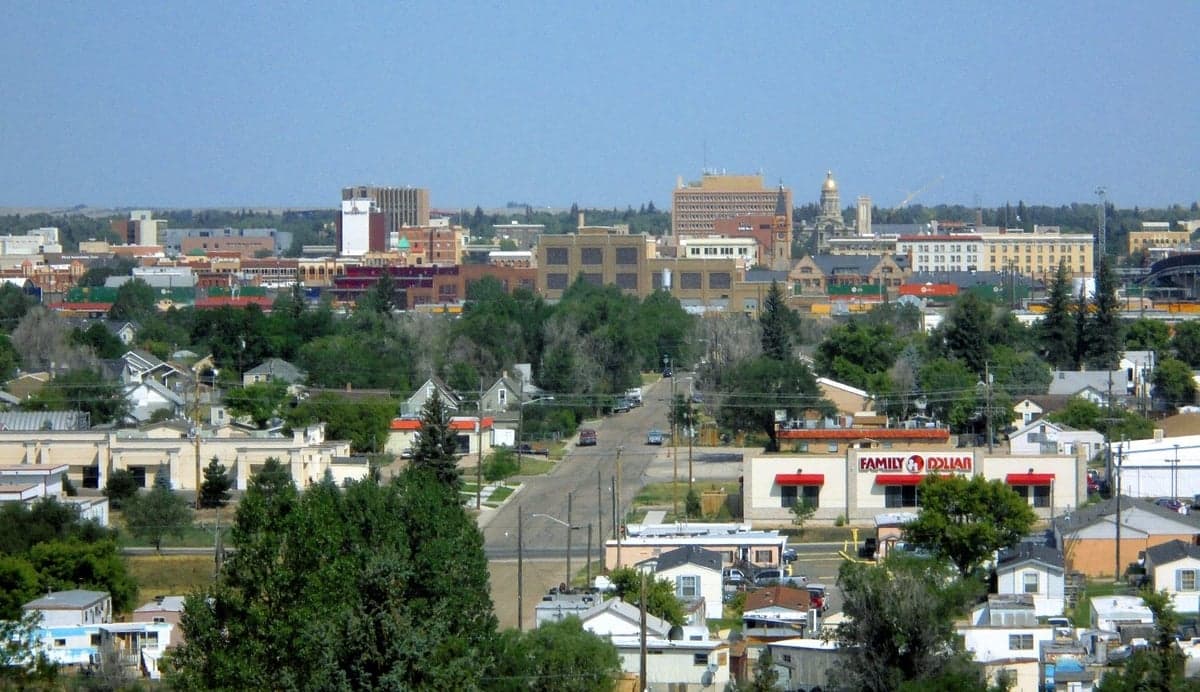
Photo: Wikipedia
Personal Sovereignty in Cheyenne, WY
Viable for self-reliance. Generally workable, though some barriers may limit total independence.
What does Personal Sovereignty tell us?
Personal Sovereignty measures your capacity for self-reliance and independence with minimal government friction. Higher scores mean fewer barriers between you and the way you want to live... but it assumes you have the space you need and good neighbors.
What does this tell us?
Personal Sovereignty measures your capacity for self-reliance and independence with minimal government friction. Higher scores mean fewer barriers between you and the way you want to live... but it assumes you have the space you need and good neighbors.
State Policy
Energy independence: Net exporter (800% of energy produced in-state)
Personal Liberty
Homesteading

Personal Liberty Analysis
Cheyenne, Wyoming offers one of the strongest personal sovereignty environments in the lower 48, particularly for those who view government overreach as a growing threat to individual autonomy. The city sits in a state that consistently ranks among the most free in the nation, with a political culture that treats personal liberty as the default rather than a privilege granted by the state. For single individuals and parents alike, Cheyenne provides a legal and cultural framework where you can live largely unbothered by the regulatory creep that defines much of the country. This isn't a theoretical freedom—it's baked into the state constitution, the tax code, and the everyday attitude of local government.
Tax burden and regulatory posture in Cheyenne
Wyoming is one of the few states where the government actively stays out of your wallet and your business. There is no state income tax, which means every dollar you earn is yours to keep, save, or invest—no state-level confiscation for social programs you didn't vote for. Property taxes are among the lowest in the nation, with Laramie County's effective rate hovering around 0.6% of assessed value, and the state caps annual increases at 4% for primary residences. Sales tax in Cheyenne is 5.5% (4% state, 1.5% county), but groceries and prescription drugs are exempt. The regulatory environment is equally lean: Wyoming has no state-level occupational licensing for dozens of common trades, no state-run health insurance exchange, and no "red flag" gun law. The state legislature meets only part-time (40 days every two years), which naturally limits the volume of new laws that can be passed. For someone concerned about government creep, this is a deliberate feature—the state is designed to do less, not more.
Self-defense and gun law specifics in Cheyenne
Cheyenne sits in a state that treats the Second Amendment as a non-negotiable right, not a privilege subject to bureaucratic whims. Wyoming is a constitutional carry state—no permit is required to carry a concealed firearm for anyone 21 or older who can legally possess a gun. Open carry is also legal without a permit. There is no state-level background check requirement for private sales, no waiting period, no magazine capacity restrictions, and no registry of firearms or owners. The state preempts all local gun ordinances, meaning Cheyenne city council cannot pass its own restrictions—a critical protection against the kind of patchwork laws that plague states like Colorado or Washington. Stand-your-ground law is fully in effect, with no duty to retreat in any place you have a legal right to be. For parents, this extends to school zones: while federal law technically restricts firearms near schools, Wyoming has a state law that nullifies the federal Gun-Free School Zones Act for permitless carry holders. In practical terms, this means you can keep a firearm in your vehicle on school property, and the state will not prosecute you for doing so. The culture matches the law—Cheyenne has a strong shooting community, with multiple public ranges within 30 minutes and the Cheyenne Gun Club offering memberships for serious marksmen.
Self-reliance and homesteading viability in Cheyenne
For those looking to reduce dependence on fragile supply chains and government systems, Cheyenne offers genuine homesteading potential that is rare in a state capital. The city's zoning code is remarkably permissive: within city limits, you can keep up to four chickens on a standard residential lot (no roosters), and beekeeping is allowed with a simple registration. Outside city limits in Laramie County, there are no meaningful restrictions on livestock, gardens, or rainwater collection—Wyoming law explicitly protects the right to capture rainwater from your roof for non-potable uses, a right that is still contested in many western states. Lot sizes vary widely: older neighborhoods near downtown have standard 6,000-8,000 sq ft lots, but newer subdivisions on the city's south and east sides offer acreage parcels (1-5 acres) that are still within a 15-minute drive of downtown. Off-grid living is legally feasible in the county, though the city requires grid connection for new construction within its jurisdiction. The growing season is short (about 120 days between last and first frost), but cold-hardy crops like potatoes, carrots, kale, and squash do well. Water rights are a serious consideration—Wyoming follows prior appropriation doctrine, so any well drilling requires a permit from the State Engineer's Office, and domestic wells are limited to 25 gallons per minute for household use only. For serious preppers, the county allows private shooting ranges on parcels of 5 acres or more, and there are no state-level restrictions on stockpiling ammunition or storing bulk food.
Personal liberties in Cheyenne: parental rights, medical autonomy, speech, and property
Wyoming's legal framework gives individuals and families wide latitude to make their own decisions without state interference. Parental rights are explicitly protected under state law—Wyoming has a Parents' Bill of Rights that affirms parents have the fundamental right to direct their children's education, healthcare, and upbringing. This means no vaccine mandates for school attendance (religious and philosophical exemptions are honored), no state interference in homeschooling (you simply file a basic intent form with the local school district), and no curriculum requirements that override parental values. Medical autonomy is similarly strong: Wyoming has no state-level vaccine mandate for adults, no mask mandates (the legislature banned them in 2023), and no restrictions on ivermectin or hydroxychloroquine prescriptions. The state does not participate in the federal REAL ID program for driver's licenses (you can still use a standard license for federal purposes until May 2027, and the state offers a non-compliant option indefinitely). Property rights are protected by Wyoming's "private property protection" law, which requires the government to compensate landowners for any regulatory taking that reduces property value by more than 50%. Free speech is robust—there are no state-level hate speech laws, no restrictions on political speech, and the city has never attempted to create a "misinformation" enforcement board. For those who value the ability to speak, heal, and raise children without government approval, Cheyenne offers a legal environment that is increasingly rare in the United States.
Compared to other state capitals in the Mountain West, Cheyenne stands out as a place where personal sovereignty is not just tolerated but actively protected by law and culture. Denver, Salt Lake City, and Helena all have significantly more restrictive gun laws, higher tax burdens, and more intrusive public health mandates. Even Boise, which shares some of Wyoming's libertarian streak, has seen local governments chip away at property rights and parental autonomy in recent years. Cheyenne remains a refuge for those who believe the individual should be the primary unit of decision-making, not the state. The trade-offs are real—the economy is smaller, the winters are harsh, and the cultural amenities are limited—but for someone prioritizing freedom over convenience, this is one of the few places left where the government still remembers its proper place.

* Values derived from national, state, county, city and local statistics and may differ in a specific area. Last updated: 2026-04-21T11:37:47.000Z
Narrative content on this page is AI-generated and may contain mistakes. Verify any details that matter before acting on them.
ReloMaps may earn a commission from affiliate links at no extra cost to you.

