Photo: Wikipedia
Demographics of Christiansburg, VA
Affluence Level in Christiansburg, VA
A middle-class area roughly in line with national averages across income, home values, education, and employment.
People of Christiansburg, VA
Christiansburg, Virginia, is a town of 22,820 residents where the population is overwhelmingly white (83.5%) and college-educated (45.5%), with a notably small foreign-born share of just 3.0%. The town’s character is shaped by its role as a stable, family-oriented county seat and bedroom community for nearby Virginia Tech and Radford University, blending Appalachian roots with a growing professional class. Distinctive identity markers include a strong military veteran presence (due to proximity to the Radford Army Ammunition Plant) and a conservative-leaning civic culture that contrasts with the more transient, liberal college towns to the north.
How the city was settled and grew
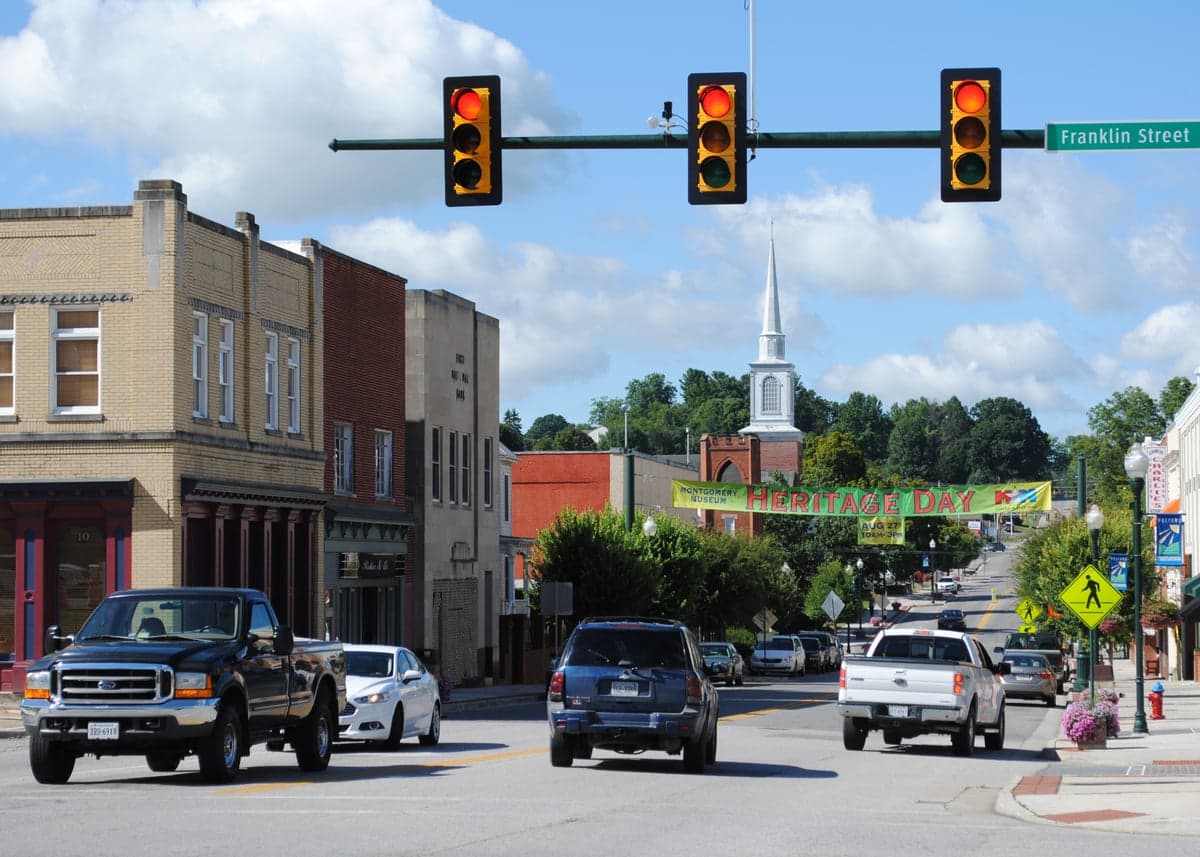
Christiansburg’s original population arrived in the late 18th century as Scots-Irish and German settlers pushed southwest along the Great Wagon Road, drawn by land grants in the fertile New River Valley. The town was formally established in 1792 as the Montgomery County seat, and its early economy revolved around agriculture, milling, and the stagecoach trade. The arrival of the Virginia and Tennessee Railroad in the 1850s spurred a second wave of English and German merchants and craftsmen, who built the brick storefronts and homes that still define Downtown Christiansburg and the Cambria Historic District. By the early 20th century, the population remained nearly entirely native-born white, with a small Black community concentrated in the Depot Street area near the railroad, many of whom worked as domestic laborers or railroad hands. The town grew slowly through the mid-20th century, adding a modest number of Appalachian migrants from surrounding coal counties during the Great Depression and World War II.
Modern era (post-1965)
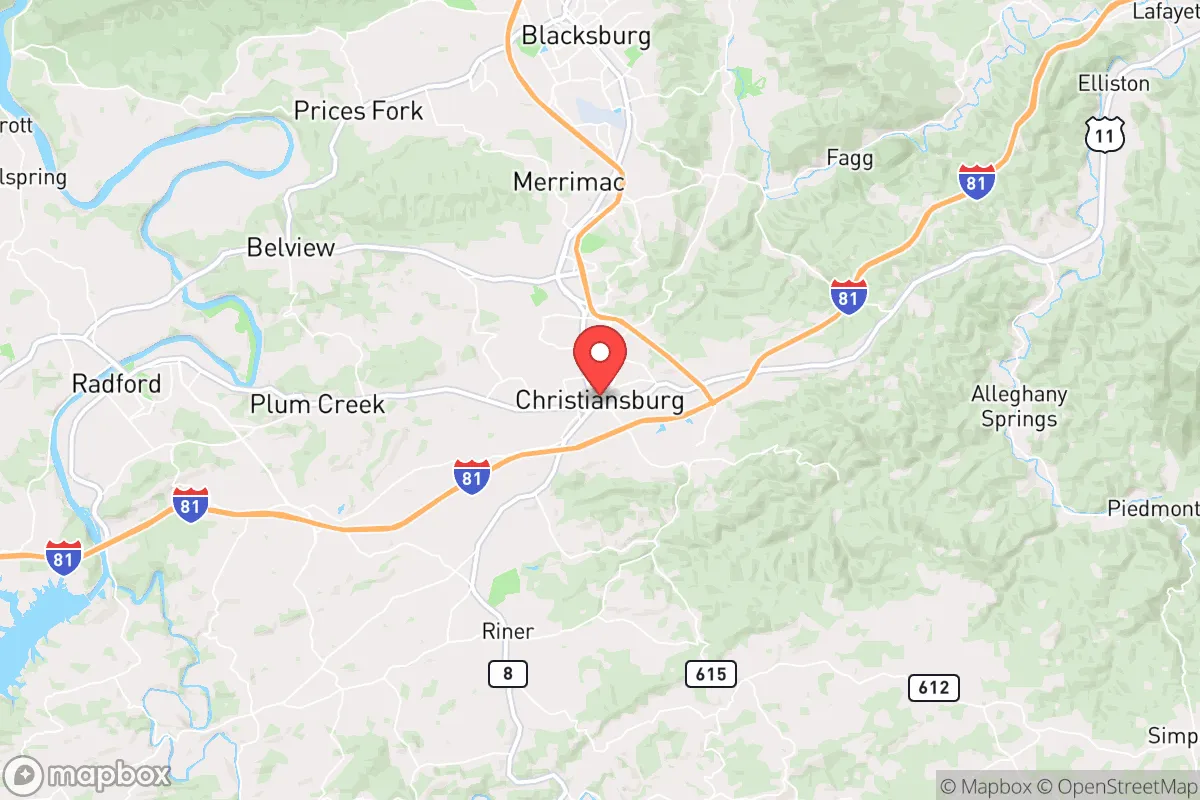
After the 1965 Hart-Cellar Act, Christiansburg saw negligible foreign immigration compared to larger Virginia cities. The town’s modern growth has been driven almost entirely by domestic in-migration — specifically, white-collar professionals and families moving from Northern Virginia, the Washington D.C. metro area, and other parts of the Mid-Atlantic for jobs at Virginia Tech, the Radford Army Ammunition Plant, and the growing healthcare sector. This wave settled predominantly in newer subdivisions like Hethwood and Foxridge (built in the 1970s–1990s), as well as the sprawling Pepper’s Ferry Road corridor, which is lined with chain retail and single-family homes. The Black population, which was historically small, declined further as older families aged out and younger generations left for larger cities; today, Black residents make up just 5.2% of the population. The Hispanic share (4.2%) and East/Southeast Asian share (1.6%) are modest and concentrated in rental apartments near the Pepper’s Ferry area, often tied to service-sector or tech-adjacent employment. The Indian-subcontinent population (2.2%) is a newer, professional cohort — many are Virginia Tech faculty or medical staff — and tends to settle in newer subdivisions like Lusters Gate or the North Franklin Street corridor, rather than in older historic neighborhoods.
The future
Christiansburg’s population is likely to continue homogenizing along class and educational lines, rather than tribalizing into distinct ethnic enclaves. The foreign-born share (3.0%) is well below the national average and shows no sign of rapid growth; the Indian and East/Southeast Asian communities are small, professional, and residentially dispersed, with little tendency toward clustering. The Hispanic population is growing slowly, primarily through births rather than new immigration, and is assimilating into the broader white-majority culture. The most significant demographic trend is the steady in-migration of college-educated white families from outside the region, drawn by affordable housing (relative to Northern Virginia) and the area’s strong public schools. This group is filling new subdivisions on the town’s southern and western edges, such as Ridgewood and Falling Branch, while the historic core — Downtown and Cambria — is seeing modest reinvestment but little population growth. Over the next 10–20 years, Christiansburg will likely become slightly more white, more educated, and more economically stratified, with a growing gap between the professional newcomers and the older, less mobile working-class population.
For someone moving in now, Christiansburg offers a stable, low-crime, family-oriented environment with a conservative-leaning civic culture and excellent schools. It is not a diverse or rapidly changing town, but rather a place where the population is gradually becoming more homogeneous in background and outlook. The key trade-off is between the area’s strong quality of life and its limited demographic variety — a consideration for those who value either stability or exposure to different cultures.

* Values derived from national, state, county, city and local statistics and may differ in a specific area. Last updated: 2026-04-19T15:39:03.000Z
Narrative content on this page is AI-generated and may contain mistakes. Verify any details that matter before acting on them.
ReloMaps may earn a commission from affiliate links at no extra cost to you.

