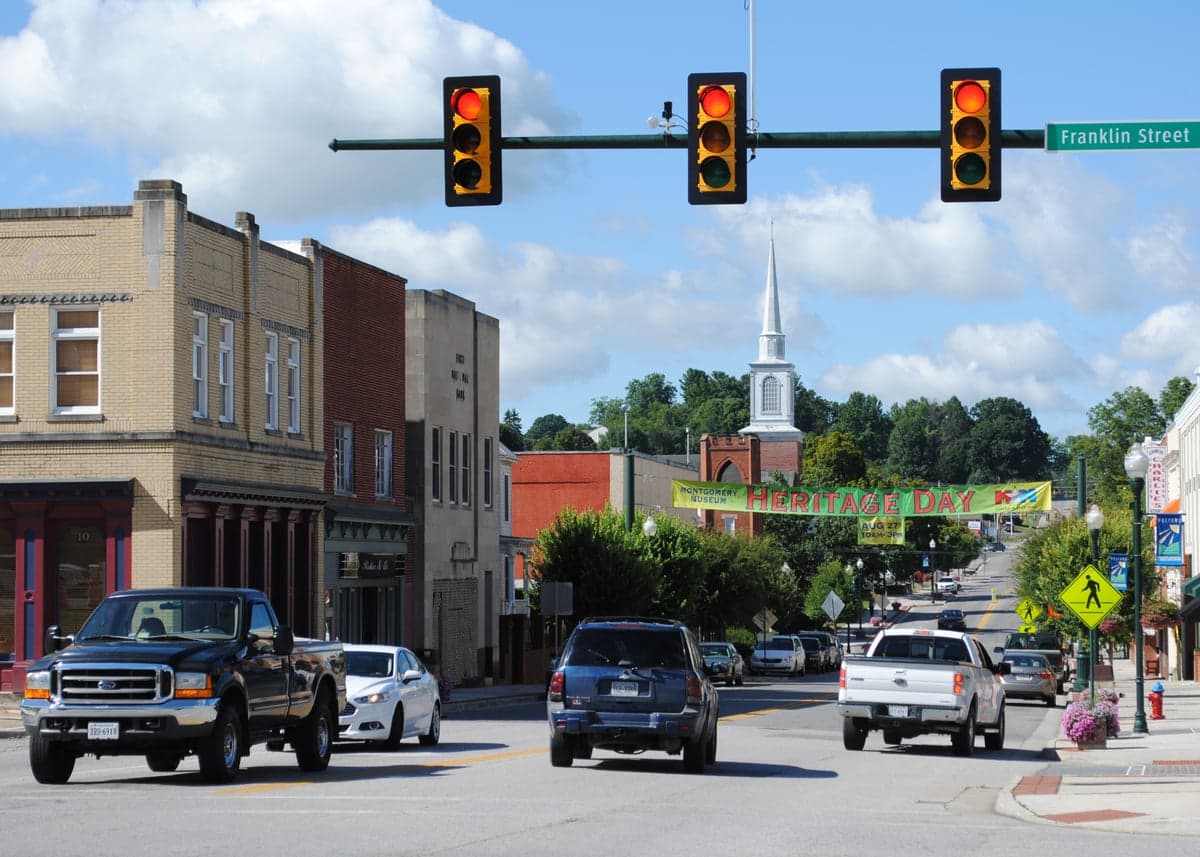
Photo: Wikipedia
Personal Sovereignty in Christiansburg, VA
Viable for self-reliance. Generally workable, though some barriers may limit total independence.
What does Personal Sovereignty tell us?
Personal Sovereignty measures your capacity for self-reliance and independence with minimal government friction. Higher scores mean fewer barriers between you and the way you want to live... but it assumes you have the space you need and good neighbors.
What does this tell us?
Personal Sovereignty measures your capacity for self-reliance and independence with minimal government friction. Higher scores mean fewer barriers between you and the way you want to live... but it assumes you have the space you need and good neighbors.
State Policy
Energy independence: Importer (20% of energy produced in-state)
Personal Liberty
Homesteading

Personal Liberty Analysis
Christiansburg, Virginia, offers a notably higher degree of personal sovereignty than many mid-Atlantic towns, largely due to Virginia’s status as a “shall-issue” state for firearms and its relatively light-touch regulatory environment outside of Northern Virginia. For those prioritizing autonomy—whether from federal overreach, state mandates, or local zoning boards—this Montgomery County seat provides a practical balance of rural freedom and access to infrastructure. The town’s political culture, while not uniformly libertarian, leans toward a live-and-let-live ethos that appeals to preppers, homesteaders, and anyone wary of government creep into daily life.
Tax burden and regulatory posture: how Virginia compares to neighboring states
Virginia’s overall tax burden ranks near the middle nationally, but Christiansburg benefits from a local government that avoids the aggressive taxation seen in places like Northern Virginia or Maryland. The state income tax is a flat 5.75%, and while there is no state-level homestead exemption, property taxes in Montgomery County hover around 0.85% of assessed value—significantly lower than the 1.2%+ rates common in Pennsylvania or New York. Sales tax is 5.3% (plus 1% local option), which is reasonable for the region. More importantly, Christiansburg’s town council has historically resisted adopting the kind of overbearing business licensing and zoning fees that choke small-scale enterprises. For a prepper or survivalist, this means fewer bureaucratic hurdles when setting up a home-based business, storing supplies, or running a small farm. Virginia’s right-to-work laws also protect individual employment freedom, preventing forced union membership—a key consideration for those who value economic independence over collective bargaining mandates.
Self-defense and gun law specifics: what the Second Amendment looks like here
Virginia is a “shall-issue” state for concealed carry, meaning the sheriff’s office in Montgomery County must issue a permit if you meet basic criteria—no subjective “good cause” requirement like in New York or California. Christiansburg residents enjoy constitutional carry for active-duty military and veterans, and the state preempts local governments from enacting their own gun bans, so town ordinances won’t surprise you. Open carry is legal without a permit for anyone 18 or older who can legally possess a firearm. Magazine capacity is unrestricted, and there is no state-level registry for long guns or handguns. However, Virginia does require a background check for all firearm transfers at gun shows, and private sales between strangers are technically legal but carry risk if you don’t know the buyer. For the survivalist mindset, the key takeaway is that Christiansburg sits in a county where the sheriff’s office is generally pro-Second Amendment, and the local gun culture is strong—you’ll find multiple gun shops, ranges, and a community that treats firearms as tools, not taboos. Stand-your-ground laws apply, and there is no duty to retreat in your home or vehicle.
Self-reliance and homesteading viability: lot sizes, zoning, and off-grid feasibility
Christiansburg’s zoning code is surprisingly accommodating for a town of 22,000. Within the town limits, residential lots can be as small as 6,000 square feet in older neighborhoods, but the real opportunity lies in the county’s agricultural zoning. Just outside town, you can find 5- to 20-acre parcels with no HOA restrictions, allowing for livestock, gardens, and even small-scale aquaculture. The town’s zoning ordinance explicitly permits “keeping of domestic animals” (chickens, rabbits, goats) on lots of half an acre or more, and beekeeping is allowed with a simple registration. Off-grid feasibility is moderate: Virginia’s building code requires connection to public water and sewer if available, but on rural parcels, you can drill a well and install a septic system without much pushback. Solar panels are permitted by right, though the town has no explicit net-metering mandate for excess power—so battery storage is a smarter bet for true independence. The biggest regulatory hurdle is the state’s stormwater management rules for new construction, but existing homes are grandfathered. For a prepper, the ideal play is to buy a few acres in the county (Montgomery County’s rural crescent) where you can build a pole barn, store supplies, and live without a homeowner’s association breathing down your neck.
Personal liberties: parental rights, medical autonomy, speech, and property
Virginia’s legal landscape for personal liberties is a mixed bag, but Christiansburg’s local culture tilts toward individual freedom. On parental rights, Virginia law gives parents broad authority over their children’s education, including the right to homeschool with a simple notice and annual assessment—no state-mandated curriculum or home visits. The town has multiple homeschooling co-ops and a supportive community for those opting out of public school. Medical autonomy is more constrained: Virginia has not enacted a broad medical freedom law, and vaccine mandates for school attendance remain in place (though religious exemptions are available). However, Christiansburg’s local health department is not aggressive in enforcement, and many families simply use the exemption process without hassle. Free speech is protected under the First Amendment, and the town has no local ordinances restricting political signs or public assembly—a contrast to cities like Charlottesville that have imposed time-place-manner restrictions. Property rights are strong: Virginia is a “pure” fee-simple state with no statewide rent control, and eminent domain is rarely used for private development. The biggest threat to property sovereignty is the potential for future zoning changes, but Christiansburg’s current comprehensive plan emphasizes “preserving rural character,” which aligns with prepper interests.
Compared to the regulatory chokeholds of the Northeast or West Coast, Christiansburg offers a breathing room that’s increasingly rare. The town’s tax burden is manageable, its gun laws are respectful of the Second Amendment, and its zoning allows for genuine self-reliance without constant government interference. For a single individual or family looking to maintain personal sovereignty while still having access to hospitals, schools, and supply chains, this is a solid bet—provided you stay out of the town’s historic district and avoid any future annexation by Blacksburg’s more progressive city council. The sovereignty here isn’t absolute, but it’s far better than most places within a day’s drive of Washington, D.C.

* Values derived from national, state, county, city and local statistics and may differ in a specific area. Last updated: 2026-04-19T15:39:03.000Z
Narrative content on this page is AI-generated and may contain mistakes. Verify any details that matter before acting on them.
ReloMaps may earn a commission from affiliate links at no extra cost to you.

