 Popular
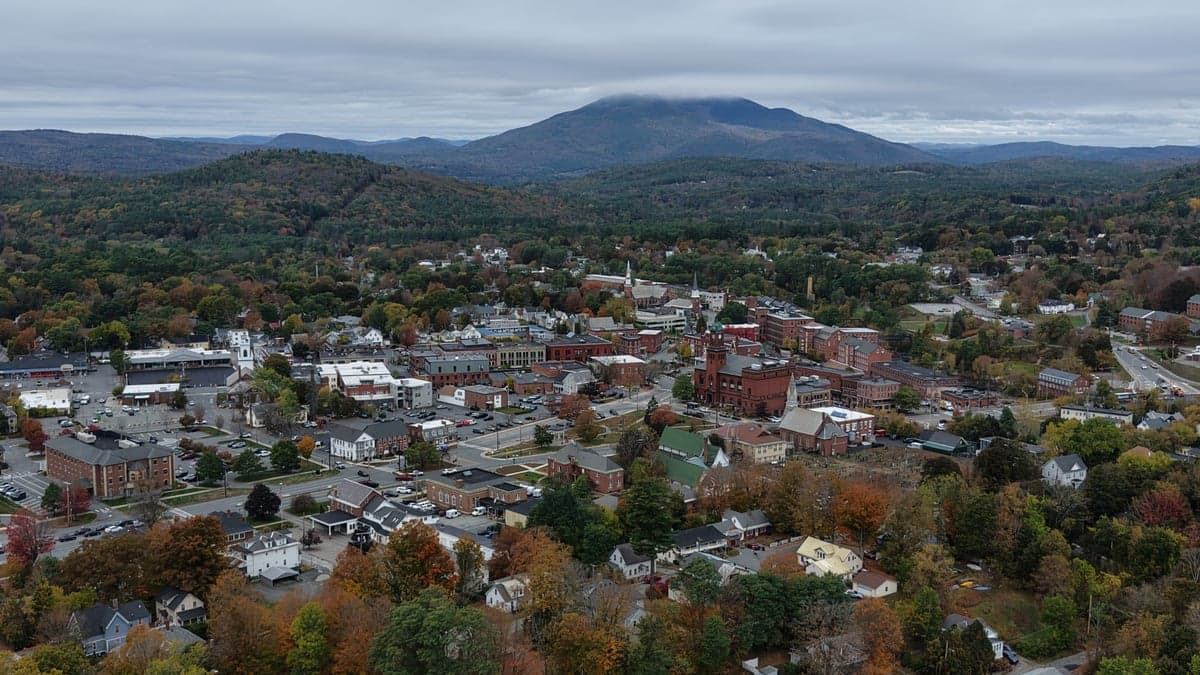
Photo: Wikipedia
Demographics of Claremont, NH
Affluence Level in Claremont, NH
A below-average socioeconomic profile. Incomes, home values, and educational attainment trail the U.S., with higher poverty and unemployment.
People of Claremont, NH
The people of Claremont, New Hampshire, today number 13,054, forming a predominantly white (87.1%) community with a small but visible Hispanic population (5.1%) and negligible foreign-born presence (0.0%). The city’s character is shaped by its industrial past and current economic challenges, with only 20.3% of adults holding a college degree, reflecting a working-class identity that persists across its distinct neighborhoods. Claremont is a place where the echoes of mill-town history are still felt in the layout of its streets and the makeup of its wards, but where demographic change has been slow compared to the rest of New England.
How the city was settled and grew
Claremont’s population history begins with European settlers arriving in the 1760s, drawn by land grants from the Masonian Proprietors. The original settlers were primarily English Protestants from Massachusetts and Connecticut, who established farms along the Sugar River. The real population boom came with the Industrial Revolution. By the 1820s, the river’s water power attracted textile mills, and the city became a magnet for French-Canadian immigrants from Quebec, who arrived in large numbers between 1850 and 1900. These families settled in the North End and along Pleasant Street, building the dense, triple-decker housing that still defines those blocks. A smaller wave of Irish immigrants arrived for railroad construction and mill labor, clustering in the West Claremont area near the rail yards. By 1900, Claremont was a classic mill town: overwhelmingly white, heavily Catholic, and organized around the factory whistle. The city’s population peaked at around 13,800 in the 1960s, just as the mills began their long decline.
Modern era (post-1965)
After the 1965 Hart-Cellar Act, Claremont saw virtually no new immigration. The foreign-born population today sits at 0.0%, a stark contrast to many other New England cities. Instead, the post-1965 story is one of domestic out-migration and suburbanization. As the mills closed through the 1970s and 1980s, younger families left for jobs in Manchester, Concord, or southern states. Those who stayed were often older, less mobile residents, concentrated in the Downtown and East Side neighborhoods, where housing is cheapest. The Hispanic population (5.1%) is a recent and modest development, largely consisting of families who moved from other parts of New Hampshire or Massachusetts for lower housing costs, settling in the South End and along Washington Street. The Black population (1.3%) and East/Southeast Asian population (0.4%) remain tiny, with no distinct ethnic enclaves. The Indian subcontinent population is 0.0%. The city’s racial composition has barely shifted since 1970, making it one of the least diverse cities in New Hampshire.
The future
Claremont’s population is aging and slowly declining, with a median age of 44.5 years. The city is not homogenizing in the sense of becoming more diverse; rather, it is becoming older and whiter as younger, more diverse cohorts leave for larger cities. The Hispanic population is growing slightly, but from a very low base, and is unlikely to reach 10% within the next decade. The foreign-born population is expected to remain near zero, as the city lacks the job base or social infrastructure to attract immigrants. The North End and West Claremont neighborhoods are seeing the most turnover, as older residents pass away and their homes are bought by out-of-state buyers seeking affordable second homes or rental properties. This is creating a subtle shift: the city is becoming less a community of multi-generational mill families and more a mix of long-term poor residents and new arrivals from southern New England. The next 10-20 years will likely see continued population decline, with the city becoming a bedroom community for the Lebanon-Hanover area, rather than a destination for new immigrant groups.
For someone moving in now, Claremont offers a low-cost, low-diversity environment with a strong sense of local history but limited economic opportunity. The city is becoming a quieter, older place, where the biggest demographic change is not who arrives, but who leaves. New residents should expect a community that is stable in its racial makeup but unstable in its economic base, with the Downtown and East Side remaining the most affordable entry points for newcomers.

* Values derived from national, state, county, city and local statistics and may differ in a specific area. Last updated: 2026-04-19T05:08:20.000Z
Narrative content on this page is AI-generated and may contain mistakes. Verify any details that matter before acting on them.
ReloMaps may earn a commission from affiliate links at no extra cost to you.

