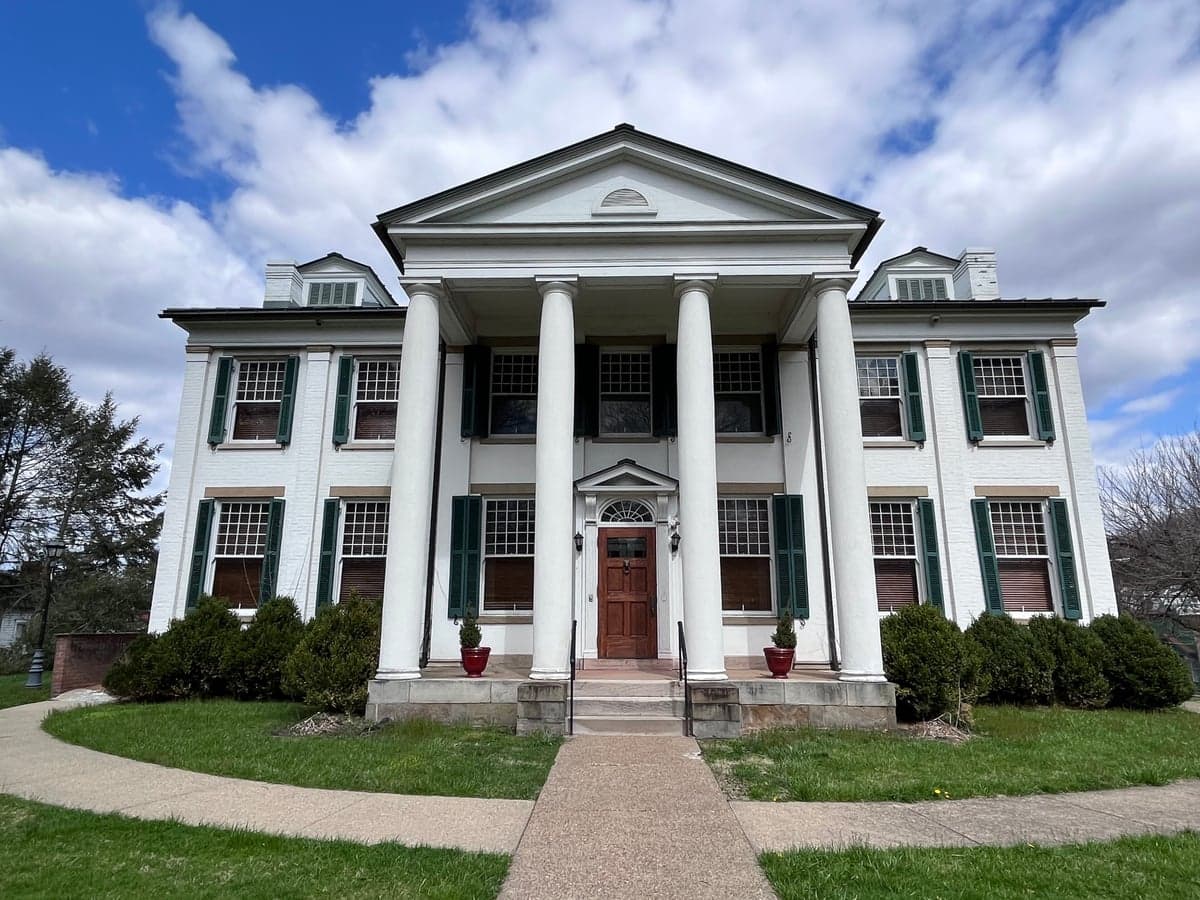
Photo: Wikipedia
Demographics of Clarksburg, WV
Affluence Level in Clarksburg, WV
A low-income area with significant economic hardship. Household wealth and educational attainment are well below national averages.
People of Clarksburg, WV
The people of Clarksburg, West Virginia today number 15,829, forming a predominantly white (89.6%) and native-born community where only 0.2% of residents are foreign-born. The city retains a distinctively working-class character rooted in its industrial past, with 24.1% of adults holding a college degree—below the national average—and a population density that feels small-town rather than urban. Clarksburg’s identity is shaped by its history as a hub for Italian, Irish, and Eastern European immigrants who arrived for coal and glass manufacturing, and by a modern era of demographic stability and gradual out-migration.
How the city was settled and grew
Clarksburg’s population history begins with its 1785 founding as a frontier outpost on the West Fork River, drawing early settlers of English, Scots-Irish, and German stock who took up land grants in the surrounding hills. The real demographic transformation came after the Civil War, when the region’s vast bituminous coal seams and the rise of glassmaking—fueled by local natural gas—triggered a wave of immigration. Between 1880 and 1920, thousands of Italian immigrants arrived to work in the coal mines and glass factories, settling in the North View and Stealey neighborhoods, where Italian social clubs and Catholic parishes still anchor the community. Irish immigrants, who had come earlier for railroad construction, concentrated in the Downtown area near the rail yards, while a smaller wave of Eastern European Jews—primarily from Poland and Russia—established a tight-knit enclave around East Pike Street, founding synagogues and businesses that served the growing commercial district. By 1930, Clarksburg’s population peaked at over 28,000, making it one of West Virginia’s largest cities, with a diverse working-class fabric that included African Americans who migrated from the rural South for industrial jobs, settling in the Adamston neighborhood near the glass plants.
Modern era (post-1965)
After the 1965 Hart-Cellar Act, Clarksburg saw virtually no new immigration—the foreign-born share today is a negligible 0.2%—reflecting the city’s declining industrial base and geographic isolation from major migration corridors. Instead, the post-1965 period was defined by domestic out-migration as coal and glass jobs vanished. The white population, which was 96% in 1980, has held relatively steady at 89.6% today, while the Black share dropped from a peak of roughly 5% in the 1970s to 2.8% as families left for larger Mid-Atlantic cities. The Nutter Fort area, technically a separate town but functionally a Clarksburg suburb, absorbed many white families moving from older city neighborhoods during the 1970s and 1980s suburbanization. Hispanic residents, now 2.6% of the population, are a recent arrival—mostly Mexican-origin workers drawn to warehouse and service jobs in the 2000s—and are scattered across the South Side and Downtown rental stock. East/Southeast Asian residents (0.5%) are a tiny presence, primarily a few families connected to the local hospital and university system, with no distinct ethnic enclave. The Indian-subcontinent population is effectively zero.
The future
Clarksburg’s population is heading toward continued slow decline and homogenization. The city lost roughly 15% of its residents between 2000 and 2020, and projections suggest another 5-10% drop by 2035 as the population ages (median age is 42) and younger adults leave for job markets in Morgantown, Pittsburgh, or Charlotte. The Hispanic share may grow modestly—perhaps to 4-5% by 2040—as service-sector employers like the United Hospital Center and retail distribution centers draw new workers, but this growth will likely be absorbed into existing neighborhoods rather than creating a distinct barrio. The white majority will remain dominant, and the Black and Asian shares are expected to plateau or decline slightly. No new immigrant communities are emerging, and the city’s low college attainment rate (24.1%) limits its appeal to knowledge-economy migrants. Clarksburg is not tribalizing into enclaves; it is simply thinning out, with the Downtown core losing population fastest while the North View and Stealey neighborhoods hold steady as stable, older-working-class areas.
For someone moving in now, Clarksburg is becoming a quieter, more homogeneous small city—a place where the population is shrinking but the remaining residents are deeply rooted, with strong family and church ties. The lack of ethnic diversity and immigration means a culturally uniform environment, but also low social friction and a pace of life that appeals to those seeking stability over dynamism. The city’s future is not one of revival, but of managed decline into a tight-knit, predominantly white community of 12,000-14,000 by 2040.

* Values derived from national, state, county, city and local statistics and may differ in a specific area. Last updated: 2026-04-23T06:06:02.000Z
Narrative content on this page is AI-generated and may contain mistakes. Verify any details that matter before acting on them.
ReloMaps may earn a commission from affiliate links at no extra cost to you.

