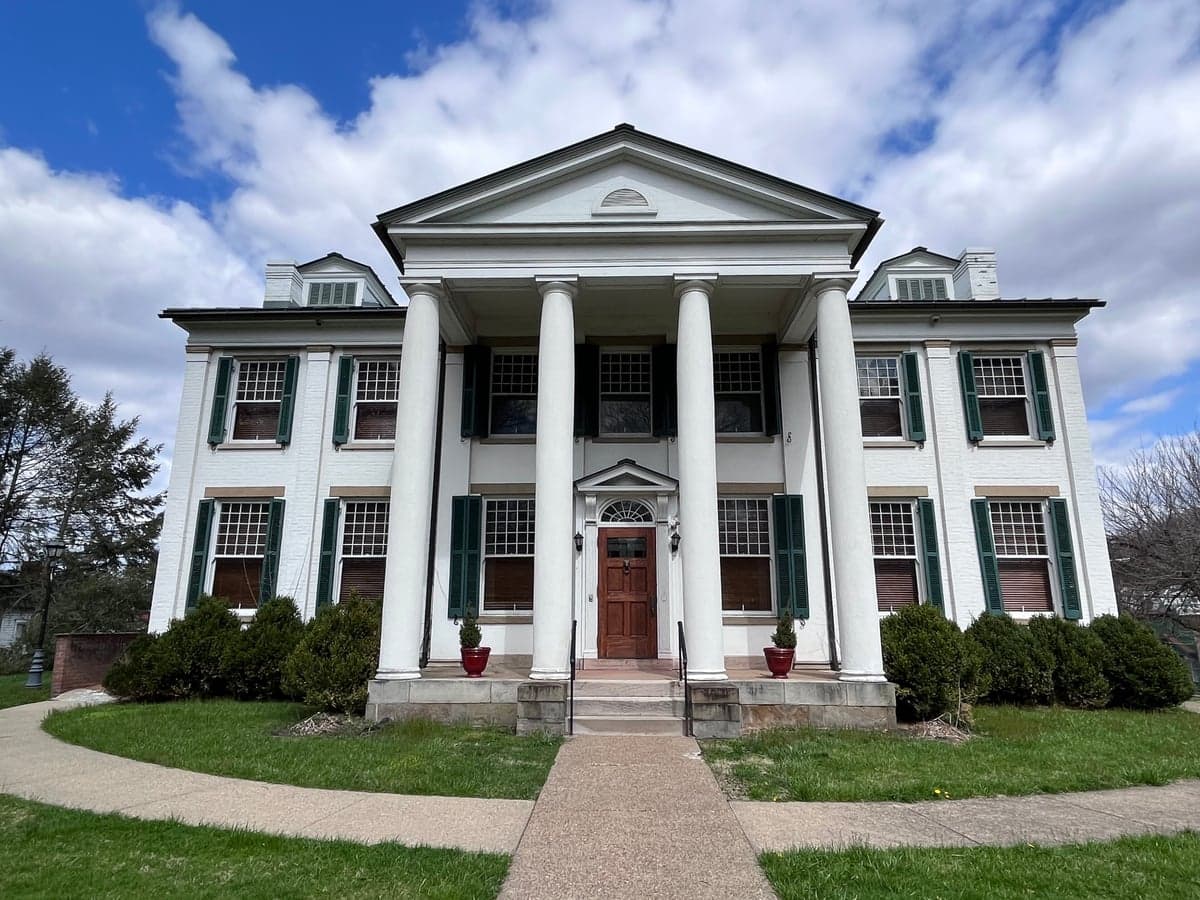
Photo: Wikipedia
Personal Sovereignty in Clarksburg, WV
Viable for self-reliance. Generally workable, though some barriers may limit total independence.
What does Personal Sovereignty tell us?
Personal Sovereignty measures your capacity for self-reliance and independence with minimal government friction. Higher scores mean fewer barriers between you and the way you want to live... but it assumes you have the space you need and good neighbors.
What does this tell us?
Personal Sovereignty measures your capacity for self-reliance and independence with minimal government friction. Higher scores mean fewer barriers between you and the way you want to live... but it assumes you have the space you need and good neighbors.
State Policy
Energy independence: Net exporter (200% of energy produced in-state)
Personal Liberty
Homesteading

Personal Liberty Analysis
Clarksburg, West Virginia offers a notably high degree of personal sovereignty compared to much of the United States, particularly for those who prioritize autonomy from state overreach. The city sits within a state that has consistently pushed back against federal mandates, from pandemic-era restrictions to environmental regulations, creating an environment where individual decision-making is broadly respected. For the survivalist or prepper mindset, Clarksburg provides a legal and cultural foundation that allows for a greater degree of self-reliance, though the practical realities of living in a small, post-industrial city require careful consideration of local ordinances and economic conditions.
Tax burden and regulatory posture: How much the state leaves in your pocket
West Virginia's tax structure is generally favorable for those seeking to minimize government extraction from their income and property. The state has a flat personal income tax rate of 4.12% as of 2026, down from a more progressive structure in prior years, and there is no state-level tax on Social Security benefits. Property taxes in Harrison County, where Clarksburg sits, are among the lowest in the nation, with effective rates typically around 0.5% to 0.7% of assessed value. This means a $150,000 home might carry an annual tax bill of roughly $750 to $1,050, a fraction of what you'd pay in states like New York or Illinois. The regulatory posture at the state level is decidedly pro-business and anti-red tape. West Virginia has a right-to-work law, no state-level OSHA plan (relying on federal OSHA instead, which is generally less aggressive), and a regulatory climate that the Mercatus Center consistently ranks as one of the least burdensome in the country. For someone looking to start a small business, operate a home-based firearms business, or simply keep more of what they earn, Clarksburg's tax and regulatory environment is a clear asset. The city itself has some local business licensing and zoning requirements, but they are minimal compared to larger metropolitan areas.
Self-defense and gun law specifics: What you can own and where you can carry
West Virginia is a constitutional carry state, meaning that as of 2026, any law-abiding adult 21 or older can carry a concealed firearm without a permit. This is a foundational liberty for the prepper community, as it removes a bureaucratic barrier to self-defense. The state also has strong preemption laws, meaning Clarksburg cannot enact its own gun control ordinances that are stricter than state law. You can legally own standard-capacity magazines, suppressors (with a federal tax stamp), and short-barreled rifles under state law, though federal NFA rules still apply. Stand-your-ground laws are in effect, with no duty to retreat in any place where you have a legal right to be. Castle doctrine protections are robust, covering your home, vehicle, and place of business. For the survivalist, this means you can maintain a well-stocked armory without fear of local overreach, and you can carry that capability with you throughout the state. The only practical limitation is that Clarksburg is within a few hours' drive of states with far more restrictive laws (Maryland, Pennsylvania, Virginia), so travel requires awareness of changing legal landscapes.
Self-reliance and homesteading viability: Lot sizes, zoning, and off-grid feasibility
Clarksburg itself is a compact, older city with a mix of residential lots typically ranging from 0.1 to 0.5 acres in the core neighborhoods. However, the surrounding Harrison County area, particularly the rural fringes within a 10- to 15-minute drive, offers lots of 1 to 5 acres at prices often under $10,000 per acre. Zoning in the city limits is standard residential, which can restrict things like keeping livestock, building large outbuildings, or operating a home-based manufacturing shop. But the county's rural zoning is far more permissive. Off-grid feasibility is high in the outlying areas. West Virginia has no state-level prohibition on rainwater collection, and many rural properties have existing wells or easy access to groundwater. Solar panel installation is straightforward, with no state-level permitting hurdles, though net metering policies are less generous than in some western states. Septic systems are the norm outside city limits, and composting toilets are legal. For the prepper looking to establish a retreat with food production, water independence, and alternative energy, the Clarksburg region offers some of the most affordable and legally permissive land east of the Mississippi. The main constraint is the hilly terrain, which can limit garden space and building sites, but also provides natural security and privacy.
Personal liberties: Parental rights, medical autonomy, speech, and property
West Virginia has a strong track record on parental rights, with laws that give parents broad authority over their children's education, medical decisions, and upbringing. The state has a robust school choice program, including charter schools, education savings accounts, and open enrollment, allowing parents to direct their children's education away from government-run institutions if they choose. Medical autonomy is a mixed bag. The state has no vaccine mandate for adults and has passed laws prohibiting COVID-19 vaccine mandates by private employers, but it does have standard childhood vaccine requirements for school attendance. Religious and medical exemptions are available. On medical freedom more broadly, West Virginia has not enacted the kind of broad health freedom laws seen in states like Idaho or Oklahoma, but it also has not aggressively pursued prosecutions for alternative medical practices. Free speech protections are strong, with no state-level hate speech laws that would criminalize political or religious expression. Property rights are well-protected, with a constitutional provision requiring just compensation for takings, and the state has been resistant to federal land-use overreach like the Waters of the United States rule. For the conservative individual concerned about government overreach into family life, medical choices, and property use, Clarksburg sits in a state that has consistently pushed back against federal encroachment.
Overall, Clarksburg offers a level of personal sovereignty that is rare in the eastern United States. The combination of constitutional carry, low taxes, permissive land use in the surrounding county, and strong parental rights creates an environment where a self-reliant individual can operate with minimal government interference. It is not a libertarian utopia—local zoning in the city, standard school vaccine requirements, and the presence of federal law enforcement (the FBI's Criminal Justice Information Services division is a major local employer) mean that government presence is still felt. But compared to the regulatory and tax burdens of the Northeast or West Coast, Clarksburg represents a genuine refuge for those who value autonomy, self-defense, and the freedom to live as they see fit. For the survivalist or prepper looking to relocate to a low-cost, low-regulation area with access to land and a culture of self-reliance, this region deserves serious consideration.

* Values derived from national, state, county, city and local statistics and may differ in a specific area. Last updated: 2026-04-23T06:06:02.000Z
Narrative content on this page is AI-generated and may contain mistakes. Verify any details that matter before acting on them.
ReloMaps may earn a commission from affiliate links at no extra cost to you.

