 Popular
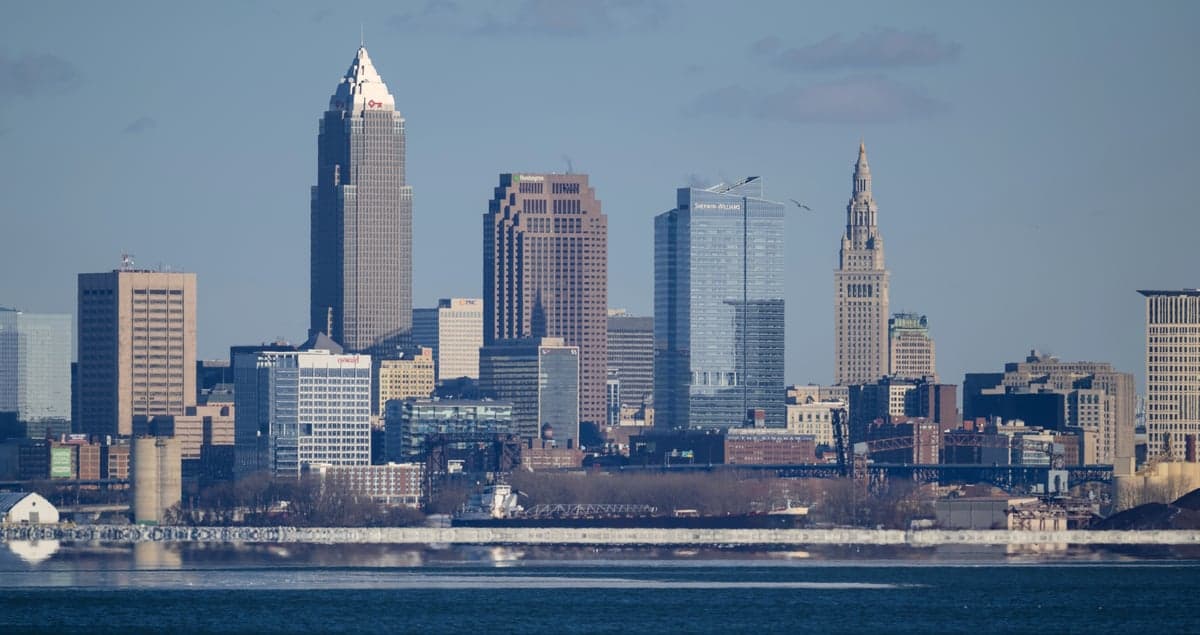
Photo: Wikipedia
Demographics of Cleveland, OH
Affluence Level in Cleveland, OH
A below-average socioeconomic profile. Incomes, home values, and educational attainment trail the U.S., with higher poverty and unemployment.
People of Cleveland, OH
The people of Cleveland today form a predominantly Black (46.0%) and White (33.8%) city, with a growing Hispanic population (12.8%) and small but distinct East/Southeast Asian (1.5%) and Indian-subcontinent (0.8%) communities. At 367,523 residents, the city is notably less dense than its mid-20th-century peak of over 900,000, and its foreign-born share sits at just 3.1% — well below the national average. Clevelanders are characterized by deep ethnic roots in Eastern and Southern European immigrant neighborhoods, a strong working-class identity forged in heavy industry, and a recent wave of suburban-to-urban return migration among younger professionals. Only 21.3% of adults hold a bachelor’s degree, reflecting the city’s historic reliance on blue-collar manufacturing employment.
How the city was settled and grew
Cleveland’s population history begins with its 1796 founding by Connecticut Land Company surveyors, who parceled the Western Reserve into farms. The real growth engine was the Ohio & Erie Canal, completed in 1832, which turned Cleveland into a Great Lakes shipping hub. German and Irish immigrants arrived in the 1840s and 1850s to dig the canal and build the railroads, settling in Ohio City (west side) and the Flats along the Cuyahoga River. By the 1870s, the city’s iron ore and coal convergence made it a steel and oil refining powerhouse — John D. Rockefeller built Standard Oil here. That industrial boom drew massive waves of Southern and Eastern Europeans: Poles, Czechs, Slovaks, Hungarians, Italians, and Slovenes. They clustered in distinct neighborhoods that still bear their names — Tremont (Greek and Polish), Slavic Village (Poles, Czechs, Slovaks), and Little Italy (University Circle). By 1920, Cleveland was the fifth-largest U.S. city, with a population that was overwhelmingly White and foreign-born or first-generation. The Great Migration of Black Americans from the rural South began during World War I and accelerated through the 1940s and 1950s, with most settling on the east side in Hough, Glenville, and Fairfax.
Modern era (post-1965)
The 1965 Hart-Celler Act ended national-origin quotas, but Cleveland’s foreign-born population never rebounded to its early-20th-century levels — today it is just 3.1%. Instead, the post-1965 story is one of domestic migration and suburbanization. White flight accelerated after the 1966 Hough riots and the 1968 Glenville shootout, with many families moving to inner-ring suburbs like Parma, Lakewood, and Euclid. Between 1950 and 1990, the city lost over half its population. The Black population peaked at roughly 47% in the 1980s and has since stabilized near 46.0%. Hispanic growth is the most notable recent shift: the Hispanic share rose from roughly 4% in 1990 to 12.8% today, driven primarily by Puerto Rican migration (Cleveland has one of the largest Puerto Rican communities in the Midwest) and, more recently, Mexican and Central American arrivals. The Hispanic population is concentrated on the west side, particularly in Clark-Fulton and La Villa Hispana (Detroit-Shoreway). The East/Southeast Asian community (1.5%) is small and centered in University Circle and AsiaTown (neighborhoods near St. Clair and Superior avenues), anchored by Chinese, Vietnamese, and Korean families. The Indian-subcontinent population (0.8%) is even smaller, with no single dominant neighborhood but a visible presence in the university-adjacent areas. Suburbanization continues: Cuyahoga County’s population is stable, but Cleveland proper has not reversed its long decline, though the rate of loss has slowed to near zero since 2020.
The future
Cleveland’s population is likely to stabilize or see modest growth over the next decade, driven by two countervailing trends. First, the Hispanic population is the fastest-growing segment and is projected to reach 15-18% by 2035, continuing to concentrate in west-side neighborhoods and gradually spreading into older White ethnic enclaves like Old Brooklyn and Kamm’s Corners. Second, the city is attracting a small but visible inflow of college-educated professionals — both White and Black — drawn by low housing costs, anchor institutions like the Cleveland Clinic and Case Western Reserve University, and a growing tech and healthcare sector. These newcomers are settling in Downtown, Ohio City, and Detroit-Shoreway, areas that have seen significant new apartment construction. The Black population share is expected to remain near 45-46%, with some out-migration of middle-class Black families to suburbs like Warrensville Heights and South Euclid. The East/Southeast Asian and Indian communities are likely to remain small but stable, tied to university and medical employment. The city is not homogenizing — instead, it is becoming more ethnically layered, with distinct enclaves persisting alongside gentrifying mixed-income corridors. The foreign-born share will likely rise slowly but remain below 5%.
For someone moving to Cleveland now, the city offers a rare combination: deeply rooted ethnic neighborhoods with distinct identities, a stable Black majority population with strong civic institutions, and a slowly diversifying west side driven by Hispanic growth. The population is no longer in freefall, but it is not booming either — it is settling into a smaller, more fragmented, but arguably more stable form than the industrial-era metropolis it once was. New arrivals will find a city where neighborhood choice strongly correlates with ethnic and economic background, and where the cost of entry is low enough that demographic change happens gradually, not disruptively.

* Values derived from national, state, county, city and local statistics and may differ in a specific area. Last updated: 2026-04-21T18:57:31.000Z
Narrative content on this page is AI-generated and may contain mistakes. Verify any details that matter before acting on them.
ReloMaps may earn a commission from affiliate links at no extra cost to you.

