
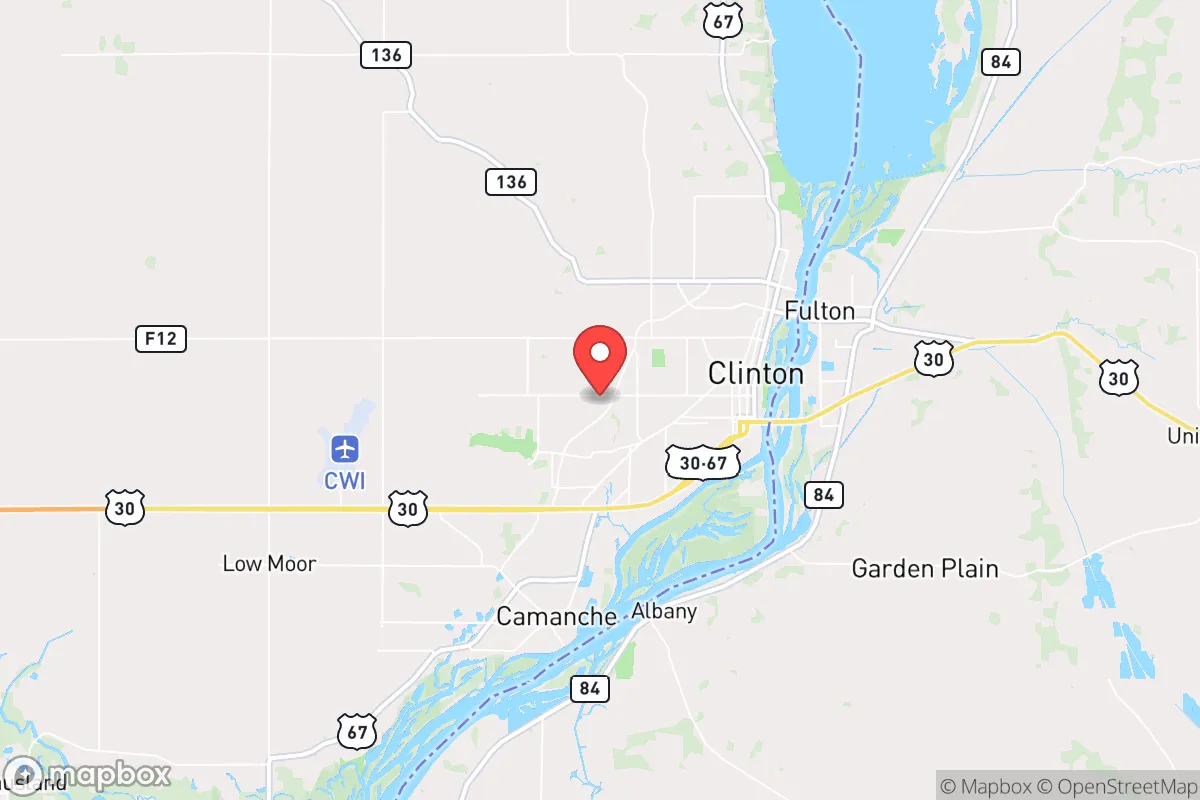
Photo: Wikipedia
Personal Sovereignty in Clinton, IA
Viable for self-reliance. Generally workable, though some barriers may limit total independence.
What does Personal Sovereignty tell us?
Personal Sovereignty measures your capacity for self-reliance and independence with minimal government friction. Higher scores mean fewer barriers between you and the way you want to live... but it assumes you have the space you need and good neighbors.
What does this tell us?
Personal Sovereignty measures your capacity for self-reliance and independence with minimal government friction. Higher scores mean fewer barriers between you and the way you want to live... but it assumes you have the space you need and good neighbors.
State Policy
Energy independence: Importer (50% of energy produced in-state)
Personal Liberty
Homesteading

Personal Liberty Analysis
Clinton, Iowa offers a notably high degree of personal sovereignty compared to many coastal and Midwestern urban centers, largely due to the state’s consistent legislative push to protect individual rights against federal and state-level overreach. For the strategic relocator—whether a single prepper or a family seeking to insulate themselves from top-down control—this small Mississippi River city (population roughly 24,000) sits in a state that has become a deliberate counterweight to progressive governance. The autonomy environment here is defined by a hands-off regulatory culture, strong Second Amendment protections, and a tax structure that leaves more money in your pocket to build your own resilience. While no location is a libertarian utopia, Clinton’s combination of low population density, a declining but still functional industrial base, and Iowa’s conservative legal framework makes it a viable base for those prioritizing self-reliance and minimal government interference in daily life.
Tax burden and regulatory posture: How Iowa’s flat tax and deregulation affect your wallet and plans
Iowa has aggressively shifted toward a low-tax, low-regulation model in recent years, and Clinton residents benefit directly. The state enacted a flat individual income tax rate of 3.8% in 2025, with a scheduled drop to 3.5% by 2026—a sharp contrast to neighboring Illinois’s 4.95% flat rate or Minnesota’s progressive top bracket exceeding 9%. Property taxes in Clinton County are moderate, with effective rates around 1.2% of assessed home value, and the city itself has not imposed any local income tax. For a prepper or homesteader, this means less of your income is siphoned off before you can invest in land, supplies, or alternative energy systems. On the regulatory side, Iowa has rolled back occupational licensing requirements for dozens of trades, making it easier to work independently as a contractor, electrician, or mechanic without navigating bureaucratic red tape. The state also preempts local governments from enacting stricter building codes than the state minimum, which matters if you plan to construct a workshop, root cellar, or off-grid dwelling without endless permit delays. Clinton’s city council has generally followed this pro-business, pro-property-rights posture, though zoning in older neighborhoods can still be restrictive—more on that below.
Self-defense and gun law specifics: Constitutional carry, stand your ground, and what it means for your family
Iowa is one of the strongest Second Amendment states in the Midwest, and Clinton reflects that reality. Since 2021, Iowa has had constitutional carry—no permit required to carry a concealed firearm for any law-abiding adult 21 or older. Open carry is also legal without a permit. The state does not have a “red flag” law, meaning no court can order the temporary seizure of your firearms based on a complaint alone, a critical distinction for those wary of due process erosion. Stand your ground is codified in Iowa law (Iowa Code § 704.1), with no duty to retreat if you are lawfully present and reasonably believe force is necessary to prevent death or great bodily harm. This extends to your home, vehicle, and any place you have a legal right to be. For parents, this means your family’s safety is legally prioritized over the attacker’s rights. Clinton County’s sheriff’s office has a reputation for being pro-2A, and local gun ranges and clubs are active. The only notable restriction: Iowa still requires a permit to purchase a handgun from a private seller (though not from a federal firearms licensee), and the state maintains a background check system for those permits. But compared to Illinois, which requires a Firearm Owner’s ID card and a concealed carry license with a 16-hour training course, or Minnesota’s permit-to-purchase system, Clinton offers a far more straightforward path to armed self-defense. Magazine capacity is unrestricted, and there is no state-level assault weapons ban.
Self-reliance and homesteading viability: Lot sizes, zoning, and off-grid feasibility in Clinton
Clinton’s zoning and land-use policies are generally favorable for those seeking a self-reliant lifestyle, though the city’s older urban core presents some limitations. Inside city limits, standard residential lots range from 6,000 to 10,000 square feet, and many properties already have detached garages or sheds that can be converted into workshops or food storage areas. However, the city’s zoning code restricts keeping livestock (chickens are allowed only in certain districts, and larger animals like goats or pigs are prohibited within city limits). For serious homesteading—think a few acres with a garden, chickens, and possibly a small orchard—you’ll want to look at unincorporated Clinton County or nearby towns like Camanche or Fulton (Illinois side, but with its own tax implications). Outside city limits, lot sizes jump to 1-5 acres commonly, with no zoning restrictions on livestock, outbuildings, or alternative energy systems. Off-grid feasibility is high: Iowa has net metering for solar (though the compensation rate has been reduced in recent years), and there are no state-level bans on rainwater collection. Well water is common in rural areas, and septic systems are permitted with standard county health inspections. The Mississippi River provides a reliable water source for those with the means to treat it, and the surrounding farmland means soil quality is excellent for gardening. The main constraint is winter—Clinton averages 30 inches of snow annually, so any off-grid setup needs robust heating and insulation. Wood stoves are common and legal, and firewood is abundant from local timber.
Personal liberties: Parental rights, medical autonomy, speech, and property protections
Iowa has been a battleground for parental rights, and recent legislation has tilted strongly toward family autonomy. In 2023, the state passed a law requiring schools to obtain parental consent before students can change their name or pronouns, and it banned instruction on gender identity and sexual orientation through grade 6 (the “Parental Rights in Education” law). For parents concerned about government or school overreach into family matters, Clinton’s school district has generally complied with these state mandates, though local board dynamics vary. Medical autonomy is mixed: Iowa does not have a state-level vaccine mandate for adults, and COVID-era restrictions were lifted early compared to neighboring states. However, the state does require certain childhood vaccinations for school attendance (with medical and religious exemptions available). The bigger win for medical freedom advocates is Iowa’s lack of a prescription drug monitoring program that shares data with federal agencies without a warrant, and the state has not adopted any “public health emergency” powers that could shut down businesses or churches unilaterally. On speech and property, Iowa is a right-to-work state (no forced union membership), and it has strong property rights protections under the Iowa Constitution, including a requirement that eminent domain be used only for “public use” (not economic development, as in the Kelo case). Clinton’s local government has not been aggressive with code enforcement or nuisance ordinances, meaning you can generally keep your property as you see fit without harassment. The city’s police department is understaffed, which some see as a downside, but for the prepper mindset, less police presence often means less chance of overreach.
Overall, Clinton, IA offers a sovereignty profile that ranks well above the national average, especially for those coming from high-tax, high-regulation states like California, New York, or Illinois. The combination of constitutional carry, no red flag laws, a flat income tax, strong parental rights, and permissive rural zoning creates an environment where a determined individual or family can build a self-reliant life with minimal government interference. The trade-offs are real: the local economy is stagnant, the population is aging, and the city’s infrastructure (roads, water, schools) shows signs of deferred maintenance. But for the strategic relocator who values personal autonomy over urban amenities, Clinton represents a solid foothold in a state that has deliberately chosen to push back against federal overreach and progressive governance. It’s not a libertarian paradise—no place is—but it’s a place where you can live by your own rules, defend your home, and raise your family without the state constantly looking over your shoulder.

* Values derived from national, state, county, city and local statistics and may differ in a specific area. Last updated: 2026-04-30T00:18:06.000Z
Narrative content on this page is AI-generated and may contain mistakes. Verify any details that matter before acting on them.
ReloMaps may earn a commission from affiliate links at no extra cost to you.

