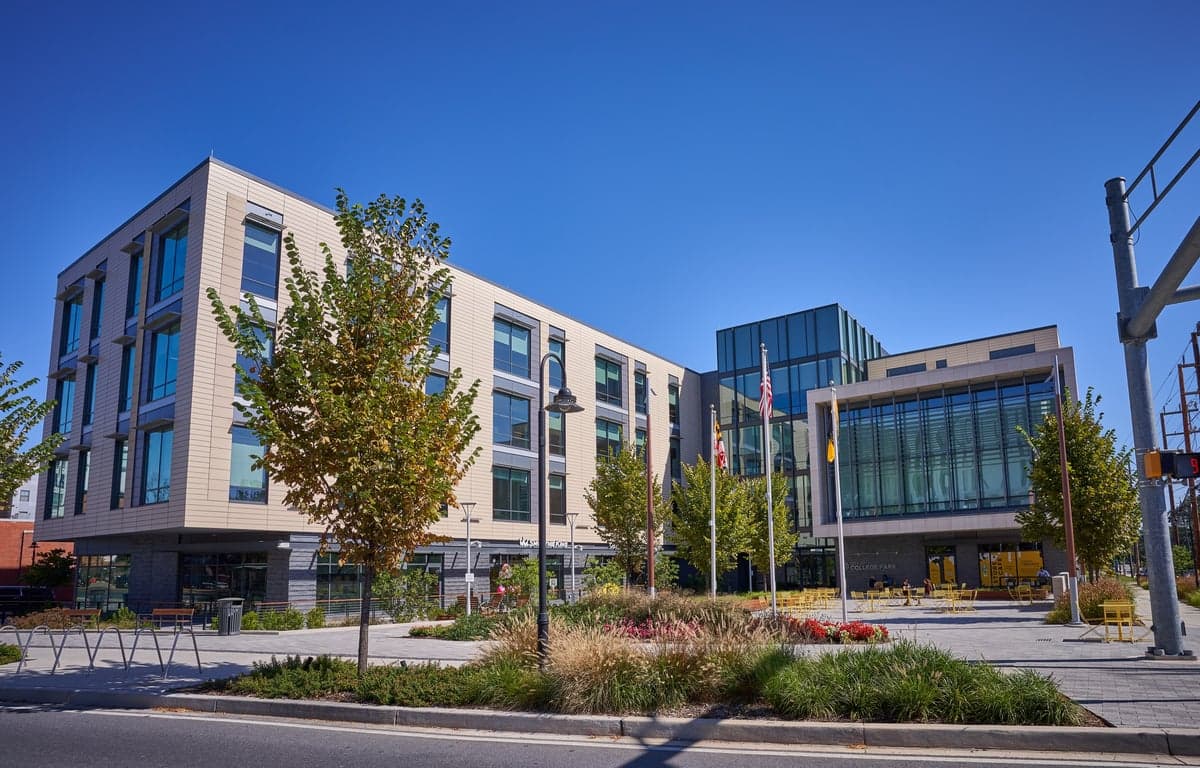
Photo: Wikipedia
Political ClimatePolitical Climate in College Park, MD
District shown is the primary district for this city’s centroid. Cities may span multiple districts.
Local Political AnalysisPolitical Analysis of College Park, MD
College Park, Maryland, is about as deep blue as it gets, with a Cook PVI of D+39, meaning it votes nearly 40 points more Democratic than the national average. That’s not just a lean; it’s a landslide, and it’s been that way for decades, driven by the massive presence of the University of Maryland and the surrounding federal workforce. If you’re looking for a place where local politics feel like a one-party system, this is it, and the trajectory has only gotten more progressive over the last ten years, with fewer and fewer dissenting voices in city council or county government.
How it compares
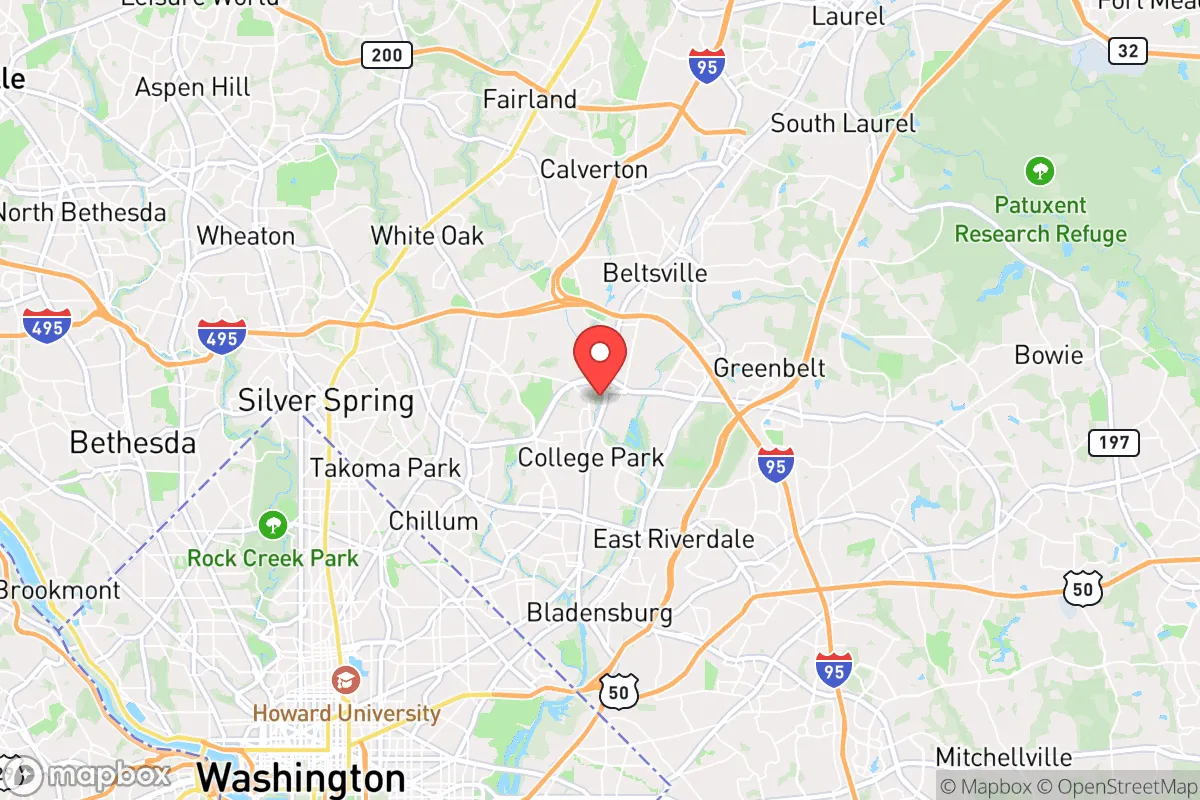
To really understand College Park, you have to look at the towns just a few miles away. Head north to Beltsville or Laurel, and you’ll find a more mixed political scene—still blue, but with a noticeable conservative minority that shows up at town halls and votes in local elections. Drive west to Greenbelt, and it’s even more progressive than College Park, with a long history of cooperative housing and activist politics. The real contrast is south and east, toward Bowie or Upper Marlboro, where you’ll find more moderate Democrats and a handful of Republicans who actually win local races. College Park, though, is insulated by the university bubble—professors, students, and staff who overwhelmingly support progressive policies on taxes, zoning, and public safety. That means the city council rarely faces serious opposition to things like increased spending, new regulations on landlords, or police oversight measures that would be non-starters in more balanced communities.
What this means for residents
For a long-time resident, the biggest concern is how this one-party dominance affects your daily freedoms. Property taxes have crept up steadily, and there’s little pushback because the voting base is young renters who don’t feel the pinch the way homeowners do. You’ve also seen the city get more aggressive with code enforcement—things like noise ordinances, rental inspections, and even restrictions on how you can use your own yard. It’s not that any single policy is outrageous, but the cumulative effect is a government that feels comfortable telling you how to live. The school board and county council are even more progressive, pushing curriculum changes and diversity initiatives that can feel like social engineering rather than education. If you value personal autonomy—whether it’s in how you raise your kids, run your business, or maintain your property—the political climate here can feel suffocating, especially compared to the more hands-off approach you’d find in nearby rural areas like Howard County’s western edge or even parts of Anne Arundel County.
Cultural and policy distinctions
One thing that stands out is the city’s embrace of “sanctuary” policies and its willingness to challenge state and federal authority on immigration enforcement. That might sound noble to some, but it means local police are handcuffed from cooperating with ICE, even when dealing with serious crimes. There’s also a strong push for environmental regulations that go beyond state requirements—things like bans on gas-powered leaf blowers and strict stormwater fees that hit homeowners harder than the university. The culture here is activist-heavy, with neighborhood groups that organize around social justice causes, and the city council often takes cues from them rather than from the broader, more moderate community. If you’re a conservative or even a moderate who just wants to be left alone, you’ll find yourself constantly swimming against the current. The long-term trend is more of the same, with younger, more progressive voters replacing older residents, and the university’s influence only growing. It’s a fine place if you share the prevailing ideology, but if you don’t, you’ll feel like an outsider in your own hometown.

State Political ClimatePolitical Climate in Maryland
State Political AnalysisPolitical Environment in the State
Maryland has long been a deep blue state, with Democrats holding every statewide office and commanding supermajorities in the General Assembly for most of the last two decades. The state’s overall partisan lean is roughly D+14, but that number masks a fierce and growing urban-rural split that has turned the state into a political battleground of geography. Over the past 10-20 years, the Democratic coalition has consolidated power in the Baltimore-Washington corridor, while the rural western and eastern shores have shifted hard right, creating a state where your zip code essentially determines your political reality.
Urban vs. rural divide
The political map of Maryland is a study in extremes. The entire state’s blue hue is driven by the densely populated suburbs of Washington, D.C. — Montgomery County and Prince George’s County alone deliver nearly a third of the state’s Democratic votes. Baltimore City is another Democratic stronghold, though its population decline has slightly reduced its influence. Meanwhile, the state’s rural areas are overwhelmingly Republican. Garrett County in the far west voted 72% for Trump in 2020, and Allegany County (home to Cumberland) is similarly red. The Eastern Shore, including Worcester County (Ocean City) and Queen Anne’s County, is reliably conservative. The real flashpoints are the exurban “collar counties” like Frederick County and Harford County, which have trended redder as they absorb conservative-leaning families fleeing the high taxes and progressive policies of the inner suburbs. Frederick itself is a purple city, but the county as a whole is now solidly Republican-leaning. Anne Arundel County (Annapolis) is a classic swing county, often deciding statewide races.
Policy environment
Maryland’s policy environment is aggressively progressive, and it shows in the tax code. The state has a progressive income tax that tops out at 5.75%, but when you add county-level “piggyback” taxes, effective rates can exceed 9% in high-tax jurisdictions like Montgomery County. Property taxes are also high, especially in the D.C. suburbs. The regulatory posture is business-unfriendly, with strict environmental regulations, a high minimum wage ($15.00 as of 2024, indexed to inflation), and a paid family leave program that adds a new payroll tax. Education policy is dominated by the Blueprint for Maryland’s Future, a massive funding plan that pours billions into public schools but has been criticized for lacking accountability and for pushing progressive curricula. On healthcare, Maryland operates an all-payer rate-setting system for hospitals, which keeps costs relatively stable but limits choice. Election laws are among the most liberal in the nation: no-excuse mail-in voting, same-day registration, and automatic voter registration are all in place. For a conservative, the policy environment feels like a one-party state where the legislature routinely overrides local control, especially on issues like zoning, gun laws, and education.
Trajectory & freedom
Maryland is becoming less free by almost any measure, and the trend is accelerating. The most glaring example is gun rights. In 2023, the General Assembly passed the Gun Safety Act of 2023, which bans the carry of firearms in a long list of “sensitive places” — including any location where alcohol is sold, parks, and public transportation — effectively gutting the spirit of the Bruen decision. The state also passed a ban on “ghost guns” and raised the purchasing age for rifles to 21. On parental rights, Maryland has moved in the opposite direction of states like Florida. The Transgender Health Equity Act (2023) prohibits the state from denying gender-affirming care to minors, overriding parental consent concerns. The Freedom to Read Act (2024) prevents school libraries from removing books based on viewpoint, which has been used to keep sexually explicit materials in schools. On medical freedom, Maryland was one of the first states to mandate COVID-19 vaccines for healthcare workers and school staff, and it maintains one of the strictest vaccine mandates for schoolchildren in the country. Property rights are under constant assault from the state’s aggressive Smart Growth policies, which force high-density development and limit rural landowners’ ability to build. The trajectory is clear: more mandates, more taxes, and less local control.
Civil unrest & political movements
Maryland has a history of civil unrest, most notably the 2015 Baltimore riots following the death of Freddie Gray, which led to a state of emergency and National Guard deployment. Since then, the Black Lives Matter movement has remained active, particularly in Baltimore and Prince George’s County. On the right, the Maryland Shall Issue gun rights group is highly organized and has successfully challenged several gun laws in court. The Maryland Farm Bureau and local Parents’ Rights in Education groups have become more vocal, especially in rural counties like Carroll County and Washington County. Immigration politics are a flashpoint: Maryland is a sanctuary state, with a 2023 law prohibiting local law enforcement from cooperating with ICE detainers. This has led to tensions in border counties like Cecil County, where residents feel the state’s policies are forcing them to absorb illegal immigration. Election integrity remains a concern for conservatives, given the state’s widespread mail-in voting system and the fact that the state board of elections is controlled by Democrats. There have been no major fraud scandals, but the lack of voter ID laws and the ease of ballot harvesting have eroded trust. A new resident would notice the stark contrast between the progressive activism in the D.C. suburbs and the quiet, traditional conservatism of the Eastern Shore and western Maryland.
Projection
Over the next 5-10 years, Maryland is likely to become more Democratic and more progressive. Demographic trends are working against conservatives: the state’s growth is concentrated in the D.C. suburbs, which are becoming denser and more liberal, while rural counties are losing population. The in-migration from other blue states (New York, California) is accelerating this shift. The Republican Party in Maryland is increasingly confined to the rural fringe and has little hope of winning statewide office without a major national realignment. The state’s tax burden and regulatory climate will continue to drive out middle-class families and small businesses, but the influx of high-income federal contractors and remote workers will keep the tax base afloat. The most likely scenario is that Maryland becomes a laboratory for progressive policies — universal healthcare, rent control, wealth taxes — that will be watched by other blue states. For a conservative moving in now, the expectation should be that the political environment will become less hospitable over time, with more restrictions on gun rights, higher taxes, and less parental control over education.
Bottom line for a new resident: If you are a conservative considering Maryland, you need to be strategic. The rural counties — Garrett, Allegany, Carroll, and the Eastern Shore — offer a more traditional lifestyle and lower taxes, but you will still be subject to state-level policies you likely oppose. The D.C. suburbs are a non-starter for most conservatives. The best bet is an exurban county like Frederick or Harford, where you can find a community of like-minded people and a decent quality of life, but you will be fighting an uphill battle against a state government that is increasingly hostile to your values. If you value personal freedom, low taxes, and local control, Maryland is not the place for you — unless you are ready to be a political minority and fight for every inch of ground.
* Values derived from national, state, county, city and local statistics and may differ in a specific area. Last updated: 2026-04-22T03:18:32.000Z
Narrative content on this page is AI-generated and may contain mistakes. Verify any details that matter before acting on them.
ReloMaps may earn a commission from affiliate links at no extra cost to you.

