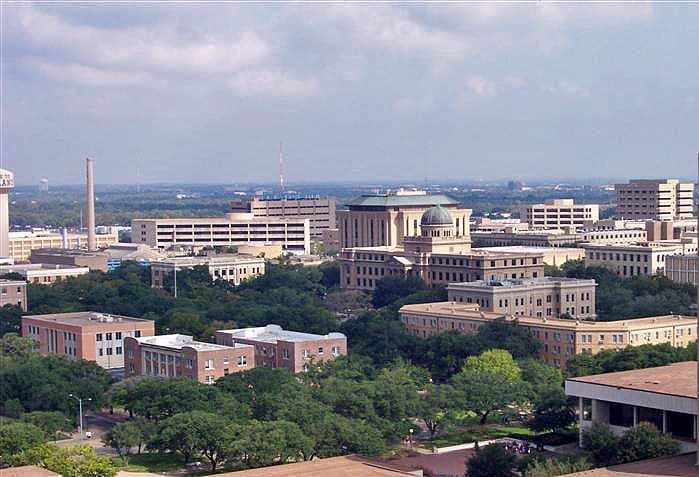
Photo: Wikipedia
Strategic Assessment of College Station, TX
Meaningful friction. Expect exposure to either population pressure, blast zones, or natural disaster risk. Consider buying a retreat property.
What does the Strategic Assessment tell us?
Our Strategic Assessment grades tactical survivability of an area. Major population centers, military targets, fallout zones, natural disasters, and border exposure all drive risk — lower exposure means a more defensible position in a crisis.
This is heavily inspired by Joel Skousen's Strategic Relocation book. Highly recommended you checkout the book ($)What does this tell us?
Our Strategic Assessment grades tactical survivability of an area. Major population centers, military targets, fallout zones, natural disasters, and border exposure all drive risk — lower exposure means a more defensible position in a crisis.
This is heavily inspired by Joel Skousen's Strategic Relocation book. Highly recommended you checkout the book ($)Strategic Pillars

Key Distances
Regional Safe Places
Below is our recommended "safe zones" in Texas and the surrounding area based on our strategic heuristics. For most people, it's unrealistic to live in a “safe zone” full-time due to work, family or other personal reasons. They tend to be more rural. However, many of these areas are perfect for second homes and retreat properties that double as a vacation home or even a short-term rental.

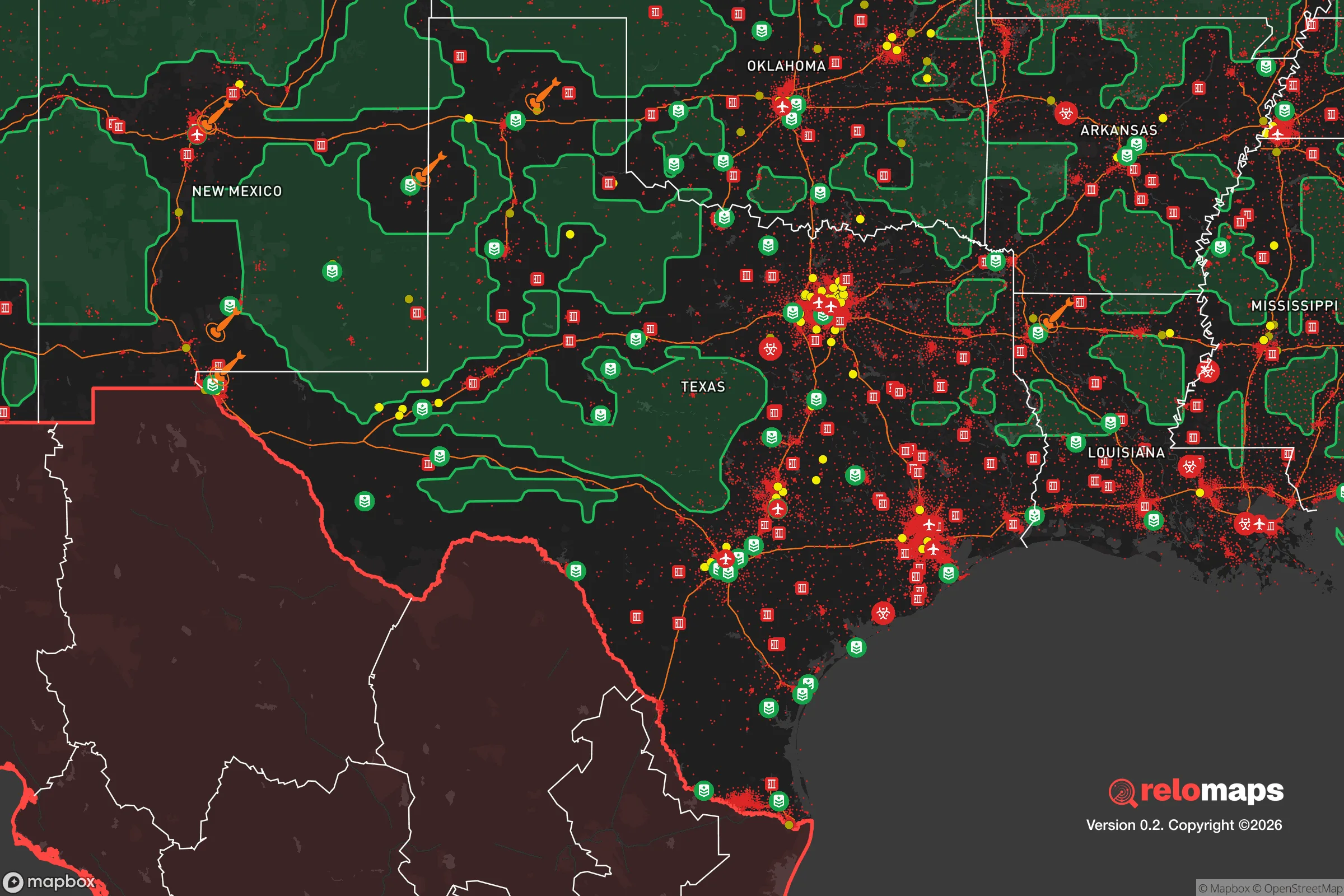


Important Note: For informational purposes only. This does not mean nothing bad ever happens in the green zones. Please use common sense. This is based on public data and modeled with AI. We tried to take a conservative approach but mistakes happen. We update this regularly as new information becomes available.
Solar Generator Recommendations
Backup power matters more here than in safer locations. We've picked three solar generators across budgets and capacity tiers — start with the budget unit if you only need a few essentials, or step up if you want to run a fridge and HVAC for days at a time.

Jackery Portable Power Station Explorer 300
Budget OptionPower on the Go: Weighing only 11 lbs, it's convenient to set up and store with book-sized foldable solar panels

BLUETTI Portable Power Station AC180
Designed for both indoor and outdoor scenarios, AC180 is highly capable as it has a robost capacity and continuous output power.

EF ECOFLOW DELTA Pro Ultra Power Station
Upgraded PickEcoFlow DELTA Pro Ultra is a whole-home energy system designed to grow with your family. Integrated with the Smart Home Panel 2, it scales to meet your evolving energy needs — keeping your home powered, intelligent, and secure through every stage of life.
We earn a commission, at no additional cost to you.
Strategic Assessment Analysis
College Station, Texas, offers a surprisingly resilient relocation option for those prioritizing strategic depth and long-term preparedness, provided you understand its specific trade-offs. Its inland location, robust local economy anchored by Texas A&M University, and distance from coastal hurricane zones give it a solid baseline, but its proximity to major petrochemical infrastructure and a growing population corridor demands a clear-eyed assessment. For the conservative prepper or survivalist, this is not a bug-out paradise but a viable, defensible hub for rebuilding community and maintaining a normal life while staying ready for disruption.
Geographic position and natural advantages for long-term stability
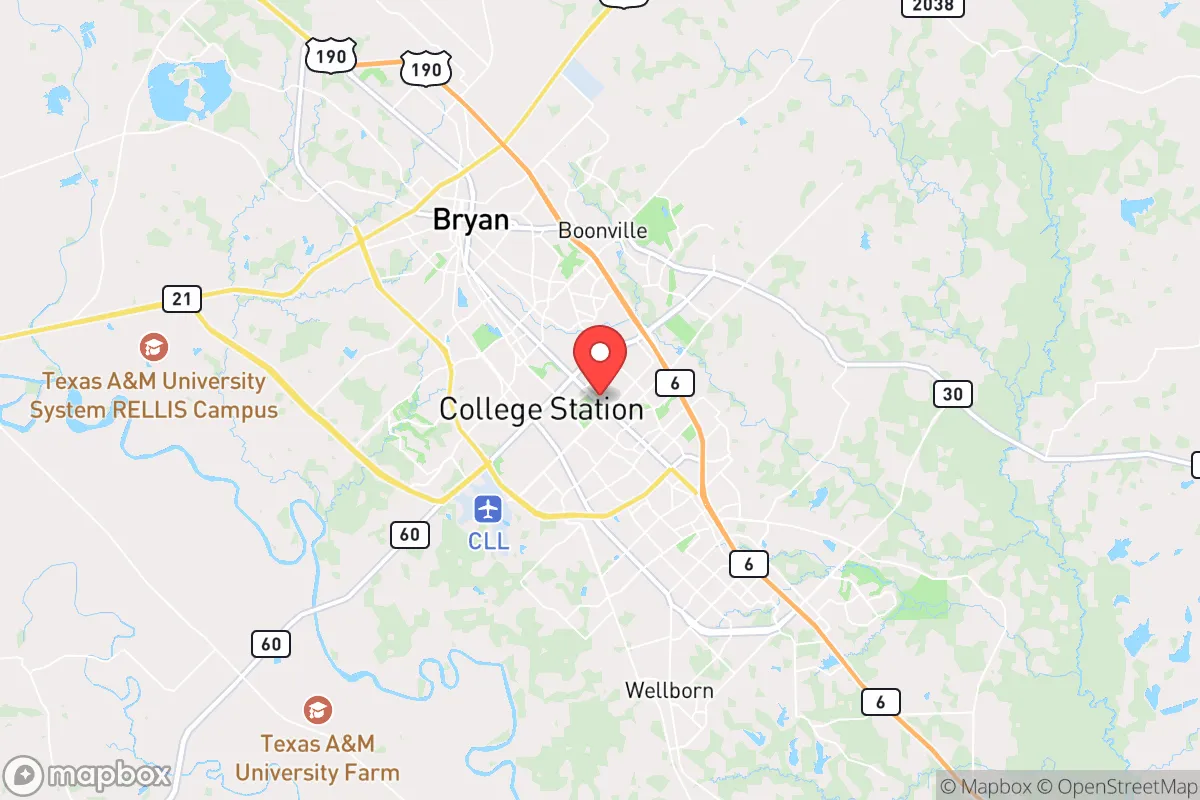
College Station sits in the Brazos Valley, roughly 90 miles northwest of Houston and 100 miles east of Austin, placing it in a sweet spot: close enough to access major medical and supply chains, yet far enough to avoid the immediate fallout of a coastal hurricane or a major urban collapse. The area’s elevation is modest—around 300 feet—but it lacks the floodplain risks of Houston, with the Brazos River providing a reliable water source rather than a constant threat. The local climate is humid subtropical, with hot summers and mild winters, which supports year-round gardening and livestock grazing. The surrounding farmland is fertile, and the region’s aquifer systems, including the Carrizo-Wilcox and Gulf Coast aquifers, offer groundwater potential for those who drill private wells. For a relocator, this means you can realistically establish a semi-self-sufficient homestead within a 30-minute drive of town, leveraging the area’s agricultural heritage and relatively low land prices compared to the Texas Hill Country or Dallas suburbs.
Risks, exposures, and proximity to fallout-relevant landmarks
The most significant strategic liability is College Station’s proximity to the Houston Ship Channel and the Texas Gulf Coast’s petrochemical complex, which includes refineries, chemical plants, and LNG terminals. A major industrial accident, terrorist attack, or wartime strike on these facilities could produce toxic plumes or secondary economic shocks that ripple inland. The city itself is not a primary target, but it lies within the fallout zone of a worst-case scenario at the nearby Bryan-College Station industrial parks, which host ammonia and fertilizer storage. Additionally, the area is crisscrossed by major rail lines and highways (notably Highway 6 and Highway 21) that could become chokepoints during an evacuation or civil unrest. The presence of Texas A&M—a massive institution with its own police force, emergency management resources, and a student population of 70,000—is a double-edged sword: it provides a centralized command structure and medical facilities, but also a dense, potentially chaotic population center during a crisis. For the prepper, the key is to locate outside the immediate blast radius of industrial sites and avoid being trapped in the university’s traffic grid.
Practical resilience for a relocator: food, water, energy, and defensibility
On the ground, College Station offers strong practical resilience if you plan ahead. The local food system is robust: the Brazos Valley is a major agricultural producer, with cattle, poultry, and row crops like corn and cotton. Farmers’ markets and local co-ops are common, and the area’s hunting opportunities (deer, feral hogs, turkey) are excellent within a short drive. Water is the region’s strongest asset—the Brazos River and Lake Somerville (30 minutes east) provide surface water, and private well drilling is feasible in most rural parcels, though you’ll need to budget for a deep well (200-400 feet) and a solar or generator-powered pump. Energy reliability is average: the Texas grid (ERCOT) is prone to winter storms and summer peak demand failures, but College Station’s municipal utility, College Station Utilities, has a better track record than many. Solar is viable year-round, and many rural properties already have propane tanks for backup. Defensibility is moderate: the terrain is flat to gently rolling, with scattered oak and pine woodlots, which limits natural cover but also offers clear sightlines. A rural property with a long driveway, a perimeter fence, and a good well can be made secure with modest investment. The local culture is heavily conservative, with a strong gun culture and a “neighbor-help-neighbor” ethos, which is a significant social resilience factor. The biggest practical weakness is the lack of a major military base nearby (Fort Hood is 90 miles north) and the area’s reliance on a single major highway (Highway 6) for evacuation, which could become a parking lot during a mass event.
Overall strategic picture for the conservative relocator
College Station is not a remote survivalist retreat—it’s a functioning small city with a college-town vibe, good schools, and a growing population. For the conservative individual or family looking to relocate with a prepper mindset, it offers a rare combination: a stable, low-crime community with a strong local economy, access to fertile land and water, and a culture that values self-reliance and firearms ownership. The risks are real but manageable: avoid living within five miles of the industrial parks or the university’s main campus, secure your own water and energy, and build relationships with like-minded neighbors in the rural outskirts (especially toward Snook, Kurten, or Millican). The area’s proximity to Houston and Austin is a vulnerability, but also a resource—you can stock up on supplies, access specialized medical care, and maintain a low profile while staying connected to the broader economy. If you’re looking for a place to ride out a decade of instability without abandoning modern life, College Station is a solid strategic bet. Just don’t expect to disappear into the woods—this is about building a resilient community, not hiding from the world.

* Values derived from national, state, county, city and local statistics and may differ in a specific area. Last updated: 2026-04-21T12:55:54.000Z
Narrative content on this page is AI-generated and may contain mistakes. Verify any details that matter before acting on them.
ReloMaps may earn a commission from affiliate links at no extra cost to you.

