Photo: Wikipedia
Demographics of Columbus, MT
Affluence Level in Columbus, MT
A middle-class area roughly in line with national averages across income, home values, education, and employment.
People of Columbus, MT
The people of Columbus, Montana, today form a small, predominantly white community of 1,925 residents, characterized by a strong rural identity and a low density of just over 1,000 people per square mile. Distinctive markers include a very low foreign-born population (0.4%), a modest Hispanic minority (3.5%), and a small East/Southeast Asian presence (1.1%), with no Black or Indian subcontinent residents recorded. The population is notably less college-educated than the national average (20.6%), reflecting a workforce historically tied to agriculture, railroads, and local services rather than a knowledge economy.
How the city was settled and grew
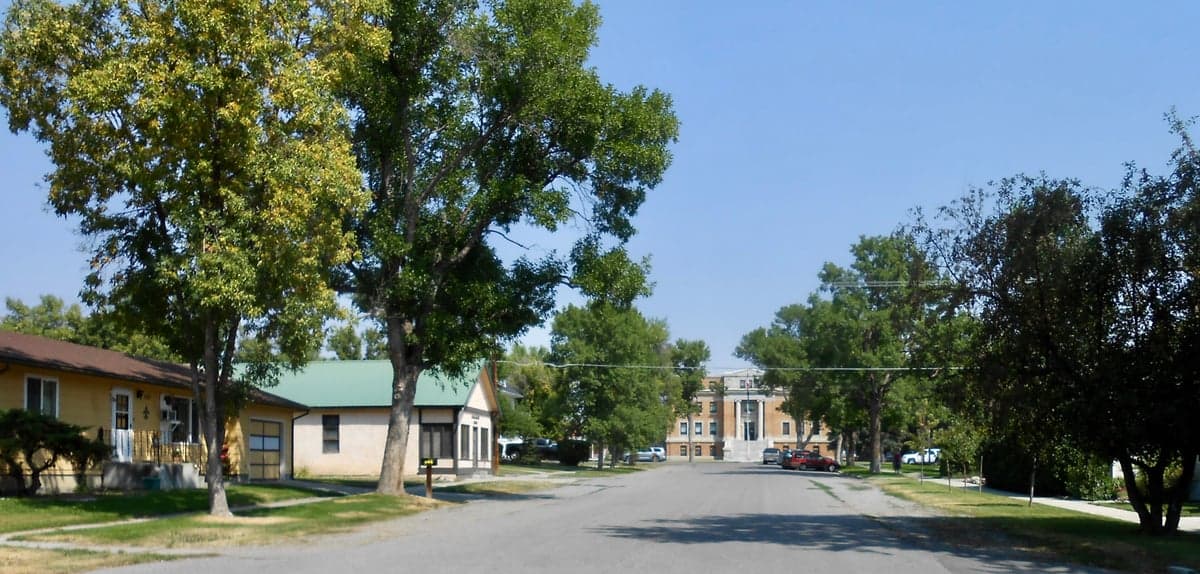
Columbus was founded in the 1880s as a railroad town on the Yellowstone River, serving as a supply hub for nearby mining camps and cattle ranches. The original population was overwhelmingly of Northern European stock—primarily German, Irish, and Scandinavian homesteaders drawn by the 1862 Homestead Act and later the arrival of the Northern Pacific Railway. These early settlers built the Downtown Historic District along Pike Avenue, where wood-frame storefronts and the Stillwater County Courthouse still anchor the town center. A second wave arrived in the early 1900s, when coal mining in the nearby Bull Mountains attracted a small number of Italian and Eastern European laborers, who settled in what is now the South Side neighborhood near the railroad tracks. By 1950, Columbus was a stable, almost entirely white community of about 1,200 people, with its economy split between ranching, railroad maintenance, and the county government seat.
Modern era (post-1965)
After the 1965 Immigration Act, Columbus saw virtually no new foreign-born influx—the foreign-born share today is just 0.4%, one of the lowest in Montana. Instead, the modern era has been defined by domestic in-migration from other parts of the state and the rural Midwest. The West End subdivision, developed in the 1970s and 1980s, absorbed most of these new arrivals—families seeking affordable land and a slower pace of life. The Hispanic population, now 3.5%, grew slowly through the 1990s and 2000s, largely from Mexican-American families moving from larger Montana cities like Billings (40 miles west) for agricultural work; they are concentrated in the River Road area along the Yellowstone. The East/Southeast Asian community (1.1%) is very small and likely tied to the local hospital or the Stillwater Mine, with no distinct ethnic enclave. The Black and Indian subcontinent populations remain at zero, reflecting the area's lack of economic pull for those groups. The North Park neighborhood, built around the golf course in the 1990s, attracted a mix of retirees and commuters to Billings, but the overall population has barely grown—from 1,900 in 2000 to 1,925 today.
The future
Columbus is likely to remain a homogenizing, slowly shrinking community over the next 10–20 years. The foreign-born share is so low that any significant growth would require a major economic shift—such as a new mine or a large employer—which is not on the horizon. The Hispanic population may grow modestly as agricultural families expand, but it will remain a small minority. The East/Southeast Asian population is too tiny to form a community and will likely plateau. The East Side neighborhood, near the high school, is seeing some new single-family construction, but it attracts the same demographic profile: white, native-born families from within Montana. Without a college or a major industry, Columbus lacks the magnets that draw diverse populations. The city is not tribalizing into distinct enclaves; rather, it is becoming more uniformly white and older, with a median age likely rising above the current 43.
For someone moving in now, Columbus offers a stable, culturally homogeneous small town where nearly everyone is native-born and English-speaking. The lack of diversity is a feature for those seeking a traditional rural Montana lifestyle, but it also means limited exposure to different perspectives and a workforce that may struggle to attract outside talent. The population trajectory points toward slow decline unless a new economic driver emerges—something to watch for in the next decade.

* Values derived from national, state, county, city and local statistics and may differ in a specific area. Last updated: 2026-04-29T21:22:13.000Z
Narrative content on this page is AI-generated and may contain mistakes. Verify any details that matter before acting on them.
ReloMaps may earn a commission from affiliate links at no extra cost to you.

