Photo: Wikipedia
Personal Sovereignty in Columbus, MT
Viable for self-reliance. Generally workable, though some barriers may limit total independence.
What does Personal Sovereignty tell us?
Personal Sovereignty measures your capacity for self-reliance and independence with minimal government friction. Higher scores mean fewer barriers between you and the way you want to live... but it assumes you have the space you need and good neighbors.
What does this tell us?
Personal Sovereignty measures your capacity for self-reliance and independence with minimal government friction. Higher scores mean fewer barriers between you and the way you want to live... but it assumes you have the space you need and good neighbors.
State Policy
Energy independence: Net exporter (120% of energy produced in-state)
Personal Liberty
Homesteading

Personal Liberty Analysis
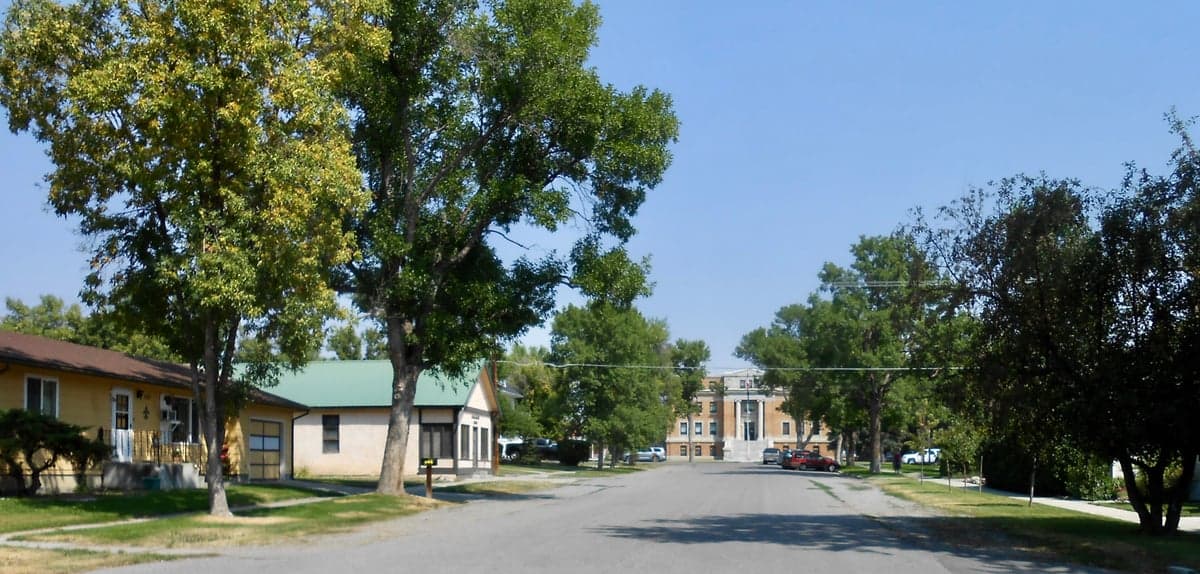
Columbus, Montana offers a level of personal sovereignty that stands out in the modern American landscape, largely because Montana itself has long resisted federal overreach and maintained a culture of self-reliance. For those looking to escape the tightening grip of coastal or urban governance, this small town in Stillwater County provides a tangible alternative where individual rights are not just theoretical but embedded in daily life. The state’s constitutional protections, low population density, and distance from major regulatory hubs create an environment where you can live largely on your own terms—provided you’re willing to shoulder the responsibilities that come with that freedom. For the survivalist or prepper, Columbus isn’t a compromise; it’s a strategic foothold in a region that still respects the line between government and citizen.
Tax burden and regulatory posture: How Montana compares to high-tax states
Montana’s tax structure is a clear advantage for anyone prioritizing financial sovereignty. There is no state sales tax, which means every dollar you earn or spend stays in your pocket—no hidden consumption taxes on gear, supplies, or land purchases. The state income tax is a flat 6.75% as of 2026, which is moderate but predictable, and property taxes in Stillwater County are among the lowest in the state, averaging around 0.7% of assessed value. For context, that’s roughly half the effective rate you’d see in states like Texas or New York. The regulatory posture here is equally favorable: Montana has no universal background check law for private firearm sales, no red flag law, and no state-level occupational licensing requirements that would hinder starting a small homesteading operation or repair business. The state legislature has consistently pushed back against federal mandates, including refusing to enforce certain EPA overreach on private land. For the prepper, this means fewer bureaucratic hurdles when building a root cellar, drilling a well, or storing fuel—activities that in other states would trigger endless permits and inspections. Columbus itself is small enough that county commissioners are accessible, and zoning is minimal outside the town limits, giving you room to operate without constant government oversight.
Self-defense and gun law specifics: What the Second Sanctuary means for residents
Montana is a constitutional carry state, meaning no permit is required to carry a concealed firearm for anyone legally allowed to possess one. Columbus sits in Stillwater County, which has formally declared itself a Second Amendment Sanctuary—a symbolic but meaningful stance that signals local law enforcement will not cooperate with federal gun control measures they deem unconstitutional. This is not just rhetoric; in practice, it means you can buy, sell, and transfer firearms privately without a background check, and there are no state-level magazine capacity bans or assault weapon restrictions. The state also has strong castle doctrine and stand-your-ground laws, so if you’re forced to defend your home or person, the legal system is on your side. For the survivalist, this legal framework is critical: you can stockpile ammunition, build a secure armory, and train without fear of sudden regulatory changes. The nearest major city, Billings, is about 45 minutes east, but its gun laws mirror the state’s permissive approach, so even urban trips don’t require legal gymnastics. The only caveat is that federal law still applies on federal lands—like the nearby Custer Gallatin National Forest—so carrying in those areas requires attention to specific regulations, but that’s a minor constraint in an otherwise free environment.
Self-reliance and homesteading viability: Lot sizes, zoning, and off-grid feasibility
If your goal is to become as self-sufficient as possible, Columbus offers realistic options that many parts of the country have zoned out of existence. Within the town limits, residential lots typically range from a quarter-acre to half-acre, which is enough for a substantial garden, a few chickens, and a small workshop. But the real opportunity lies just outside town, where you can find parcels of 5 to 40 acres for under $5,000 per acre—prices that would be unthinkable in the Front Range or Pacific Northwest. Stillwater County’s zoning is minimal: there are no county-wide building codes for rural properties, no restrictions on rainwater collection, and no prohibitions on composting toilets or solar panels. Off-grid living is entirely feasible, as the area gets over 200 sunny days per year, and groundwater is accessible via well drilling at depths of 100 to 300 feet. The county does require a septic system permit, but that’s a one-time cost, not an ongoing regulatory burden. For the prepper, this means you can build a remote cabin, set up a solar array, and store months of supplies without a zoning board breathing down your neck. The local climate—cold winters, hot summers—requires serious planning for heating and water storage, but that’s a challenge of self-reliance, not government interference. The nearest off-grid community is about 20 miles south, near the Beartooth Mountains, where several families have been living without grid connections for decades.
Personal liberties: Parental rights, medical autonomy, speech, and property
Montana has some of the strongest parental rights protections in the country, with a state law that explicitly affirms parents’ authority to direct their children’s education, healthcare, and religious upbringing. This means no mandatory vaccine requirements for school attendance, no state-mandated curriculum that undermines parental values, and a robust homeschool and private school system. Columbus has a small public school district, but many families opt for homeschooling or the nearby Christian academy in Absarokee. Medical autonomy is also respected: Montana does not have a state-level vaccine passport system, and there are no mandates for medical treatments that violate personal conscience. The state’s constitution includes a strong right to privacy, which courts have interpreted to protect medical decisions from government intrusion. On the speech front, Montana has no hate speech laws that would criminalize political or religious expression, and the state’s public forums—including county commission meetings—are genuinely open to citizen input. Property rights are protected by a state law that requires compensation for any regulatory taking, meaning the government can’t devalue your land through zoning changes without paying you. For the survivalist, this legal environment means you can stockpile supplies, discuss preparedness openly, and refuse medical interventions without fear of losing custody of your children or facing legal penalties. The only real tension comes from federal land management, as the nearby national forests are subject to changing federal rules, but that’s a national issue, not a local one.
In the broader context of American sovereignty, Columbus, MT ranks among the top small towns for those seeking to minimize government overreach while maintaining access to modern infrastructure. Compared to states like Colorado, Oregon, or New York, where personal freedoms are increasingly constrained by state-level mandates, Montana offers a genuine alternative—one where the default assumption is that you can do what you want with your property, your body, and your family, unless there’s a compelling reason otherwise. The trade-off is that you’re responsible for your own security, utilities, and emergency preparedness, but for the prepper or survivalist, that’s not a trade-off—it’s the whole point. Columbus gives you the legal and physical space to live that way, without the constant friction of a state that sees you as a subject rather than a citizen.

* Values derived from national, state, county, city and local statistics and may differ in a specific area. Last updated: 2026-04-29T21:22:13.000Z
Narrative content on this page is AI-generated and may contain mistakes. Verify any details that matter before acting on them.
ReloMaps may earn a commission from affiliate links at no extra cost to you.

