Photo: Wikipedia
Political ClimatePolitical Climate in Columbus, NE
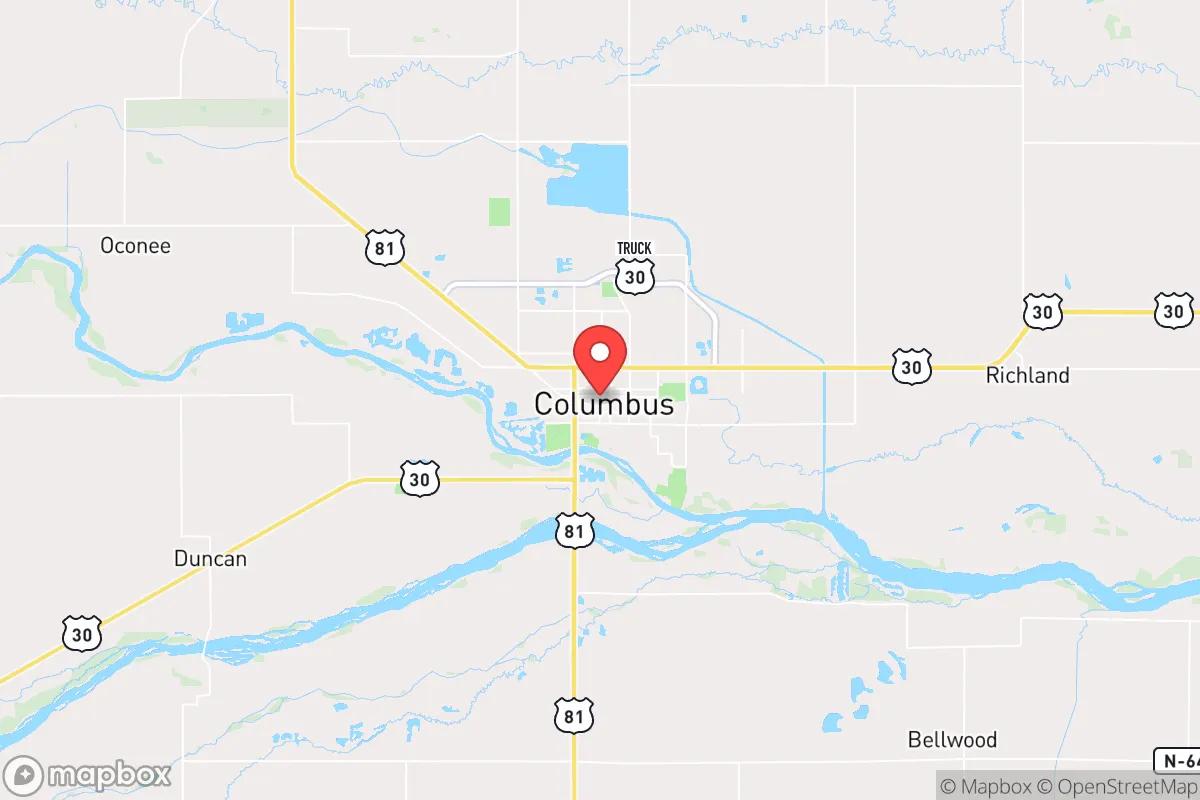
District shown is the primary district for this city’s centroid. Cities may span multiple districts.
Local Political AnalysisPolitical Analysis of Columbus, NE
Columbus, Nebraska, has long been a solidly conservative community, and that hasn’t changed much even as the rest of the country has gotten more divided. The Cook PVI rating of R+6 tells you the basics—this district leans Republican by a comfortable margin—but it doesn’t capture the local feel. Walk into any coffee shop or hardware store on a Saturday morning, and you’ll hear folks talking about the same things: keeping taxes low, protecting the Second Amendment, and wanting the government to stay out of their lives. That’s been the backbone here for decades, and while you’ll see a few more Harris signs than you did a decade ago, the overall trajectory is still firmly red. The worry among long-time residents is that the progressive wave washing over bigger cities like Omaha or Lincoln might start creeping west along Highway 30, but so far, Columbus has held the line pretty well.
How it compares
Compared to the rest of Nebraska, Columbus sits right in the middle of the state’s conservative heartland. Drive 40 miles west to Grand Island, and you’ll find a similar political vibe—maybe a touch more moderate on economic issues, but still reliably Republican. Head east toward Omaha or Lincoln, though, and the difference is night and day. Those cities have shifted noticeably left in recent years, with Omaha’s Douglas County going blue in presidential races and Lincoln’s Lancaster County trending that way too. Columbus, by contrast, feels like a time capsule of the Nebraska most people remember: steady, practical, and skeptical of big government solutions. The surrounding Platte County has voted Republican by double digits in every recent election, and local school board and city council races tend to reflect that same common-sense, limited-government approach. It’s not a place where you see a lot of political theater—just a quiet, consistent preference for personal responsibility over government overreach.
What this means for residents
For folks living here, the conservative lean means a few tangible things in daily life. Property taxes are a constant topic of conversation, but they’re still lower than what you’d pay in most of eastern Nebraska, and there’s a strong local push to keep them that way. Gun rights are respected without much fuss—you won’t find the kind of restrictive ordinances you see in bigger cities. And when it comes to schools, the local board has generally resisted the more progressive curriculum trends that have stirred up controversy elsewhere. That said, there’s a growing unease about state-level mandates and federal overreach, especially around environmental regulations that could affect local agriculture and manufacturing. The vibe is basically: we know what works for us, and we’d rather not have outsiders telling us how to run our town. If you’re someone who values that kind of independence, Columbus feels like a safe bet. If you’re hoping for a more progressive shift, you’ll probably find the pace frustratingly slow—and that’s exactly how most residents want it.
One cultural distinction worth noting: Columbus has a strong blue-collar, family-first identity that’s rooted in its manufacturing base—plants like Vishay and BD are major employers—and that keeps the political conversation grounded in practical concerns like job stability and energy costs rather than abstract ideological debates. You don’t hear much about defunding the police or critical race theory here; instead, the talk is about road repairs, school funding, and keeping the local economy humming. There’s a quiet pride in being a place that hasn’t changed much politically, even as the country around it has. The biggest concern I hear from neighbors is that the next generation might get pulled into the progressive orbit through social media and college influences, but for now, Columbus remains a place where conservative values aren’t just tolerated—they’re the norm. If that ever starts to shift, you’ll know it, because the conversations at the feed store will get a whole lot louder.

State Political ClimatePolitical Climate in Nebraska
State Political AnalysisPolitical Environment in the State
Nebraska is a reliably conservative state, but it’s not the deep-red monolith outsiders often assume. The state has voted Republican in every presidential election since 1968, and in 2024, Donald Trump carried it by roughly 19 points. However, Nebraska is unique in that it splits its electoral votes by congressional district, and the 2nd District (Omaha metro) has flipped blue in three of the last four cycles. Over the past 20 years, the state has shifted rightward in its rural and exurban areas while the urban core of Omaha has become more Democratic, creating a sharper urban-rural divide than a generation ago.
Urban vs. rural divide
The political map of Nebraska is a textbook study in geographic polarization. The eastern third of the state, anchored by Omaha (Douglas County) and Lincoln (Lancaster County), contains the vast majority of the state’s population and is where the Democratic vote is concentrated. Douglas County has trended blue in presidential races, going for Biden in 2020 by about 10 points. Lincoln, home to the University of Nebraska, is more purple but has leaned Democratic in recent cycles. The rest of the state is overwhelmingly Republican. Scottsbluff in the Panhandle, Grand Island in the central Platte Valley, and Norfolk in the northeast all vote reliably red, often by 30-40 point margins. The rural counties along the Kansas border, like Furnas and Harlan, routinely give Republicans 80%+ of the vote. The divide isn’t just about population density—it’s cultural. Omaha’s suburbs, like Papillion and La Vista, are still conservative but have moderated on social issues, while the small towns and farm communities remain rock-ribbed traditionalist.
Policy environment
Nebraska’s policy environment is broadly conservative, but with some notable wrinkles. The state has a unicameral, nonpartisan legislature—the only one in the country—which tends to produce more pragmatic, less ideological outcomes than you’d see in a partisan body. Taxes are relatively low: no state income tax on Social Security benefits, a flat state income tax rate of 5.84% (with a scheduled reduction to 5.5% by 2027), and property taxes that are high by national standards but lower than neighboring Kansas or Iowa. The state has a right-to-work law, and its regulatory posture is business-friendly, especially for agriculture and manufacturing. On education, Nebraska has a robust school choice movement: the state passed a tax-credit scholarship program for private school tuition in 2023, though it faced a referendum challenge. Healthcare policy is mixed—the state expanded Medicaid under the Affordable Care Act in 2020 via a ballot initiative, but it also passed a 12-week abortion ban in 2023 with exceptions for rape, incest, and medical emergencies. Election laws are moderately restrictive: voter ID is required, and same-day registration is not allowed, but early voting and mail-in voting are available without an excuse.
Trajectory & freedom
Nebraska has been moving in a more conservative direction on several fronts, particularly on gun rights and parental rights. In 2023, the legislature passed a permitless concealed carry law (LB 77), allowing any law-abiding adult to carry a concealed firearm without a permit. That same year, the state enacted a ban on gender-affirming care for minors (LB 574), overriding a filibuster from Omaha-area Democrats. Parental rights in education have been strengthened: a 2023 law (LB 705) requires schools to notify parents of any changes to a student’s health or well-being, effectively blocking “don’t say gay” style policies from being hidden. On the other hand, the state’s medical autonomy record is mixed—the 12-week abortion ban was a compromise that angered both pro-life activists who wanted a total ban and pro-choice advocates who wanted no restrictions. Property rights are generally strong, with no statewide rent control and minimal zoning restrictions outside of Omaha and Lincoln. Taxation is trending downward, with the flat income tax reduction scheduled through 2027. Overall, Nebraska is becoming more free in the sense of limiting government overreach on guns, education, and taxes, but less free on medical choices and some social issues.
Civil unrest & political movements
Nebraska has not seen the kind of large-scale civil unrest common in coastal states, but there have been flashpoints. In 2020, Omaha experienced several nights of protests following George Floyd’s death, with some property damage and a heavy police response. The state’s immigrant communities, concentrated in South Omaha and Lexington, have been a political battleground. In 2023, a bill (LB 535) that would have banned sanctuary cities and required local law enforcement to cooperate with ICE passed the legislature but was vetoed by Governor Jim Pillen; the veto was sustained. That fight exposed a rift between the state’s agricultural interests, which rely on immigrant labor, and the more restrictionist wing of the GOP. Election integrity has been a low-key issue: Nebraska uses paper ballots and conducts post-election audits, and there have been no major controversies. The most visible political movement in recent years has been the “school choice” coalition, which successfully pushed through the tax-credit scholarship program despite opposition from teachers’ unions. On the left, the Nebraska Democratic Party has been energized by the Omaha metro’s growth, but it remains a minority party statewide.
Projection
Over the next 5-10 years, Nebraska is likely to become more politically divided, not less. The Omaha metro is growing faster than the rest of the state, driven by tech and insurance jobs (e.g., Google’s data center in Papillion, the Mutual of Omaha headquarters). This will make the 2nd Congressional District more competitive and could eventually flip the state legislature’s nonpartisan balance toward a more moderate or even left-leaning coalition. Meanwhile, rural counties are depopulating and aging, which will amplify their conservative voting power per capita but reduce their overall influence. The state’s in-migration is modest—mostly from neighboring states like Iowa and South Dakota—and tends to be conservative-leaning, so the cultural shift will be slow. The most likely scenario is that Nebraska remains a solidly red state for presidential elections, but with a persistent blue island in Omaha that occasionally influences state policy. For a new resident, this means you can expect a stable, low-tax environment with conservative social policies, but you’ll need to be aware that the Omaha metro is a different political world than the rest of the state.
For someone moving to Nebraska, the bottom line is this: if you value low taxes, strong gun rights, and a government that mostly stays out of your family’s business, you’ll feel at home in most of the state. The rural areas and smaller cities like Kearney and Columbus offer a traditional, community-oriented lifestyle with minimal political friction. If you’re moving to Omaha or Lincoln, you’ll encounter more political diversity and a more active local government, but even there, the state’s conservative framework keeps things manageable. Just don’t expect the state to stay exactly the same—the Omaha metro’s growth is slowly pulling Nebraska’s center of gravity eastward, and that will have consequences for state policy over the next decade.
* Values derived from national, state, county, city and local statistics and may differ in a specific area. Last updated: 2026-04-21T16:45:48.000Z
Narrative content on this page is AI-generated and may contain mistakes. Verify any details that matter before acting on them.
ReloMaps may earn a commission from affiliate links at no extra cost to you.

