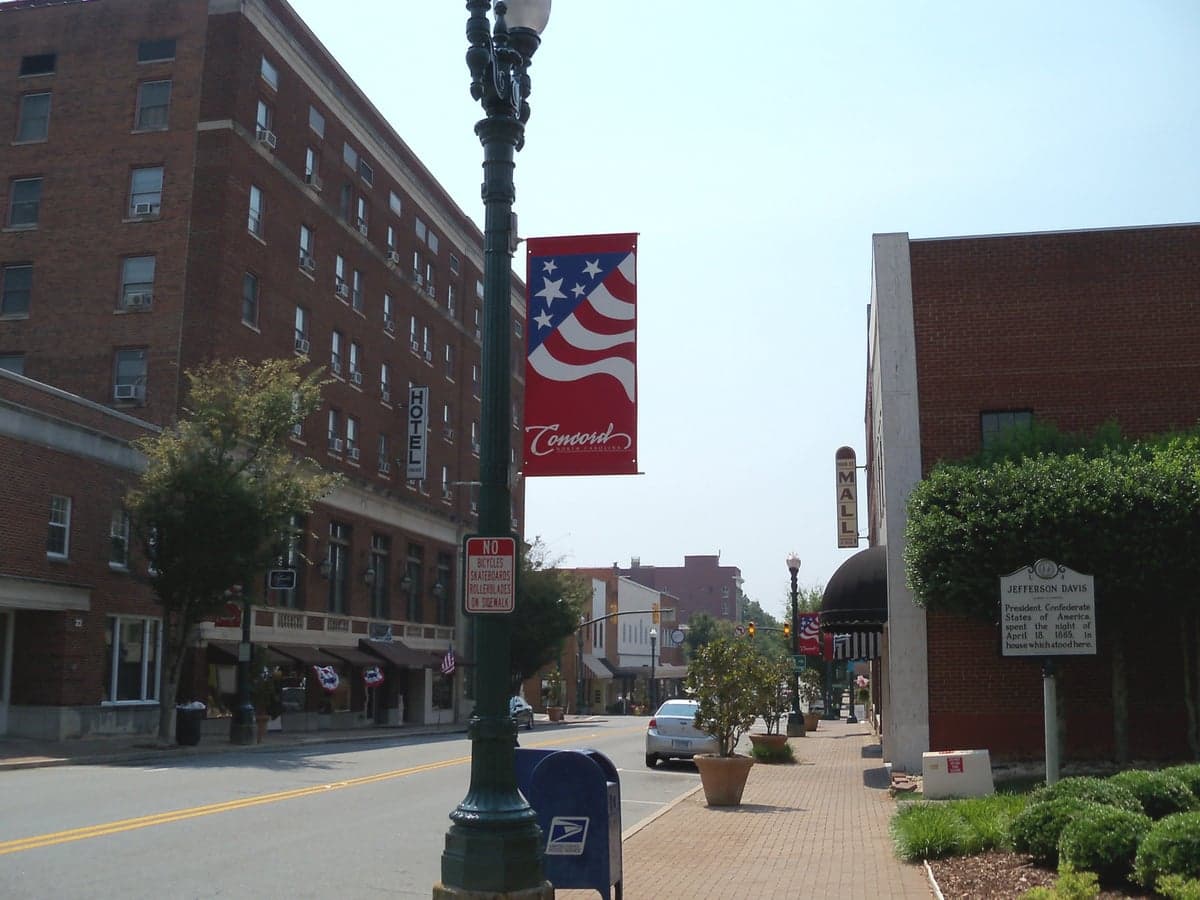
Photo: Wikipedia
Strategic Assessment of Concord, NC
Meaningful friction. Expect exposure to either population pressure, blast zones, or natural disaster risk. Consider buying a retreat property.
What does the Strategic Assessment tell us?
Our Strategic Assessment grades tactical survivability of an area. Major population centers, military targets, fallout zones, natural disasters, and border exposure all drive risk — lower exposure means a more defensible position in a crisis.
This is heavily inspired by Joel Skousen's Strategic Relocation book. Highly recommended you checkout the book ($)What does this tell us?
Our Strategic Assessment grades tactical survivability of an area. Major population centers, military targets, fallout zones, natural disasters, and border exposure all drive risk — lower exposure means a more defensible position in a crisis.
This is heavily inspired by Joel Skousen's Strategic Relocation book. Highly recommended you checkout the book ($)Strategic Pillars

Key Distances
Regional Safe Places
Below is our recommended "safe zones" in North Carolina and the surrounding area based on our strategic heuristics. For most people, it's unrealistic to live in a “safe zone” full-time due to work, family or other personal reasons. They tend to be more rural. However, many of these areas are perfect for second homes and retreat properties that double as a vacation home or even a short-term rental.

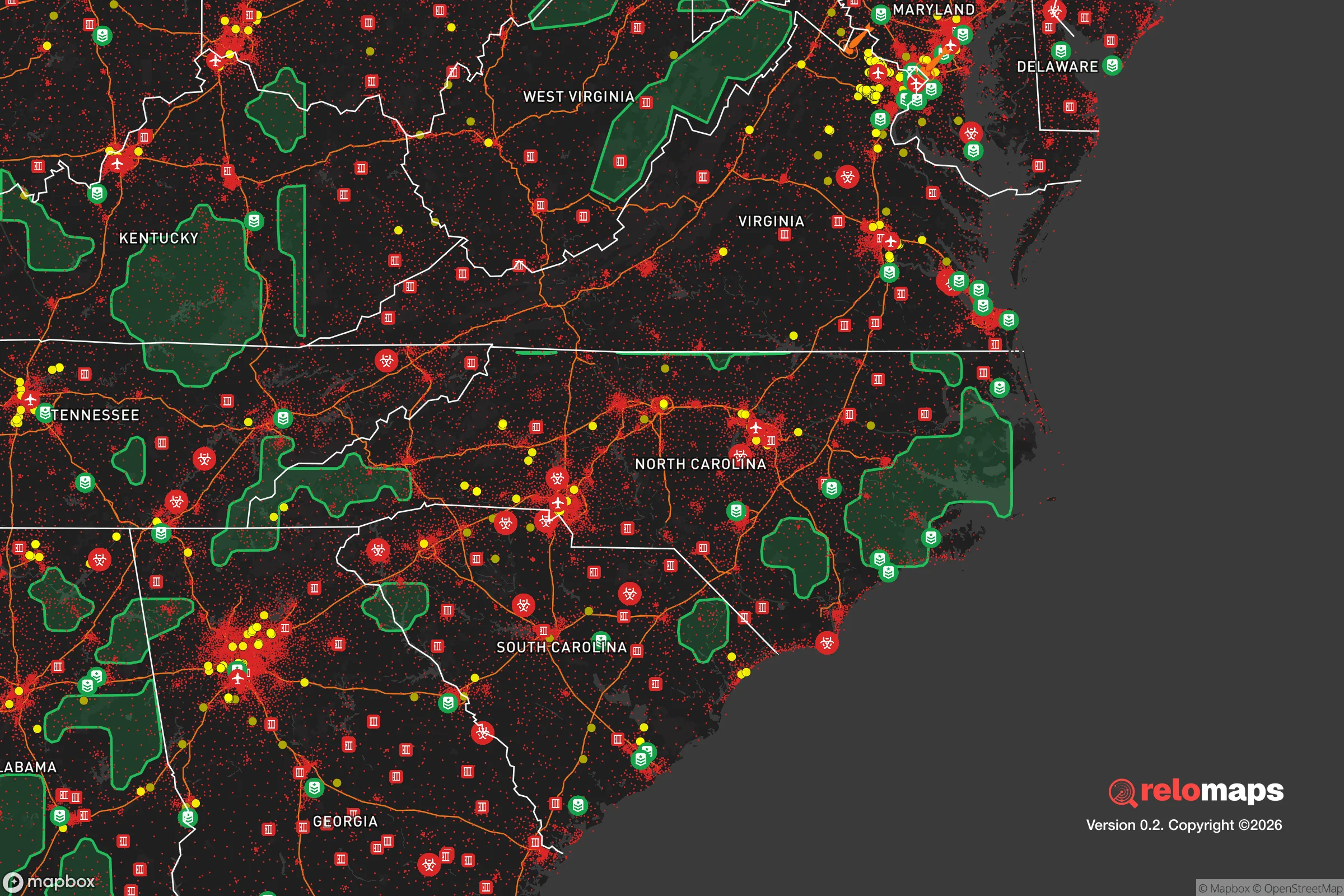


Important Note: For informational purposes only. This does not mean nothing bad ever happens in the green zones. Please use common sense. This is based on public data and modeled with AI. We tried to take a conservative approach but mistakes happen. We update this regularly as new information becomes available.
Solar Generator Recommendations
Backup power matters more here than in safer locations. We've picked three solar generators across budgets and capacity tiers — start with the budget unit if you only need a few essentials, or step up if you want to run a fridge and HVAC for days at a time.

Jackery Portable Power Station Explorer 300
Budget OptionPower on the Go: Weighing only 11 lbs, it's convenient to set up and store with book-sized foldable solar panels

BLUETTI Portable Power Station AC180
Designed for both indoor and outdoor scenarios, AC180 is highly capable as it has a robost capacity and continuous output power.

EF ECOFLOW DELTA Pro Ultra Power Station
Upgraded PickEcoFlow DELTA Pro Ultra is a whole-home energy system designed to grow with your family. Integrated with the Smart Home Panel 2, it scales to meet your evolving energy needs — keeping your home powered, intelligent, and secure through every stage of life.
We earn a commission, at no additional cost to you.
Strategic Assessment Analysis
Concord, North Carolina, offers a mixed strategic picture for the conservative prepper: its location along the I-85 corridor provides rapid access to both the Appalachian redoubt and the coastal plain, but its proximity to Charlotte—a major population center and likely target for civil unrest or infrastructure failure—introduces significant vulnerabilities. For a relocator prioritizing self-sufficiency and security, Concord’s advantages in geographic positioning and economic resilience are tempered by its exposure to the fallout of a destabilized urban core. This assessment weighs those factors for a single individual or family preparing for civic unrest, mass casualty events, and systemic disruptions.
Geographic position and natural advantages for long-term survival
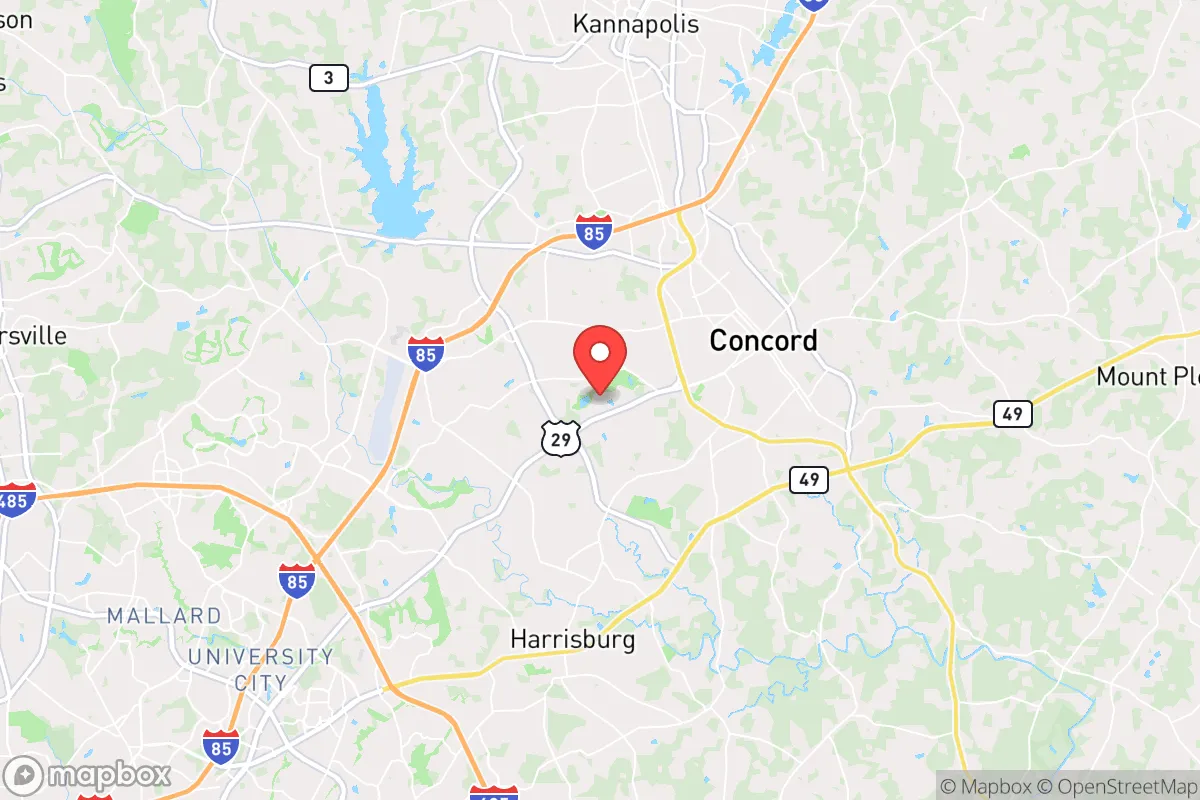
Concord sits in the Piedmont region of North Carolina, roughly 20 miles northeast of Charlotte, placing it at a strategic crossroads. The area’s terrain is gently rolling, with clay-based soils that support mixed hardwood forests—useful for timber, fuel, and concealment. The Yadkin-Pee Dee River system flows to the east, providing a potential water source, though it’s not immediately accessible from most residential lots. The climate is humid subtropical, with hot summers and mild winters, allowing for year-round gardening and minimal heating demands. This reduces reliance on external energy grids during a collapse scenario. The region’s elevation (around 700 feet) offers no significant defensive high ground, but the lack of major floodplains or earthquake zones means natural disaster risk is low. For a prepper, the key natural advantage is the ability to grow food for much of the year—first and last frost dates typically allow for a 200-day growing season—and the proximity to the Uwharrie National Forest (about 45 minutes east) for hunting, foraging, and a bug-out option. However, the area’s flatness and open farmland also mean limited natural cover for a retreat; defensibility will depend on property-level improvements rather than terrain.
Risks, exposures, and proximity to fallout-relevant landmarks
The single greatest risk for a Concord-based prepper is its proximity to Charlotte, a city of over 900,000 people and a major financial hub. In a scenario of civil unrest—whether from economic collapse, political violence, or supply chain disruptions—Charlotte’s population could surge outward along I-85, turning Concord into a chokepoint for refugees and looters. The city’s status as a banking center (headquarters of Bank of America) also makes it a potential target for cyberattacks or coordinated strikes aimed at destabilizing the national economy. Additionally, Concord is within 30 miles of the McGuire Nuclear Station (near Huntersville), a dual-reactor facility that, while well-regulated, presents a low-probability but high-consequence risk of radiological release. The prevailing winds in the region blow from the southwest, meaning a plume from McGuire could drift directly over Concord. Other fallout-relevant landmarks include the Charlotte-Douglas International Airport (a likely staging area for federal response or, in a worst case, a target) and the numerous rail lines running through the city that carry hazardous materials. For a prepper, the exposure is not just physical but logistical: during a crisis, Concord’s roads—especially I-85 and US-29—will become impassable, trapping residents in a suburban environment with limited escape routes. The city’s population of roughly 110,000 (as of 2025) means it’s dense enough to attract chaos but not large enough to have its own robust emergency infrastructure.
Practical resilience for a relocator: food, water, energy, and defensibility
For a single individual or family looking to establish a resilient homestead, Concord presents a mixed bag. Food security is achievable: the growing season is long, and local farmers’ markets (like the Concord Farmers Market) provide access to seeds, livestock, and knowledge. However, suburban zoning in many parts of the city restricts livestock (chickens are often allowed, but goats or pigs may require a special permit), and HOA covenants in newer developments can ban vegetable gardens or clotheslines. A prepper should target properties in the county’s unincorporated areas or older neighborhoods with fewer restrictions. Water is a critical vulnerability: Concord relies on the Yadkin River and groundwater wells, but the municipal system is centralized and vulnerable to contamination or pressure loss. A private well is ideal, but drilling costs in the Piedmont’s granite bedrock can run $5,000–$10,000. Rainwater collection is legal in North Carolina, but the state’s average 45 inches of annual rainfall means a 1,000-square-foot roof can yield about 28,000 gallons per year—enough for a family with careful use. Energy is another weak point: Duke Energy’s grid is reliable in normal times, but a prolonged outage (from cyberattack or EMP) would leave Concord without power for weeks. Solar panels with battery storage are a wise investment, but the region’s partly cloudy climate reduces efficiency; a backup generator with a 500-gallon propane tank is more practical for immediate needs. Defensibility is the hardest factor: Concord’s suburban layout—with cul-de-sacs, strip malls, and open lots—offers little natural cover. A prepper should prioritize a property with a long setback from the road, a fenced perimeter, and a basement or reinforced safe room. The local law enforcement presence (Concord Police Department and Cabarrus County Sheriff’s Office) is professional, but during a mass casualty event, response times will stretch to hours or days. Building a network of like-minded neighbors is essential; the area has a growing conservative and prepper community, with groups meeting at local gun shops like Hyatt Guns (in Charlotte) or at the Cabarrus County Gun Show.
The overall strategic picture for Concord is one of calculated risk. It is not a remote survivalist paradise—it is a suburban buffer zone that offers economic opportunity and moderate natural advantages but sits in the shadow of a major city. For a relocator willing to invest in off-grid infrastructure, build a local network, and maintain a low profile, Concord can serve as a staging ground for a deeper retreat into the Appalachian foothills (about 90 minutes west) or as a long-term base if the Charlotte threat is mitigated. The key is to treat Concord as a transitional location: close enough to jobs and resources to build capital, but with a clear bug-out plan for when the urban core implodes. The city’s conservative lean (Cabarrus County voted +18 R in 2024) and strong gun culture are assets, but its dependence on a fragile supply chain and proximity to a high-value target are liabilities. In a world of increasing uncertainty, Concord is a place to prepare, not to hide.

* Values derived from national, state, county, city and local statistics and may differ in a specific area. Last updated: 2026-05-03T20:27:25.000Z
Narrative content on this page is AI-generated and may contain mistakes. Verify any details that matter before acting on them.
ReloMaps may earn a commission from affiliate links at no extra cost to you.

