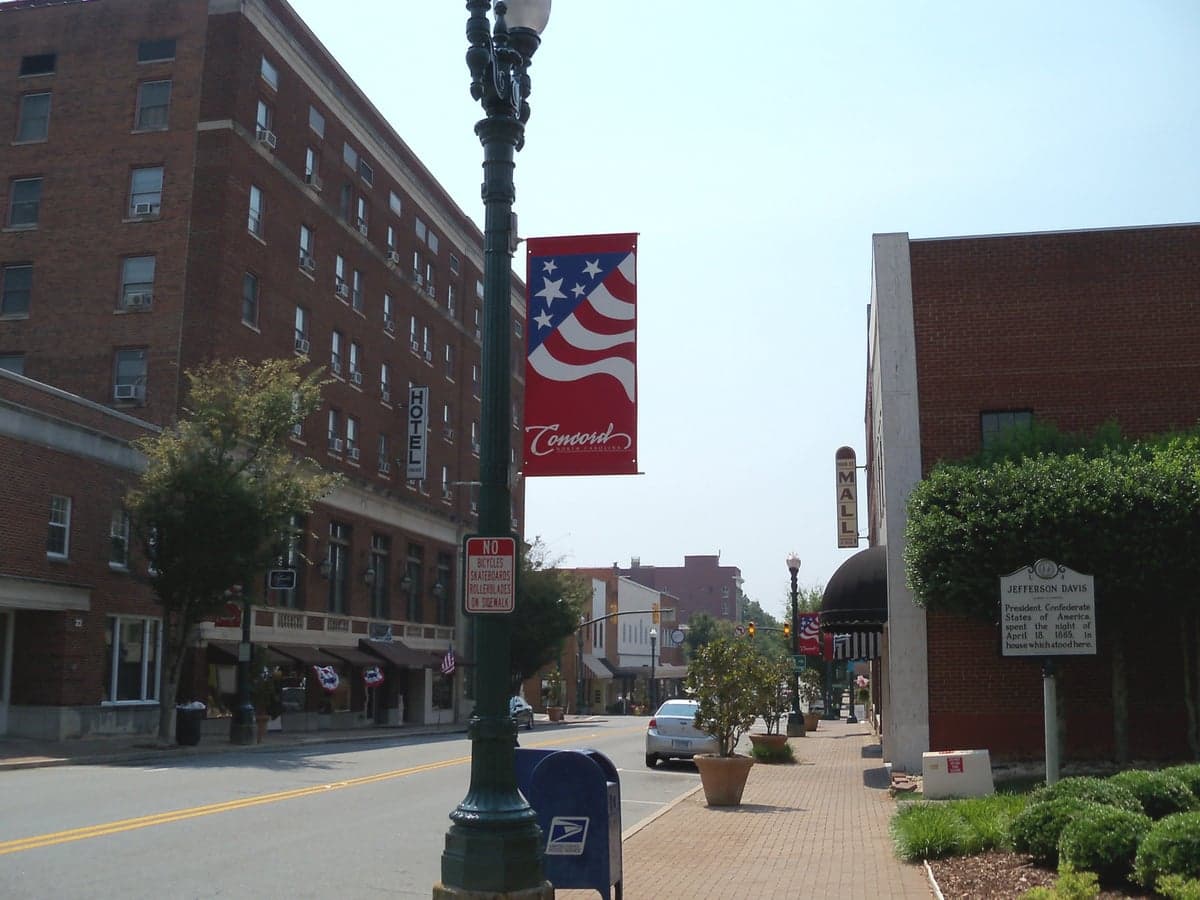
Photo: Wikipedia
Political ClimatePolitical Climate in Concord, NC
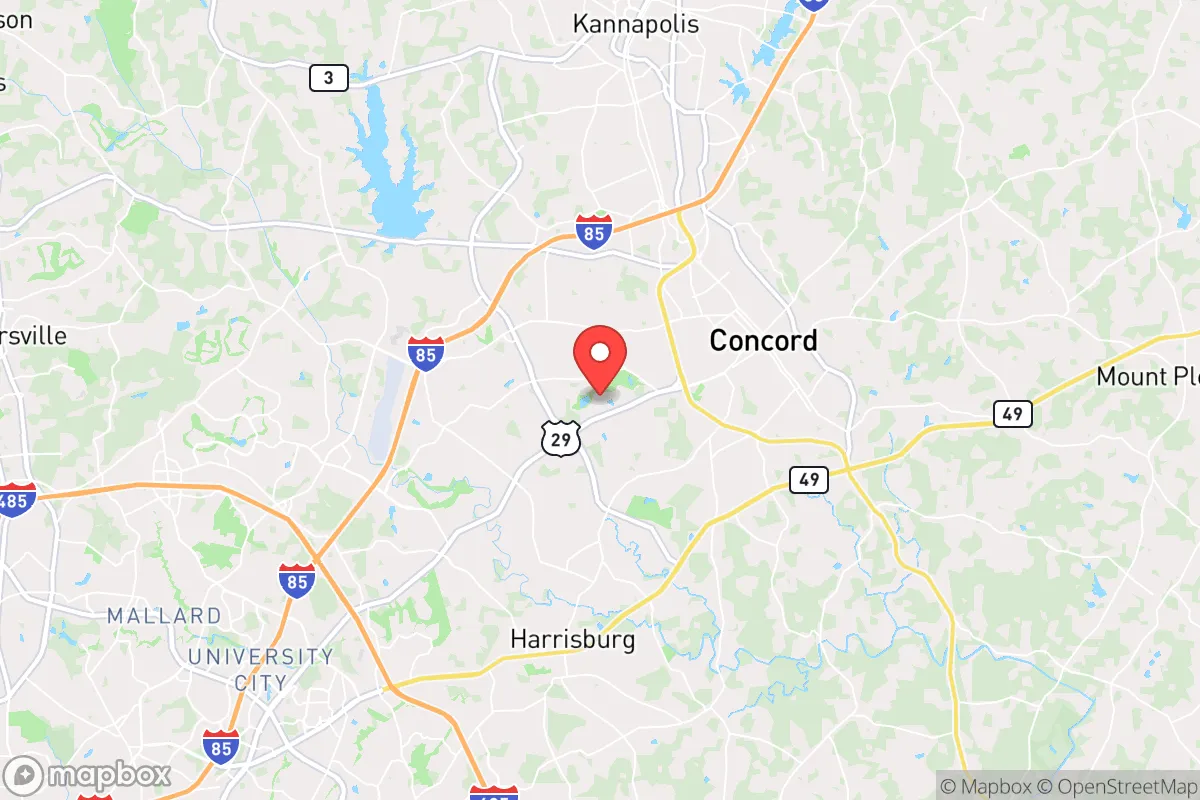
District shown is the primary district for this city’s centroid. Cities may span multiple districts.
Local Political AnalysisPolitical Analysis of Concord, NC
Concord, North Carolina, has long been a solidly conservative community, and that hasn't changed much despite the rapid growth around Charlotte. The Cook PVI rating of R+10 tells you the real story—this is a place where Republican candidates regularly win by comfortable margins, and the local culture reflects that. But if you've been around here as long as I have, you've noticed the political winds shifting in subtle ways, especially as folks from more progressive areas like Mecklenburg County and even parts of Wake County start moving in. It's still a red town, no doubt, but the shade of red is getting a little lighter, and that's something worth keeping an eye on.
How it compares
When you stack Concord up against its neighbors, the contrast is pretty stark. Head west into Charlotte proper, and you're in a deep blue urban stronghold where the city council and county commission are firmly in progressive hands. Drive south to Harrisburg, and you'll find a similar conservative vibe, though maybe a touch more moderate. But the real eye-opener is comparing Concord to places like Davidson or even parts of Huntersville—those towns have seen a noticeable shift toward more progressive policies, especially on zoning and local taxes. Concord, by contrast, has held the line. The Cabarrus County Commission is still majority Republican, and the city council tends to lean that way too. But I've seen the school board races get tighter, and that's usually the first sign of a changing tide. The surrounding rural areas—like Mount Pleasant and Midland—are still deep red, so the overall county balance holds, but the suburban core is where the pressure is building.
What this means for residents
For folks who value limited government and personal freedoms, Concord is still a pretty good place to be. You won't find the kind of overreach you see in some of the bigger cities—no heavy-handed mask mandates that lasted forever, no aggressive zoning that tells you what you can and can't do with your own property. The local leadership has generally been hands-off, letting people live their lives without a lot of bureaucratic nonsense. That said, the influx of new residents from blue areas is starting to bring some of those ideas with them. There's been more chatter about "equity" initiatives in the schools and some push for higher density development that feels like it's more about social engineering than actual housing needs. If you're worried about government creeping into your backyard, keep an eye on the next few city council elections. The long-term trend is concerning, but for now, Concord still respects the idea that you know what's best for your own family better than some bureaucrat does.
Culturally, Concord has a few distinct markers that set it apart. The NASCAR presence is still strong, and that's always been a pretty conservative crowd. You'll see more American flags and fewer "In This House We Believe" signs. The local gun culture is alive and well—plenty of folks carry, and nobody bats an eye. But the biggest policy distinction is probably the tax structure. Cabarrus County has kept property taxes relatively low compared to Mecklenburg, and there's a real resistance to raising them for "quality of life" projects that sound nice but always come with strings attached. The biggest worry I have is the long game: as Charlotte's sprawl continues, Concord will keep absorbing people who don't share the traditional values of the area. If we're not careful, we could end up like some of those northern Virginia suburbs that were red twenty years ago and are now solidly blue. For now, though, Concord is still a place where you can raise a family without feeling like the government is looking over your shoulder every step of the way.

State Political ClimatePolitical Climate in North Carolina
State Political AnalysisPolitical Environment in the State
North Carolina is a classic purple state that has been trending rightward in key races, but it remains a battleground where the conservative coalition—built on rural and suburban voters—holds a narrow but durable edge. Over the past decade, the state has voted Republican in every presidential election since 2012, with Donald Trump winning it by 1.3 points in 2024, while simultaneously electing a Democratic governor (Josh Stein in 2024) and a Republican supermajority in the legislature. The 10-20 year arc shows a state that was once reliably blue in statewide races (2008 Obama win) but has since hardened into a competitive toss-up, with the GOP gaining ground in exurban counties like Union and Johnston while Democrats consolidate in the urban cores of Charlotte, Raleigh, and Durham.
Urban vs. rural divide
The political map of North Carolina is a textbook case of the urban-rural split. The three major metro areas—Charlotte (Mecklenburg County), the Raleigh-Durham Research Triangle (Wake, Durham, Orange counties), and Greensboro-Winston-Salem (Guilford and Forsyth counties)—are solidly Democratic, driven by a mix of college-educated professionals, university communities, and growing minority populations. Mecklenburg County alone delivered 63% of its vote to Kamala Harris in 2024. Meanwhile, the vast rural and small-town regions—eastern counties like Robeson and Cumberland, the Sandhills, and the western mountain counties like Watauga and Buncombe (Asheville)—are more mixed, with many rural precincts voting 70-80% Republican. The real story is in the exurban "collar counties" around Charlotte and Raleigh: Union County (north of Charlotte) voted 68% for Trump in 2024, up from 62% in 2020, while Johnston County (southeast of Raleigh) flipped from 58% Trump in 2016 to 64% in 2024. These fast-growing, family-oriented suburbs are where the GOP is building its future majority.
Policy environment
North Carolina's policy environment is a mixed bag that leans conservative on fiscal and regulatory issues but has seen recent progressive encroachments. The state has a flat income tax rate of 4.5% (down from 5.25% in 2023, with a scheduled drop to 3.99% by 2027), no state estate tax, and a relatively low corporate tax rate of 2.5%. Property taxes are moderate, averaging about 0.78% of assessed value, but vary widely by county—Wake County (Raleigh) is around 0.85%, while rural Pender County is 0.55%. The regulatory climate is business-friendly, with right-to-work laws and no state-level minimum wage above the federal $7.25. However, the state has expanded Medicaid under the Affordable Care Act as of December 2023, a move that many conservatives opposed as a step toward government-run healthcare. Education policy is a flashpoint: the state has a robust school choice program (the Opportunity Scholarship Program, expanded in 2024 to universal eligibility), but the Democratic governor and state board of education have pushed for more centralized control and woke curriculum standards. Election laws are relatively secure—voter ID is required (implemented in 2023 after a decade-long legal battle), and the state has clean voter rolls, though Democrats continue to challenge these measures in court.
Trajectory & freedom
On the freedom front, North Carolina has been a mixed bag over the past five years. The good news: the General Assembly passed a major parental rights bill in 2023 (HB 755, the "Parents' Bill of Rights"), which requires schools to notify parents of any changes in a child's health or well-being and prohibits instruction on gender identity and sexuality in K-4 classrooms. The state also expanded gun rights in 2023 by eliminating the requirement for a permit to purchase a handgun (permitless carry for concealed weapons was already law). Property rights were strengthened with the passage of SB 469 in 2024, which limits the ability of local governments to impose rent control and restricts eminent domain abuse. The bad news: the Democratic governor and attorney general have used executive orders to push progressive agendas, including a 2023 order promoting "diversity, equity, and inclusion" in state contracting and a 2024 order restricting the use of "conversion therapy" for minors. The state also saw a controversial 2024 law (HB 237) that expanded the definition of hate crimes, which critics argue could chill free speech. Medical autonomy took a hit in 2023 when the legislature overrode the governor's veto to ban nearly all abortions after 12 weeks (SB 20), which conservatives generally support but which represents a significant government intervention into personal medical decisions. Overall, the trajectory is cautiously positive for conservatives, with the legislature holding the line on most fronts, but the executive branch remains a persistent threat to expand government overreach.
Civil unrest & political movements
North Carolina has seen its share of political turbulence. The 2020 protests in Charlotte and Raleigh over the death of George Floyd led to property damage and curfews, with the Charlotte Uptown area seeing broken windows and looting. The "Moral Monday" movement, led by the NAACP and progressive clergy, has been a fixture since 2013, with regular protests at the General Assembly against conservative legislation. More recently, the 2024 election saw organized efforts by both sides: the left-wing group "Democracy North Carolina" pushed for expanded mail-in voting and same-day registration, while conservative groups like "Election Integrity Network" focused on poll watching and challenging questionable ballots. Immigration politics are relatively quiet compared to border states, but Durham and Orange counties have declared themselves "sanctuary" jurisdictions, refusing to cooperate with ICE detainers—a policy that the legislature has tried to ban with the "No Sanctuary Cities" bill (SB 101), which passed the House in 2023 but stalled in the Senate. There's no serious secession or nullification rhetoric, but the "State Sovereignty" movement has a small but vocal presence in western counties like Watauga and Mitchell. Election integrity remains a hot-button issue: the 2024 election saw a lawsuit over 60,000 ballots that were allegedly cast without proper verification in Mecklenburg County, though the courts ultimately dismissed the challenge. A new resident would notice the constant low-grade political tension, especially in the Triangle and Charlotte, where yard signs and bumper stickers are a common sight.
Projection
Over the next 5-10 years, North Carolina is likely to remain a purple state with a slight rightward tilt, driven by in-migration from blue states (especially New York, New Jersey, and California) that is concentrated in the urban and exurban areas. The key battleground will be the exurban counties: if Union, Johnston, and Cabarrus continue to trend red while the urban cores grow bluer, the state will stay competitive but lean Republican in presidential and Senate races. However, the influx of out-of-state transplants—many of whom bring progressive voting habits—could flip the state if they settle in the suburbs rather than the cities. The legislature is likely to remain under Republican control due to gerrymandered maps that favor rural and exurban districts, but the governor's mansion may flip back and forth. Expect continued battles over school choice (the voucher program will likely expand), election integrity (voter ID will be strengthened), and parental rights (more bills on curriculum transparency). The biggest wildcard is the state's growing Hispanic population, which is concentrated in Charlotte and the eastern counties and could shift the electorate if it becomes more politically engaged. For someone moving in now, expect a state where conservative values are protected at the legislative level but constantly under assault from the executive branch and urban cultural forces.
For a conservative individual or family considering relocation, North Carolina offers a strong foundation: low taxes, school choice, gun rights, and a legislature that generally respects personal freedom. The trade-off is that you'll be living in a state where the governor and major cities are actively working against those values, so you'll need to be engaged at the local level—join your county GOP, attend school board meetings, and vote in every election. The exurbs of Charlotte (Union County) and Raleigh (Johnston County) are the safest bets for a like-minded community, while the rural counties in the Sandhills and mountains offer a quieter, more traditional lifestyle. Just be prepared for the culture war to be a constant background noise, especially if you're in the Triangle or Asheville. Bottom line: North Carolina is a state where you can live freely if you choose your location wisely and stay politically active—but it's not a conservative paradise, and it requires vigilance to keep it that way.
* Values derived from national, state, county, city and local statistics and may differ in a specific area. Last updated: 2026-05-03T20:27:25.000Z
Narrative content on this page is AI-generated and may contain mistakes. Verify any details that matter before acting on them.
ReloMaps may earn a commission from affiliate links at no extra cost to you.

