Photo: Wikipedia
Demographics of Concord, NC
Affluence Level in Concord, NC
A middle-class area roughly in line with national averages across income, home values, education, and employment.
People of Concord, NC
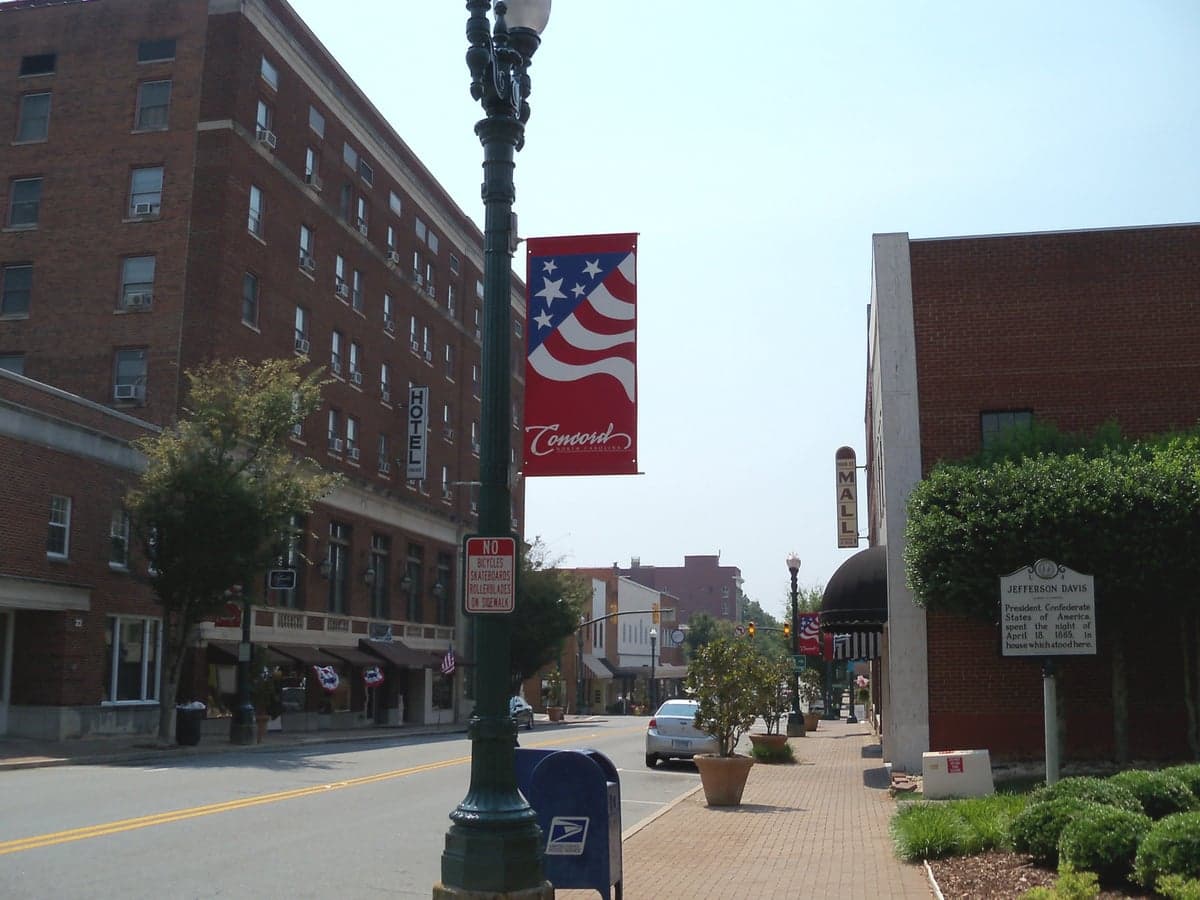
The people of Concord, North Carolina, today form a majority-minority population of 106,518 that is notably diverse by regional standards, with a white share of 51.2%, a Black population of 21.7%, a Hispanic community of 15.8%, and a significant Indian-subcontinent presence at 5.3%. The city is denser and more suburban than its historic textile-mill roots would suggest, with a college-educated rate of 41.7% that reflects the pull of Charlotte's financial and healthcare sectors. Distinctive identity markers include a strong Southern Baptist and evangelical Protestant base, a growing Catholic and Hindu population tied to recent immigration, and a civic pride centered on Concord Mills, the Charlotte Motor Speedway, and a downtown undergoing careful revitalization.
How the city was settled and grew
Concord was founded in 1796 as the county seat of Cabarrus County, drawing its earliest white settlers—primarily Scots-Irish and German farmers—via land grants along the Rocky River. These families built the original core around what is now the Historic Downtown Concord district, with its grid of brick storefronts and churches dating to the early 1800s. The first major demographic wave came after the Civil War, when the Cannon family established textile mills that drew rural white workers from the surrounding Piedmont into mill villages such as Gibson Village and Logan Village, neighborhoods of company-built houses that still stand today. A smaller but significant Black population formed during this era, concentrated in the West Concord area near the railroad tracks, where African American workers found employment as domestic laborers and mill hands. By 1900, Concord was a segregated, overwhelmingly white and native-born town of roughly 8,000, with its character shaped by the rhythms of cotton and cloth.
Modern era (post-1965)
The post-1965 period transformed Concord's population through two main forces: the suburban spillover from Charlotte and the diversification allowed by the Immigration and Nationality Act of 1965. The opening of Interstate 85 in the 1970s and the construction of the Charlotte Motor Speedway in 1960 accelerated white flight from Mecklenburg County, drawing middle-class families into new subdivisions like Country Club Hills and McWhorter, which remain predominantly white and upper-middle-income today. The Black population grew steadily through domestic migration from rural North Carolina and the Northeast, settling heavily in West Concord and the Gibson Village area, where the share of Black residents now exceeds 40% in some census tracts. The Hispanic community, largely Mexican and Central American, began arriving in the 1990s for construction and service jobs, forming a visible presence in the North Concord corridor along NC-73, where tiendas and Spanish-language churches now anchor a growing enclave. The most striking modern shift is the Indian-subcontinent population, which surged from negligible numbers in 2000 to 5.3% today, driven by professionals in healthcare and information technology who work in Charlotte but choose Concord for its schools and lower housing costs. These families cluster in newer subdivisions like Weddington Hills and the Brick Mill area, where Hindu temples and Indian grocery stores have opened to serve them. East and Southeast Asian communities remain small at 1.4%, concentrated among a handful of Vietnamese and Korean families in the same suburban tracts.
The future
The population trajectory points toward continued diversification and suburban densification, with the white share likely to fall below 50% within the next decade as Hispanic and Indian-subcontinent growth continues. The city is not homogenizing into a single melting pot; rather, distinct enclaves are solidifying—West Concord remains predominantly Black, North Concord is becoming a Hispanic corridor, and the newer subdivisions are heavily white and Indian. The foreign-born share of 6.9% is below the national average but rising, driven almost entirely by Indian and Hispanic immigration, while the Black population is growing through domestic relocation rather than foreign birth. Over the next 10-20 years, Concord will likely resemble a patchwork of ethnic neighborhoods rather than a fully integrated city, with the downtown area serving as a common ground for all groups. The college-educated rate of 41.7% will probably rise further as Charlotte's knowledge economy expands and more professionals seek affordable suburban homes in Concord.
Concord is becoming a majority-minority, educationally stratified suburb where old mill-village loyalties coexist with new immigrant enclaves. For someone moving in now, the city offers a stable, family-oriented environment with good schools and a growing diversity of cultural institutions, but the social landscape is increasingly defined by which neighborhood you choose rather than a single shared identity.

* Values derived from national, state, county, city and local statistics and may differ in a specific area. Last updated: 2026-05-03T20:27:25.000Z
Narrative content on this page is AI-generated and may contain mistakes. Verify any details that matter before acting on them.
ReloMaps may earn a commission from affiliate links at no extra cost to you.

