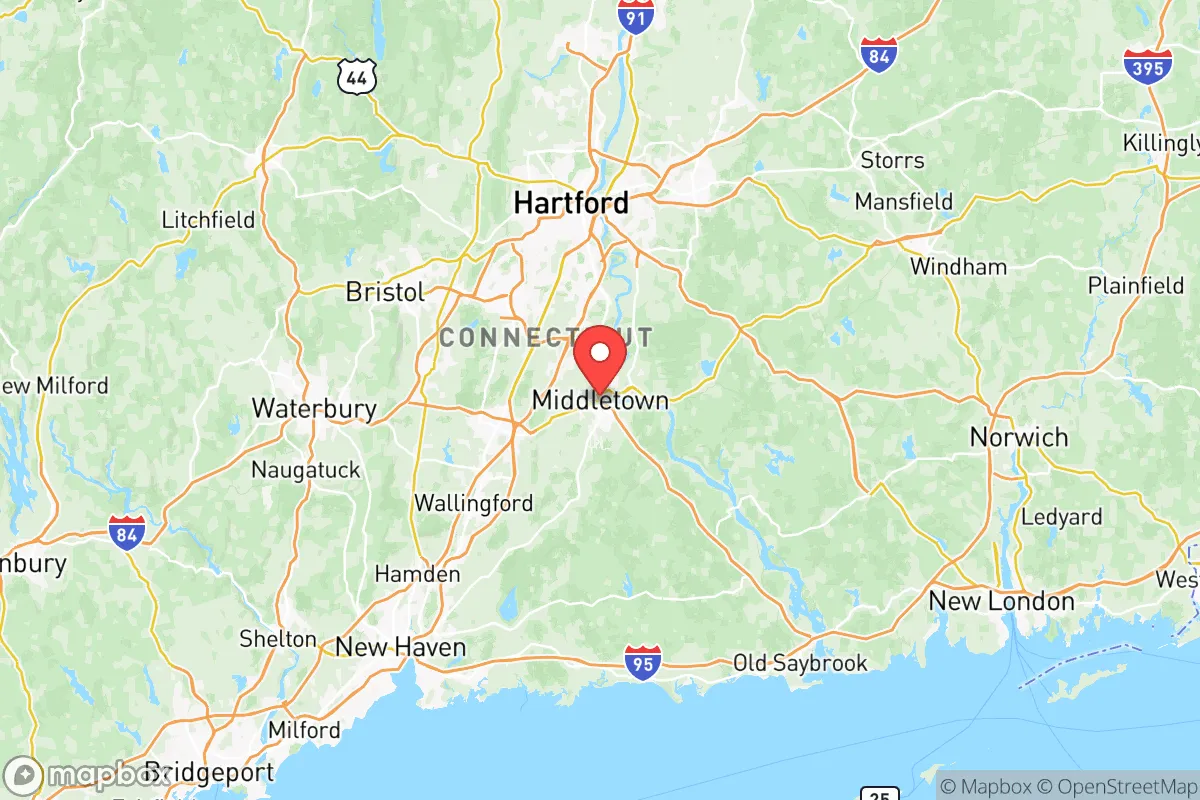
Demographics of Lower Connecticut River Valley Planning Region County
Historical data isn't available for Lower Connecticut River Valley Planning Region County. Trends shown are for Connecticut.
Affluence Level in Lower Connecticut River Valley Planning Region County
A middle-class area roughly in line with national averages across income, home values, education, and employment.
People of Lower Connecticut River Valley Planning Region County
The Lower Connecticut River Valley Planning Region is home to 174,983 residents, a population that is 80.0% white, 7.4% Hispanic, 4.5% Black, 2.2% East/Southeast Asian, and 1.3% Indian (subcontinent). With only 2.9% foreign-born and 45.5% college-educated, the region retains a distinctly New England character—rooted in centuries-old Yankee stock, shaped by later waves of European immigration, and now experiencing modest diversification through domestic migration and a small but growing immigrant presence.
Settlement & growth (pre-1960)
The region's human history begins with the Wangunk and Mohegan peoples, Algonquian-speaking tribes who lived along the Connecticut River and its tributaries for thousands of years. They fished for shad and salmon, cultivated corn and beans, and maintained seasonal villages at sites that later became Middletown, Portland, and East Haddam. English colonists from the Massachusetts Bay Colony began arriving in the 1630s, establishing the town of Saybrook (now Old Saybrook) at the river's mouth in 1635 and pushing upriver to found Haddam (1662) and Middletown (1651). These settlers were primarily Puritan English farmers and traders, drawn by the fertile river floodplains and the strategic access to Long Island Sound.
Through the 18th and early 19th centuries, the population remained overwhelmingly English-descended, with a small admixture of Scots-Irish and French Huguenots. The region's economy revolved around shipbuilding, agriculture, and river trade. Middletown grew into a major port, exporting lumber, tobacco, and livestock to the West Indies. The Connecticut River Valley's distinctive broadleaf tobacco—grown for cigar wrappers—became a cash crop that attracted seasonal laborers, but permanent settlement patterns changed little until the Industrial Revolution.
From the 1820s through the 1880s, the region industrialized along its rivers. Middletown became a center for rubber manufacturing (Goodyear's early experiments), hardware, and machine tools. Portland developed a major brownstone quarrying industry, shipping stone to New York and Boston. Chester and Deep River saw piano and organ manufacturing. These factories drew Irish immigrants in the 1840s-1850s (fleeing the Potato Famine) and Italian immigrants in the 1880s-1910s, who settled in ethnic enclaves in Middletown's North End and along the riverfront in Portland. Polish and German immigrants arrived in smaller numbers, working in the quarries and factories. By 1910, roughly 20% of the region's population was foreign-born, predominantly Irish and Italian.
The 20th century brought a gradual shift. The Great Migration of Black Americans from the South reached the region modestly, with Black families settling primarily in Middletown and Old Saybrook, working in service industries and manufacturing. World War II and the postwar boom expanded defense-related manufacturing at Pratt & Whitney in Middletown and submarine-building at Electric Boat in nearby Groton, drawing additional workers from across New England and the Rust Belt. Suburbanization began in earnest in the 1950s, with new housing developments spreading into East Haddam, Chester, and Essex, attracting white-collar commuters to Hartford and New Haven.
Modern era (post-1965)
The 1965 Hart-Cellar Act had a muted effect on the Lower Connecticut River Valley compared to coastal cities. The region's foreign-born population remains low at 2.9%, far below the national average of 13.6%. However, the post-1965 immigration that did occur has been concentrated in Middletown, which became a secondary settlement node for immigrants initially drawn to Hartford and New Haven. East/Southeast Asian communities—primarily Chinese, Vietnamese, and Filipino—arrived in the 1980s and 1990s, often as professionals in healthcare and higher education. Wesleyan University in Middletown attracted a small but visible Indian (subcontinent) population of academics and tech workers, now comprising 1.3% of the region's total.
Hispanic population growth has been the most significant demographic shift since 1965. Puerto Ricans began arriving in the 1960s and 1970s, followed by Dominicans and Mexicans in the 1990s and 2000s. Today, Hispanics make up 7.4% of the population, with the largest concentrations in Middletown (where they form roughly 15% of the city's population) and growing numbers in Portland and East Haddam. The Black population, at 4.5%, has remained relatively stable, with a mix of long-established families and newer arrivals from the Caribbean and Africa.
Domestic migration has reshaped the region more than immigration. Since the 1980s, the Lower Connecticut River Valley has attracted retirees and second-home buyers from New York, Boston, and Hartford, drawn by the river scenery, historic villages, and lower property taxes compared to Fairfield County. Essex, Chester, and Deep River have become affluent commuter and retirement enclaves, with median home prices exceeding $400,000. Old Saybrook and Westbrook have seen significant coastal development, attracting seasonal residents and year-round retirees. This in-migration has raised the region's college-educated share to 45.5%, well above the national average, and has reinforced its predominantly white, upper-middle-class character.
The future
The Lower Connecticut River Valley is likely to continue its gradual diversification, but at a slower pace than the state as a whole. The Hispanic population is projected to grow from 7.4% to perhaps 10-12% by 2040, driven by natural increase and continued migration from Hartford and New Haven. The East/Southeast Asian and Indian populations will likely grow modestly, concentrated in Middletown near Wesleyan and the Middlesex Hospital system. The white population, while declining as a share, will remain the overwhelming majority—likely still above 75% in 2040.
The region is not tribalizing into distinct ethnic enclaves in the way that Hartford or New Haven have. Instead, it is experiencing a slow, diffuse assimilation of new groups into existing towns. Middletown will remain the most diverse municipality, while the river towns—Essex, Chester, Deep River, East Haddam—will stay predominantly white and affluent. The biggest demographic pressure point is not immigration but domestic out-migration: young adults, priced out of the housing market, are leaving for cheaper regions in the South and Midwest, gradually aging the population.
For someone moving in now, the Lower Connecticut River Valley offers a stable, low-diversity, highly educated community with strong historic roots. The population is older, wealthier, and more homogenous than the national average, and is likely to remain so for the foreseeable future. New residents will find a region that values preservation, education, and quiet prosperity—but one that is slowly, incrementally becoming more varied in its makeup.

* Values derived from national, state, county, city and local statistics and may differ in a specific area. Last updated: 2026-05-08T09:54:22.000Z
Narrative content on this page is AI-generated and may contain mistakes. Verify any details that matter before acting on them.
ReloMaps may earn a commission from affiliate links at no extra cost to you.

