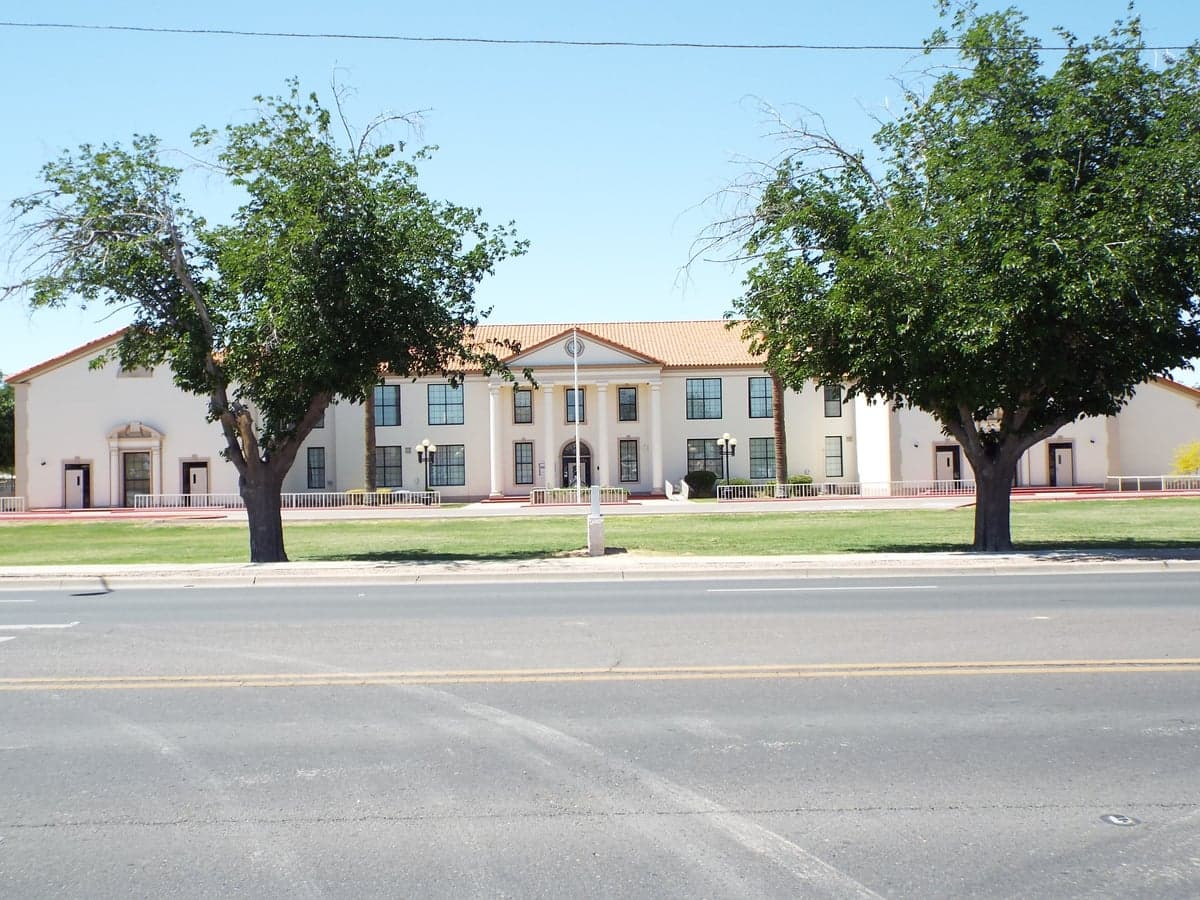
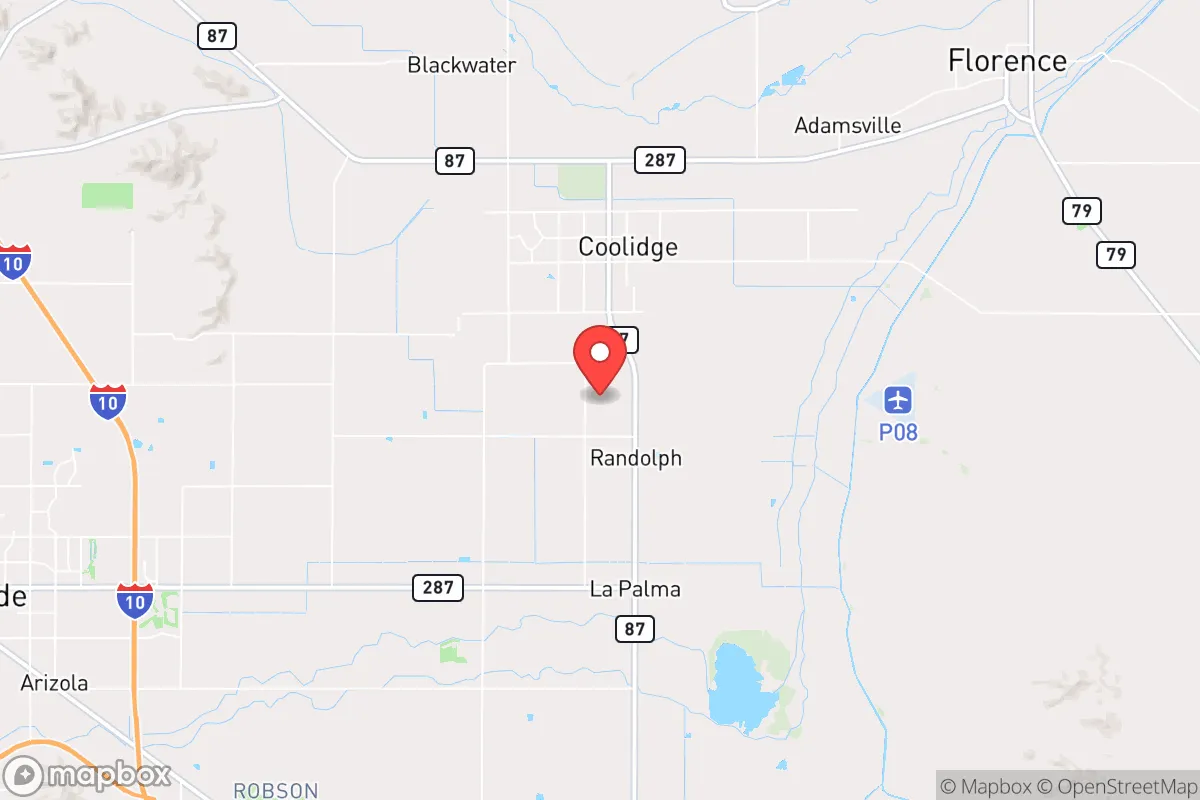
Photo: Wikipedia
Demographics of Coolidge, AZ
Affluence Level in Coolidge, AZ
A low-income area with significant economic hardship. Household wealth and educational attainment are well below national averages.
People of Coolidge, AZ
The people of Coolidge, Arizona, today form a predominantly Hispanic, working-class community of roughly 15,300 residents, with a character shaped by agricultural roots and a slow, steady suburban expansion from the Phoenix metro area. The city is notably less affluent and less educated than state averages—only 13.2% of adults hold a bachelor’s degree—and its population density remains low, giving it a small-town, rural feel. Distinctive identity markers include a strong Catholic and evangelical Protestant presence, a visible but small Black community concentrated in older central neighborhoods, and a very limited East/Southeast Asian and Indian-subcontinent presence (0.3% and 0.1%, respectively). The foreign-born share stands at 6.2%, well below the national average, indicating that most residents are U.S.-born, with the Hispanic population overwhelmingly Mexican-American and multi-generational.
How the city was settled and grew
Coolidge was founded in 1925 as a railroad town on the Southern Pacific line, named after President Calvin Coolidge, and its early population was drawn almost entirely by agriculture—specifically cotton, alfalfa, and dairy farming, enabled by the completion of the Coolidge Dam in 1928. The original settlers were a mix of Anglo homesteaders from the Midwest and South, along with Mexican and Mexican-American laborers who built the irrigation canals and worked the fields. These early waves settled in distinct areas: the Historic Downtown Coolidge grid, centered around Pima Street and Arizona Boulevard, housed the Anglo merchants and professionals, while the La Palma neighborhood, south of the railroad tracks, became the core of the Mexican-American community, with modest adobe and wood-frame homes. A small Black population arrived during the 1940s and 1950s, drawn by cotton-picking and packing-shed jobs, and concentrated in the South Side area near the old Coolidge Cotton Gin. By 1960, the population had reached roughly 4,000, with the city remaining a quiet, segregated agricultural service center.
Modern era (post-1965)
The post-1965 period brought significant demographic change, driven less by new immigration and more by the internal migration of Mexican-American families from rural Arizona and California, as well as a slow trickle of Anglo retirees and commuters seeking cheaper land. The Hispanic share grew from roughly 30% in 1970 to over 54% today, while the White non-Hispanic share dropped from about 60% to 32%. This shift was absorbed geographically: the La Palma neighborhood expanded south and east into newer subdivisions like Rancho Verde, a middle-class Hispanic enclave of tract homes built in the 1990s and 2000s. The Black population, now 5.3%, has remained stable but geographically concentrated in the South Side and parts of Sunland Estates, a mobile-home park area on the city’s western edge. The East/Southeast Asian and Indian-subcontinent populations are negligible—fewer than 50 individuals each—and are scattered without forming any identifiable ethnic enclave. The foreign-born share (6.2%) is low because the Hispanic population is largely U.S.-born, with only a small number of recent Mexican immigrants arriving since 2000, mostly settling in Rancho Verde and the newer Vista del Sol subdivision near the high school.
The future
The population of Coolidge is heading toward further Hispanicization and a slow, modest increase in overall size, driven by natural growth and spillover from the Casa Grande and Phoenix exurbs. The city’s Hispanic share is likely to rise from 54% to 60-65% by 2040, as the Anglo population ages and younger Hispanic families have higher birth rates. The Black share is expected to remain stable or decline slightly, as there is no major pull factor for new Black in-migration. The East/Southeast Asian and Indian-subcontinent populations will likely remain negligible—below 1% each—given the city’s lack of professional job opportunities and its distance from Phoenix’s tech and medical employment hubs. The city is not tribalizing into distinct enclaves so much as homogenizing into a predominantly Hispanic, working-class suburb, with the remaining Anglo population concentrated in the older Historic Downtown and Sunland Estates areas. New construction is occurring in the Vista del Sol and Rancho Verde subdivisions, which are attracting younger Hispanic families and a few Anglo commuters, but Coolidge remains a slow-growth community unlikely to see rapid demographic diversification.
For someone moving in now, Coolidge is becoming a more uniformly Hispanic, family-oriented, and affordable exurb, with a stable but aging Anglo minority and very little racial or ethnic diversity beyond the Hispanic-Black-Anglo triad. The city offers low housing costs and a quiet, rural pace, but the limited college attainment and job base mean that upward mobility often requires commuting to Casa Grande or Phoenix. New residents should expect a community where Spanish is commonly heard in public, where Catholic and evangelical churches anchor social life, and where the demographic trajectory is toward greater Hispanic cultural and numerical dominance, not toward a multi-ethnic melting pot.

* Values derived from national, state, county, city and local statistics and may differ in a specific area. Last updated: 2026-05-01T07:27:53.000Z
Narrative content on this page is AI-generated and may contain mistakes. Verify any details that matter before acting on them.
ReloMaps may earn a commission from affiliate links at no extra cost to you.

