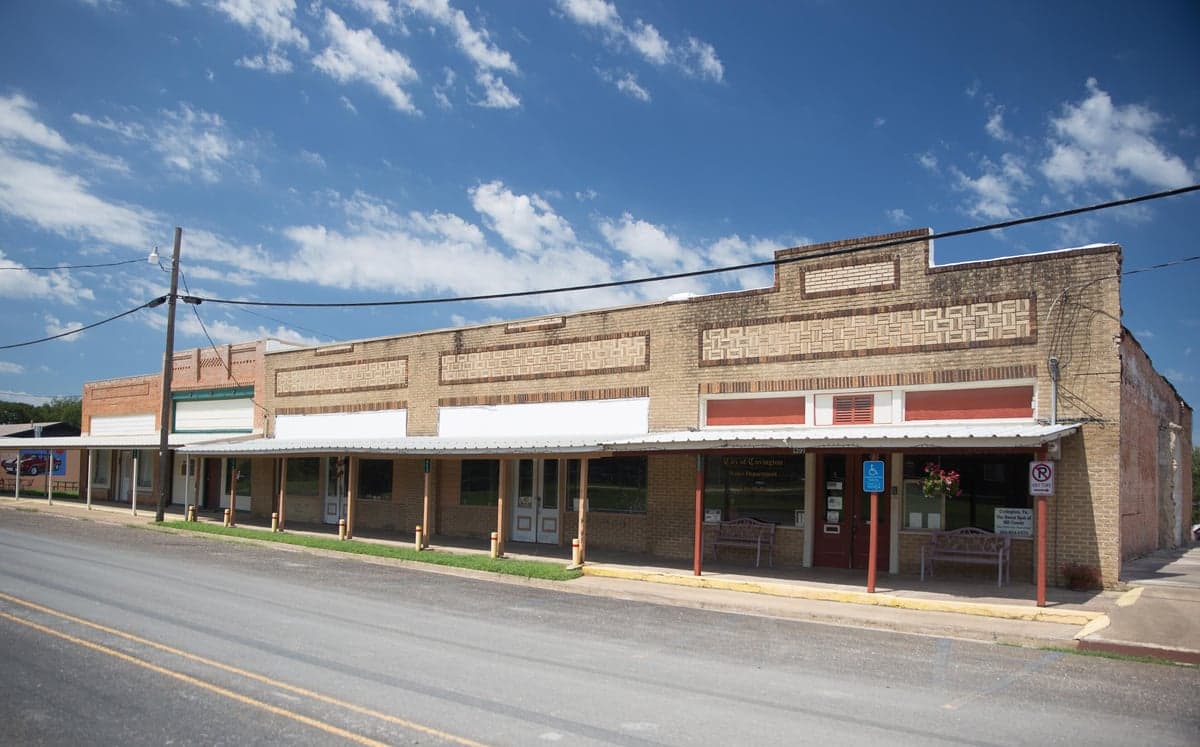
Photo: Wikipedia
Demographics of Covington, TX
Affluence Level in Covington, TX
A middle-class area roughly in line with national averages across income, home values, education, and employment.
People of Covington, TX
Covington, Texas, is a small, tight-knit community of 294 residents where the population is overwhelmingly White (81.6%) and native-born (99.3% U.S.-born). The city’s character is defined by its rural, agricultural roots and a strong sense of local tradition, with a notably low college attainment rate of 19.5% reflecting a workforce oriented toward trades, farming, and local services. With a Hispanic population of 16.0% and no recorded Black, Asian, or Indian residents, Covington remains one of the most ethnically homogeneous towns in Hill County, a place where family ties and land ownership anchor the social fabric.
How the city was settled and grew
Covington’s population history begins in the mid-19th century, when the area was part of the Peters Colony land grant system that attracted Anglo-American settlers from the Upper South and Midwest. The town was officially platted in 1854 along the route of the Houston and Texas Central Railroad, which made it a shipping point for cotton and livestock. The original settlers were predominantly farmers of English, Scottish, and Irish descent, who established homesteads in what is now Old Town Covington, the historic core around the railroad depot. A second wave arrived after the Civil War, when families from the war-ravaged South moved into the surrounding Prairie View District, a stretch of fertile blackland prairie east of town. These early residents built the town’s first churches, a school, and a cotton gin, laying the foundation for a community that would remain overwhelmingly White and rural for over a century. By 1900, Covington’s population had reached roughly 400, but the decline of cotton farming and the rise of larger regional centers like Hillsboro and Waco caused a slow, steady outmigration through the mid-20th century.
Modern era (post-1965)
After the 1965 Immigration and Nationality Act reshaped American demographics nationally, Covington saw virtually no foreign-born influx. The 0.7% foreign-born share today is among the lowest in Texas, and the city’s population actually shrank from about 350 in 1970 to 294 by 2020. The modest Hispanic growth — from near zero in 1980 to 16.0% today — came primarily from domestic migration of Mexican-American families from nearby counties, settling in the Southside Addition, a small subdivision of mobile homes and ranch-style houses built in the 1990s along Farm to Market Road 67. Meanwhile, the White population remained dominant, concentrated in the older North Covington neighborhood, where century-old farmhouses and newer modular homes sit on large lots. No significant Black, Asian, or Indian communities developed, as Covington lacked the industrial or service-sector jobs that attracted those groups to larger Texas cities. The population has aged notably — the median age is 44.5 — as younger adults have left for college or employment in the Dallas-Fort Worth metroplex, an hour’s drive north.
The future
Covington’s population is projected to remain stable or decline slightly over the next decade, with no major new housing developments or employers on the horizon. The Hispanic share is likely to grow gradually, possibly reaching 20-22% by 2040, as families from the broader Hill County area move in for affordable land and lower property taxes. However, the city’s extreme homogeneity — 0.0% Black, Asian, and Indian — is unlikely to change significantly, as Covington lacks the diversity drivers (universities, large employers, refugee resettlement) found in metropolitan Texas. The Lakeview Estates subdivision, a small cluster of homes built in the early 2000s near Lake Whitney, has attracted a handful of retirees from outside the area, but these newcomers are predominantly White and over 55. The cultural identity of Covington remains deeply tied to its agricultural past, with community life centered on the Covington Volunteer Fire Department, the annual Homecoming celebration, and the local Baptist church.
For someone moving in now, Covington offers a quiet, low-cost, and culturally stable environment where neighbors know each other and change comes slowly. It is not a place of rapid growth or demographic transformation, but rather a community that has preserved its rural character and racial composition for over 150 years. New residents should expect a close-knit, conservative social atmosphere with limited amenities and a population that values continuity over change.

* Values derived from national, state, county, city and local statistics and may differ in a specific area. Last updated: 2026-08-26T02:47:41.000Z
Narrative content on this page is AI-generated and may contain mistakes. Verify any details that matter before acting on them.
ReloMaps may earn a commission from affiliate links at no extra cost to you.

