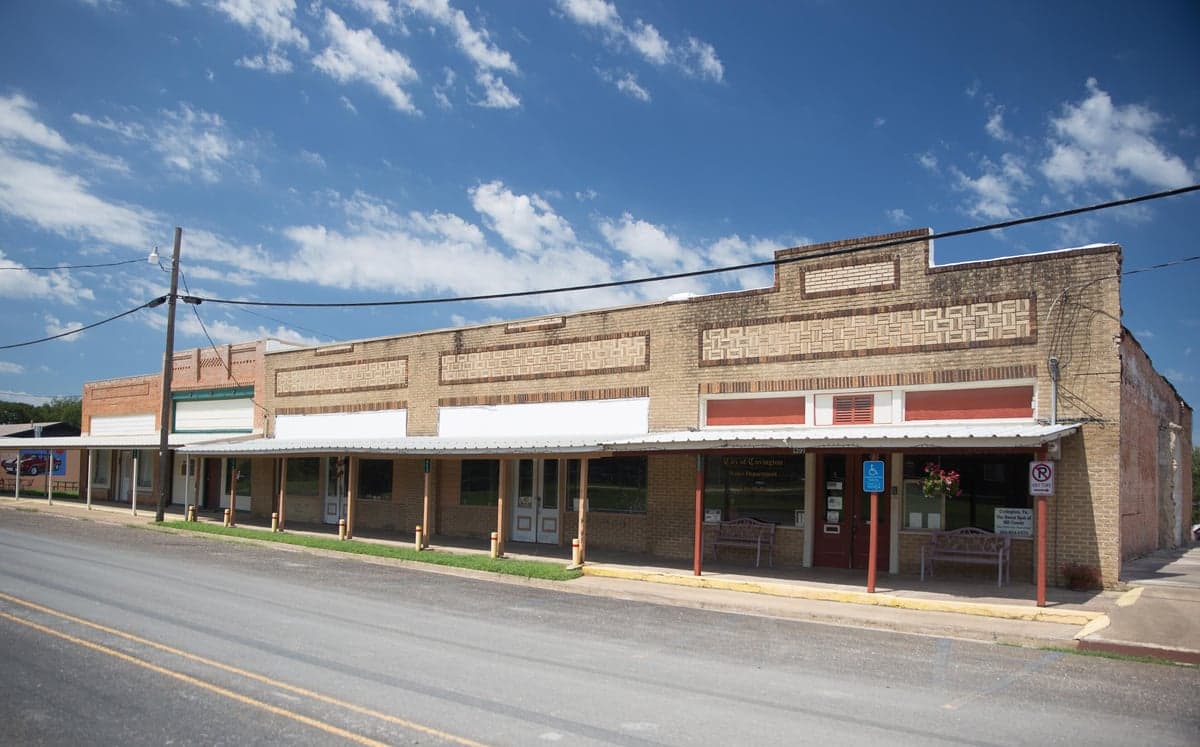
Photo: Wikipedia
Political ClimatePolitical Climate in Covington, TX
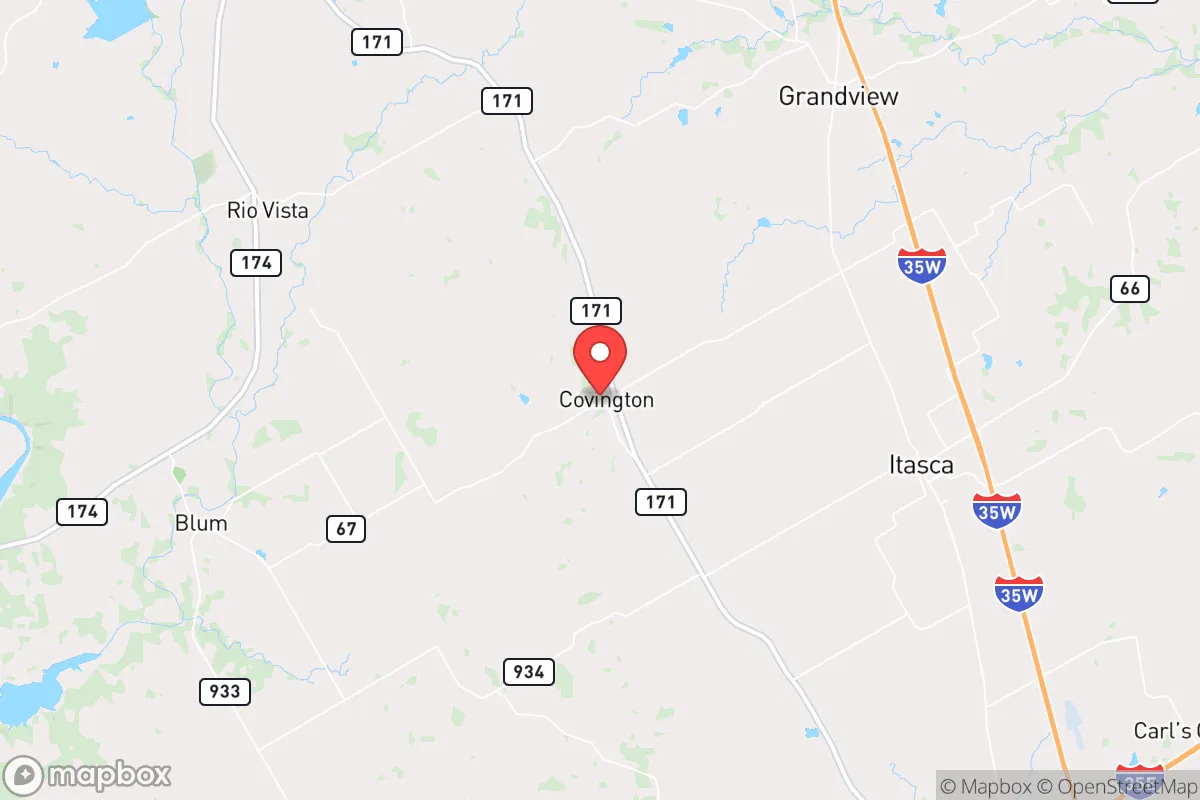
District shown is the primary district for this city’s centroid. Cities may span multiple districts.
Local Political AnalysisPolitical Analysis of Covington, TX
Covington, Texas, is about as reliably red as it gets in the Lone Star State, with a Cook Partisan Voting Index (PVI) of R+14. That’s a full ten points more conservative than the state of Texas as a whole, which sits at R+4. If you’re looking at a map of Hill County, Covington is the deep crimson dot in the middle. The area has been trending steadily rightward for the last two decades, and there’s no sign of that slowing down. The local Republican primary is where most real decisions get made, and Democratic candidates rarely crack 35% in countywide races.
How it compares
To put Covington’s R+14 in perspective, it’s more conservative than the vast majority of Texas counties outside the Panhandle and Deep East Texas. The state’s R+4 PVI already leans Republican, but that number is pulled down by blue metros like Houston, Dallas, Austin, and San Antonio. Covington, by contrast, sits in a rural pocket where the political culture is uniform and unchallenged. Drive 30 minutes south to Hillsboro, and you’ll find a similar vibe. But head 45 minutes east to Waxahachie, and you start seeing more suburban swing voters. Head an hour west to Fort Worth, and the mix gets even more diverse. Covington itself is insulated from those trends; it’s a small town where most folks know their neighbors’ politics, and the local newspaper’s letters to the editor are overwhelmingly conservative. The trajectory here is a slow, steady hardening of the existing lean—not a sudden shift, but a quiet consolidation.
What this means for residents
For conservative residents, Covington is comfortable. Local policy reflects their values without much friction. The county commission, school board, and city council are all reliably Republican, and issues like gun rights, low taxes, and limited regulation are baked into the local conversation. For liberal residents, life is more about finding your niche. You won’t face open hostility—Covington is a polite place—but you’ll be in a clear minority. Political discussions at the coffee shop or the feed store will assume a conservative baseline. If you’re progressive, you’ll likely keep your views to yourself in public settings, or find like-minded folks through online groups or occasional meetups in nearby Cleburne or Burleson, which are slightly more moderate. The practical reality is that local elections are decided in the Republican primary, so if you’re not voting in that primary, your voice has limited impact on who runs the town.
One cultural distinction worth noting: Covington’s politics are deeply tied to its rural identity. This isn’t a place where national culture wars dominate daily life—people care more about property taxes, school funding, and the local volunteer fire department than about cable news talking points. The area’s strong religious conservative bent shows up in things like Sunday morning closures and the prominence of local churches, but it’s a lived conservatism, not a performative one. Over the next decade, expect Covington to stay the course. The surrounding Hill County will likely get a little redder as suburban growth from the DFW metroplex pushes further out, but the town itself is small enough to resist major demographic change. For anyone moving here, the political climate is stable, predictable, and deeply rooted in local tradition.

State Political ClimatePolitical Climate in Texas
State Political AnalysisPolitical Environment in the State
Texas is a solidly Republican state with a Cook PVI of R+4, but that number barely hints at the political earthquake happening beneath the surface. For the past two decades, the state has been a one-party GOP stronghold at the statewide level—no Democrat has won a statewide office since 1994—but the margin has been shrinking in presidential races, from a 16-point Romney win in 2012 to a 9-point Trump win in 2020 and a 5.5-point Trump win in 2024. The real story is the collision between fast-growing, diversifying urban centers and a deeply conservative rural and exurban base that still controls the legislature and the governor’s mansion.
Urban vs. rural divide
The political map of Texas is a tale of two landscapes. The state’s biggest metros—Houston, Dallas-Fort Worth, San Antonio, and Austin—are increasingly blue, with Harris County (Houston) and Dallas County flipping from red to blue over the past decade. Austin’s Travis County is the bluest urban core in the state, consistently voting 70%+ Democratic, while El Paso is a reliably Democratic stronghold along the border. But the rest of the state is deeply red: the Panhandle (Lubbock, Amarillo), East Texas (Tyler, Longview), and the sprawling suburbs of Fort Worth’s Tarrant County—which flipped blue in 2020 but snapped back red in 2024—still anchor the GOP. The rural-urban divide is stark: in 2024, Loving County (population ~60) voted 96% Republican, while Travis County voted 77% Democratic. The fastest-growing exurbs like Comal County (New Braunfels) and Kendall County (Boerne) are among the most conservative in the state, pulling the overall map rightward even as the big cities get bluer.
Policy environment
Texas’s policy environment is a textbook example of small-government conservatism with a heavy dose of social conservatism. The state has no personal income tax, relying instead on high property taxes (among the top 10 in the nation) and a regressive sales tax. The regulatory posture is famously business-friendly: no state-level occupational licensing for many trades, weak environmental enforcement, and a “right-to-work” law that has kept union membership below 5%. On education, the state funds schools primarily through local property taxes, leading to wide disparities between wealthy suburbs and poor rural districts. School choice is a live issue: in 2023, the legislature passed a universal education savings account program (HB 1) after years of failed attempts, allowing families to use state funds for private school tuition. Healthcare policy is marked by the state’s refusal to expand Medicaid under the ACA, leaving roughly 1.5 million uninsured adults in the “coverage gap.” Election laws have tightened: SB 1 (2021) banned 24-hour and drive-through voting, imposed new ID requirements for mail ballots, and gave partisan poll watchers more access. The state also has a near-total abortion ban (SB 8, the “Heartbeat Act,” and the trigger law that took effect after Dobbs) with no exceptions for rape or incest, and a strict permitless carry law (HB 1927, 2021) that allows most adults to carry handguns without a license.
Recent policy direction
The last five years have seen Texas lurch further right on nearly every front. On gun and self-defense law, the 2021 permitless carry law (HB 1927) was followed by a 2023 law (HB 17) that prohibits state and local law enforcement from enforcing federal gun laws, effectively creating a state-level nullification of federal firearms regulations. On parental and education rights, the 2023 “Parental Bill of Rights” (HB 900) requires schools to post curriculum materials online and allows parents to challenge library books, while a separate law (SB 17) banned diversity, equity, and inclusion offices at public universities. On speech and privacy, the state passed a social media law (HB 20, 2021) that prohibits platforms from moderating content based on viewpoint—a law currently tied up in court—and a 2023 law (SB 8) that criminalizes “harmful” drag performances in front of minors. On medical and bodily autonomy, the abortion ban is the most restrictive in the nation, and the state has also banned gender-affirming care for minors (SB 14, 2023). On property rights, the legislature passed a homestead exemption increase in 2023 (Proposition 4) that raised the exemption from $40,000 to $100,000, providing some property tax relief. On voting and ballot access, the 2021 SB 1 was followed by a 2023 law (SB 2) that created a new election police unit within the Secretary of State’s office, with the power to investigate voter fraud—a move critics call voter intimidation. The overall direction is toward more state preemption of local control, especially on issues like abortion, guns, and immigration.
Civil unrest & political movements
Texas has seen its share of political flashpoints. The 2020 protests in Austin and Houston over George Floyd’s murder were among the largest in the country, with Austin seeing 30 consecutive nights of demonstrations. The state’s immigration politics are a constant battleground: Governor Abbott’s “Operation Lone Star” (2021) deployed state troopers and National Guard to the border, bused migrants to Democratic-led cities, and led to a standoff with the Biden administration over border enforcement. The “sanctuary city” debate is ongoing: SB 4 (2017) banned sanctuary policies and allowed police to inquire about immigration status, though parts of it were struck down. Secession rhetoric flares up periodically—the Texas Nationalist Movement pushes for independence, but it’s a fringe group with no real political power. Election integrity controversies have been a constant since 2020, with the GOP-controlled legislature passing multiple bills to tighten voting rules, while Democrats and voting rights groups have sued repeatedly. A new resident would notice the political polarization in everyday life: yard signs, bumper stickers, and even church affiliations often signal political allegiance, especially in the suburbs.
Projection
Over the next 5-10 years, Texas will likely remain Republican at the statewide level, but the margin will continue to shrink. The state is growing by roughly 1,000 people per day, and most of those newcomers are moving to the blue-leaning metros (Austin, Dallas, Houston) or the purple-ish suburbs (Collin County, Williamson County). The Hispanic vote is the wild card: while the state’s Hispanic population is growing, the GOP has been making inroads with working-class Hispanic voters, especially in the Rio Grande Valley (Hidalgo County flipped from 2x Obama to Trump in 2020 and stayed red in 2024). The suburban shift is real: places like Fort Bend County (southwest of Houston) have gone from solid red to competitive, and Tarrant County is a bellwether that could flip permanently blue within a decade. But the rural and exurban growth—places like Comal, Kendall, and Montgomery counties—is also booming, and those areas are getting redder. The legislature will likely stay in GOP hands through the 2030 redistricting cycle, meaning the policy direction (no income tax, abortion ban, school choice, gun rights) is stable. A new resident moving in now should expect a state that remains conservative on fiscal and social issues, but with a growing, vocal progressive minority that will keep the political temperature high.
Bottom line for a new resident: If you’re conservative, you’ll find a state that largely aligns with your values—low taxes, strong gun rights, school choice, and a government that stays out of your business. If you’re liberal, you’ll find a state where your vote matters less at the statewide level, but where you can live in a blue city (Austin, Houston, Dallas) that feels like a different country from the rural areas. The practical takeaway is that Texas is a big, diverse state where your experience depends heavily on where you live—and the political climate is likely to stay contentious but stable for the foreseeable future.
* Values derived from national, state, county, city and local statistics and may differ in a specific area. Last updated: 2026-08-26T02:47:41.000Z
Narrative content on this page is AI-generated and may contain mistakes. Verify any details that matter before acting on them.
ReloMaps may earn a commission from affiliate links at no extra cost to you.

