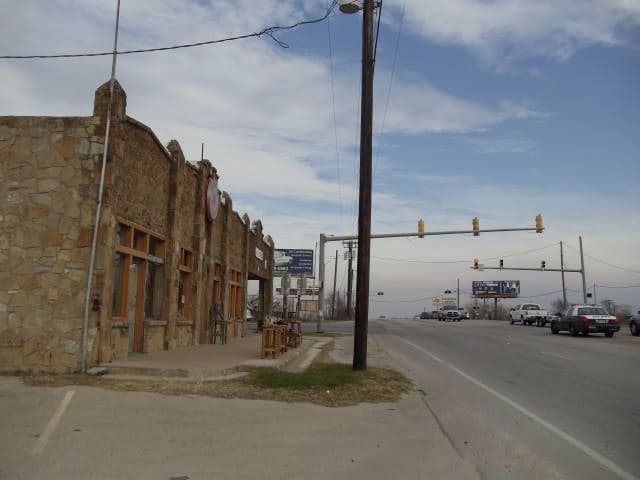
Photo: Wikipedia
Personal Sovereignty in Cresson, TX
Strong independent fundamentals that actively favor personal liberty and low regulation.
What does Personal Sovereignty tell us?
Personal Sovereignty measures your capacity for self-reliance and independence with minimal government friction. Higher scores mean fewer barriers between you and the way you want to live... but it assumes you have the space you need and good neighbors.
What does this tell us?
Personal Sovereignty measures your capacity for self-reliance and independence with minimal government friction. Higher scores mean fewer barriers between you and the way you want to live... but it assumes you have the space you need and good neighbors.
State Policy
Energy independence: Net exporter (220% of energy produced in-state)
Personal Liberty
Homesteading

Personal Liberty Analysis
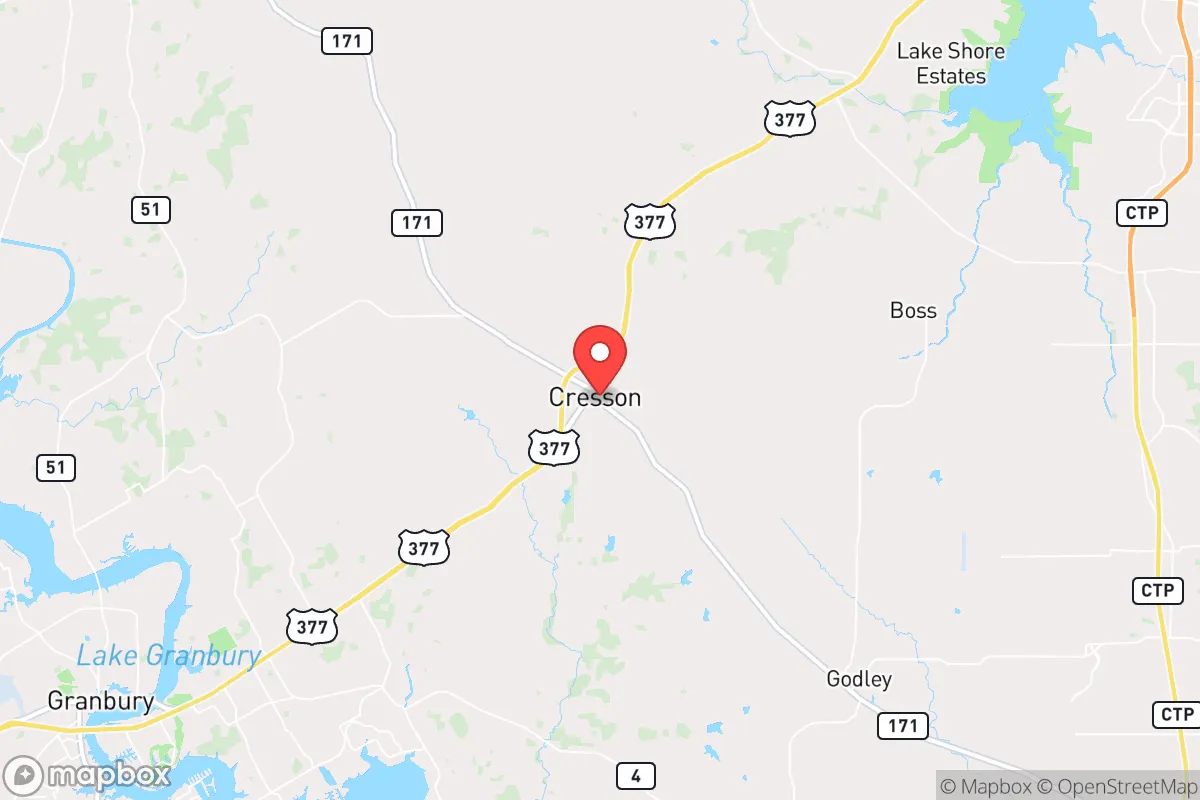
Cresson, Texas, offers a notably high degree of personal sovereignty, largely because it sits at the intersection of two counties—Hood and Parker—both of which lean heavily toward limited government and individual liberty. For the survivalist or prepper, this means fewer layers of municipal code enforcement, lower taxes, and a general cultural expectation that you handle your own affairs without government interference. The town’s small population (roughly 800–1,000 residents) and rural character amplify this autonomy, as neighbors tend to know each other and local officials are accessible. If your primary concern is preserving freedom of action—whether in self-defense, property use, or family decisions—Cresson provides a legal and social environment that is far more permissive than what you’d find in most suburban or urban areas of Texas or the nation.
Tax burden and regulatory posture: how local and state policies affect your autonomy
Texas has no state income tax, which immediately puts more money in your pocket and reduces the government’s claim on your earnings. In Cresson, property taxes are the main revenue source, but the rates are moderate compared to many Texas counties: Hood County’s effective property tax rate hovers around 1.2–1.4% of assessed value, while Parker County’s is similar. There is no city property tax because Cresson is an unincorporated community—meaning you answer to the county, not a municipal council that might impose additional fees or ordinances. This regulatory posture is a major advantage for preppers. You won’t face city-level restrictions on burning, noise, or building permits that are common in incorporated towns. The county’s approach is generally hands-off: as long as you’re not creating a public nuisance, you’re free to modify your property, store supplies, or construct outbuildings without excessive red tape. This lack of municipal oversight is a key reason Cresson attracts those seeking to minimize government entanglement in daily life.
Self-defense and gun law specifics: what you can legally do to protect yourself and your family
Texas is a constitutional carry state, meaning you can carry a handgun openly or concealed without a permit if you’re legally allowed to possess a firearm. Cresson falls under the jurisdiction of Hood and Parker counties, both of which have sheriffs’ offices that are generally supportive of Second Amendment rights. There are no local ordinances that restrict magazine capacity, firearm types, or storage requirements beyond state law. For the survivalist, this is critical: you can keep a defensive rifle, handgun, or shotgun in your vehicle or home without worrying about local bans. Stand-your-ground laws apply fully, so there is no duty to retreat before using deadly force if you reasonably believe it’s necessary to prevent death or great bodily harm. Castle doctrine protections extend to your home, vehicle, and workplace. If you’re concerned about government overreach into self-defense, Cresson’s legal environment is about as favorable as it gets in the continental U.S. The only caveat is that you must still comply with state and federal laws regarding felons, domestic violence convictions, and mental health adjudications—but for law-abiding citizens, the freedom to arm yourself is nearly absolute.
Self-reliance and homesteading viability: lot sizes, zoning, and off-grid feasibility
Cresson’s rural zoning and large lot sizes make it a prime location for homesteading and off-grid living. Most residential parcels are 1 to 10 acres, with many properties exceeding 5 acres—enough space for a substantial garden, livestock, and rainwater catchment systems. There is no city zoning board to approve your plans; county regulations are minimal. You can build a detached workshop, a root cellar, or a greenhouse without permits in most cases, as long as you meet basic setback requirements. Off-grid feasibility is high: many residents already use private wells and septic systems, and solar panels are common. The county does not prohibit composting toilets, greywater systems, or alternative energy sources. If you want to raise chickens, goats, or even a few head of cattle, there are no restrictive ordinances to stop you. The main limitation is that you must still comply with Texas health codes if you sell any produce or meat, but for personal consumption, you’re essentially free to produce your own food and water. This self-reliance is a core draw for preppers who want to reduce dependence on fragile supply chains and municipal utilities.
Personal liberties: parental rights, medical autonomy, speech, and property
Texas has strong legal protections for parental rights, and Cresson’s conservative culture reinforces them. Parents have the authority to direct their children’s education, including homeschooling without onerous state oversight—you simply need to submit a curriculum and annual assessment, but there are no home visits or mandatory testing requirements. Medical autonomy is also robust: Texas law allows parents to refuse vaccinations for their children for religious or philosophical reasons, and there is no state-level mandate for COVID-19 or other vaccines. In Cresson, you will not face pressure from local health departments to comply with public health orders that infringe on personal choice. Free speech is protected by the First Amendment, and local law enforcement does not enforce any “hate speech” or social media censorship laws—those are federal or corporate matters. Property rights are strong: eminent domain is rarely used for private development, and the county respects your right to use your land as you see fit, provided you don’t create a public hazard. For the survivalist, this means you can store supplies, build defensive structures, and maintain a low profile without fear of government intrusion.
Overall, Cresson ranks among the most sovereignty-friendly communities in Texas for those with a prepper or survivalist mindset. The combination of no city government, low taxes, constitutional carry, large lots, and minimal zoning creates an environment where you can live largely on your own terms. Compared to areas like Austin or Dallas, where municipal codes and progressive politics increasingly restrict personal freedoms, Cresson offers a refuge where government overreach is minimal and self-reliance is the norm. If your goal is to secure your family’s autonomy in an uncertain world, this small town provides the legal and practical foundation to do so—without having to move to a remote, off-grid location that lacks community support or access to supplies.

* Values derived from national, state, county, city and local statistics and may differ in a specific area. Last updated: 2026-04-28T20:26:09.000Z
Narrative content on this page is AI-generated and may contain mistakes. Verify any details that matter before acting on them.
ReloMaps may earn a commission from affiliate links at no extra cost to you.

