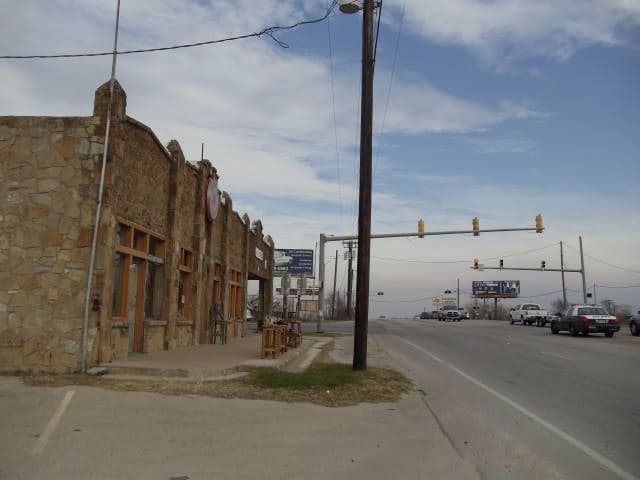
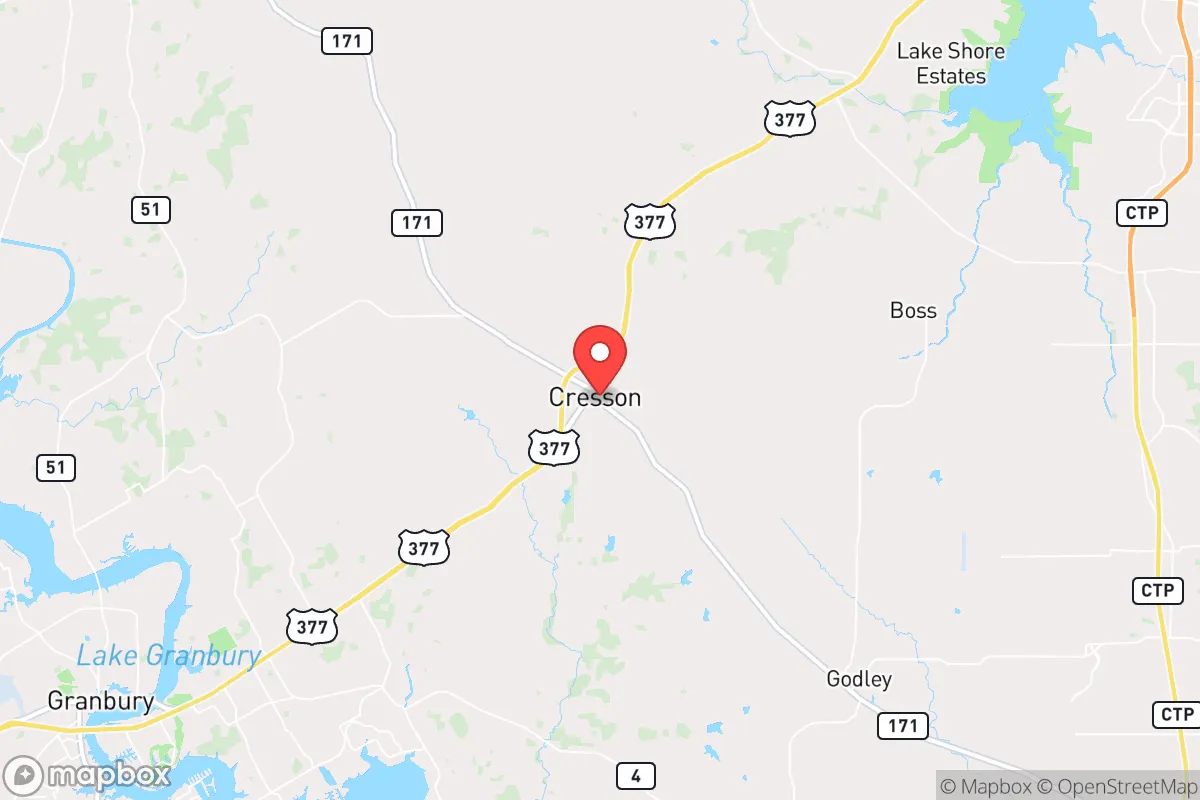
Photo: Wikipedia
Political ClimatePolitical Climate in Cresson, TX
District shown is the primary district for this city’s centroid. Cities may span multiple districts.
Local Political AnalysisPolitical Analysis of Cresson, TX
Cresson, Texas, sits squarely in deep-red territory, with a Cook PVI of R+18 that puts it among the most reliably conservative pockets in the state. That’s not just a number on a map—it’s the lived reality here, where folks have voted overwhelmingly Republican for as long as anyone can remember, and the 2024 election only reinforced that trend. The political lean here isn’t just about party labels; it’s a gut-level commitment to limited government, personal responsibility, and the kind of freedom that lets you live your life without a bureaucrat breathing down your neck. But I’ve been around long enough to see the winds shifting, and while Cresson itself holds firm, the pressure from nearby areas is something you can feel if you pay attention.
How it compares
Drive ten miles east to Burleson, and you’ll start noticing a different vibe—more suburban sprawl, more transplants from blue states, and a political temperature that’s a few degrees cooler than Cresson’s. Burleson still leans right, but it’s not the same rock-solid conservative base we have here. Head south to Granbury, and you’re back in familiar territory—another R+18 stronghold where the local government actually respects the Second Amendment and property rights. The real contrast, though, is with Fort Worth, about 25 miles north. That city’s been sliding left for years, with city council votes that feel more like Austin-lite than Texas common sense. Cresson’s advantage is that we’re far enough from that urban machine to keep our independence, but close enough that the overreach from county or state levels can still reach us if we’re not vigilant. The surrounding rural areas—like Hood and Johnson counties—are cut from the same cloth as Cresson, but the growth corridors are bringing in folks who don’t always share our values.
What this means for residents
For those of us who’ve been here a while, the political climate means we can still count on local schools to teach basics without indoctrination, and the sheriff’s office isn’t going to enforce federal gun grabs. But it also means we have to stay active—town hall meetings, school board elections, and county commissioner races matter more than ever. The biggest concern I see is the creeping influence of state-level policies that try to centralize control, like when the governor mandates business closures or vaccine passports. That’s the kind of government overreach that makes you wonder who’s really in charge. Cresson residents tend to push back hard on that stuff, but it takes constant effort. The good news is that our local leaders are still accountable to the people, not to party bosses or outside interests. If you value your right to make your own choices—whether it’s about your kids’ education, your healthcare, or your business—this is still a place where that’s respected.
Culturally, Cresson has a few distinctions that set it apart from the broader region. We don’t have the flashy politics of a big city; it’s more about neighbor-to-neighbor trust and a shared understanding that freedom isn’t free. The local churches and civic groups are the real power brokers, not political action committees. That said, I’ve noticed a subtle shift in the last five years—more young families moving in from California and Colorado, and while most of them seem to appreciate the conservative values, a few bring progressive ideas about zoning, environmental regulations, or “equity” programs that sound an awful lot like the same overreach we moved here to escape. If that trend accelerates, Cresson could face the same battles that turned places like Denton or San Marcos from conservative havens into progressive experiments. For now, though, the R+18 rating holds, and the community’s backbone is still strong. But we’re watching closely, because the moment we stop paying attention is the moment we lose what makes this place worth living in.

State Political ClimatePolitical Climate in Texas
State Political AnalysisPolitical Environment in the State
Texas has been a solidly Republican state for the past three decades, but the coalition that keeps it red is shifting under your feet. The GOP still holds every statewide office and both legislative chambers, but the margin of victory in presidential races has shrunk from 16 points in 2012 to about 5.5 points in 2024. The dominant coalition remains a mix of rural conservatives, suburban moderates, and a growing number of Hispanic voters in the Rio Grande Valley who have drifted right. However, the explosive growth of the Austin-San Antonio corridor and the Dallas-Fort Worth suburbs is injecting a steady stream of out-of-state transplants, many from blue states, who are gradually pulling the state toward a more competitive posture. If you’re looking at Texas as a relocation option, you need to understand that the political landscape is not static — it’s a battleground in slow motion.
Urban vs. rural divide
The political map of Texas is a textbook case of the urban-rural chasm. The big blue dots are Austin (Travis County), El Paso, and Houston (Harris County), which together deliver massive Democratic margins. Travis County went +50 points for Biden in 2020, and Harris County, despite trending redder in 2024, still votes comfortably blue. Meanwhile, the vast rural expanse — places like the Panhandle around Lubbock, East Texas timber country, and the Hill Country west of San Antonio — votes Republican by 60-80 point margins. The real action is in the suburbs. Collin County (north of Dallas) was once a GOP fortress, but it flipped from +27 R in 2016 to +12 R in 2024 as transplants from California and Illinois moved into Frisco and Plano. Similarly, Fort Bend County (southwest of Houston) flipped to Biden in 2020 and stayed blue in 2024, driven by a diverse, college-educated population. The Rio Grande Valley counties like Hidalgo and Cameron are the wild card — they shifted hard toward Trump in 2020 and 2024, surprising many analysts and suggesting that Hispanic working-class voters are up for grabs.
Policy environment
Texas’s policy environment is defined by a low-tax, low-regulation posture that conservatives generally admire. There is no state income tax — the state relies on property taxes and a 6.25% sales tax (local add-ons can push it to 8.25%). The regulatory climate is business-friendly, with no state-level occupational licensing for many trades and a right-to-work law that weakens union power. On education, the state passed a school voucher-like program in 2023 (HB 3) that creates education savings accounts for special-needs students, with expansion to all students expected soon. However, the state’s public school funding formula remains a perennial fight, and teacher pay lags behind inflation. On healthcare, Texas did not expand Medicaid under the ACA, leaving about 1.5 million adults in the coverage gap — a fact that frustrates some conservatives who see it as a federal overreach issue. Election laws tightened after 2020 with SB 1, which banned 24-hour and drive-through voting, added ID requirements for mail ballots, and empowered partisan poll watchers. For a conservative moving in, the policy environment is largely aligned with limited government principles, but the property tax burden is real — Texas has the 7th-highest effective property tax rate in the nation.
Trajectory & freedom
On the freedom front, Texas has been a mixed bag in recent years. The good news for gun owners: permitless carry (HB 1927) became law in 2021, meaning any law-abiding adult can carry a handgun without a license. The state also passed a Second Amendment Sanctuary law in 2021 that prohibits state agencies from enforcing federal gun laws that don’t exist in state code. On parental rights, Texas passed the READER Act in 2023, which requires schools to post all instructional materials online and allows parents to challenge books they deem inappropriate — a direct response to the critical race theory and library content debates. On medical freedom, the state banned COVID-19 vaccine mandates for private employers (SB 7 in 2023) and prohibited mask mandates in schools. However, there are concerning trends. The state’s property tax burden has risen faster than inflation, and while the legislature passed a $18 billion property tax cut in 2023, it was a one-time compression, not a permanent rate reduction. On speech, the state’s anti-BDS law (requiring contractors to pledge not to boycott Israel) was struck down by the Fifth Circuit in 2024 as a First Amendment violation — a reminder that even conservative states can overreach. The trajectory is toward more individual liberty on guns, education, and medical choices, but the property tax issue remains a ticking time bomb for middle-class homeowners.
Civil unrest & political movements
Texas has seen its share of political flashpoints. The 2020 Black Lives Matter protests in Austin were among the largest and most destructive in the country, with the city council later defunding the police by $150 million — a decision that was partially reversed after a backlash. The border crisis has been a constant source of tension. Governor Abbott’s Operation Lone Star, launched in 2021, deployed state troopers and National Guard to the border, bused migrants to sanctuary cities like New York and Chicago, and installed razor wire along the Rio Grande. This has created a running legal battle with the Biden administration, with the Supreme Court ruling in 2024 that federal agents could remove the wire — a decision that sparked outrage among conservatives. The secessionist movement, Texas Nationalist Movement, remains a fringe group with no real political power, but the rhetoric around “Texit” flares up whenever federal overreach is perceived. Election integrity remains a hot-button issue: the 2020 election saw no evidence of widespread fraud, but the 2021 voting law (SB 1) was passed in response to Democratic efforts to expand mail-in voting during the pandemic. A new resident will notice the political tension most acutely in the suburbs — yard signs, bumper stickers, and local school board meetings are where the culture war plays out daily.
Projection
Over the next 5-10 years, Texas is likely to become more competitive but not flip blue statewide. The demographic trends are clear: the state is growing by about 1,000 people per day, and a significant portion of those are from California, New York, and Illinois — states with higher taxes and more progressive governance. These transplants tend to bring their voting habits with them, which is why counties like Collin and Denton are shifting left. However, the Hispanic vote in the Rio Grande Valley and the growing Asian-American vote in suburbs like Katy and Pearland are not monolithic — many are socially conservative and economically moderate. The GOP will need to hold the line in the suburbs while expanding in the Valley to stay dominant. The biggest wild card is the state’s abortion law (SB 8, the heartbeat bill) and the near-total ban that followed Dobbs. If this drives suburban women to the polls in large numbers, it could flip a few state House seats and make the legislature more divided. For a conservative moving in now, expect the state to remain red but with a thinner margin — meaning more gridlock in Austin and more pressure on property taxes as the only revenue lever. The freedom trajectory is positive on guns and education, but the property tax issue will force a reckoning within the next decade.
Bottom line for a new resident: Texas is still a place where you can keep more of your money and live with fewer government mandates than in most blue states, but it’s not the libertarian paradise some imagine. The property taxes are high, the political climate is increasingly polarized, and the culture war is fought in every school board meeting. If you’re moving here for freedom, you’ll find it — but you’ll also need to stay engaged to keep it. The state is changing fast, and the people who shape its future are the ones who show up to vote in local elections and attend city council meetings. Don’t expect Texas to stay the same as it was 20 years ago; expect it to be a battleground for the next 20.
* Values derived from national, state, county, city and local statistics and may differ in a specific area. Last updated: 2026-04-28T20:26:09.000Z
Narrative content on this page is AI-generated and may contain mistakes. Verify any details that matter before acting on them.
ReloMaps may earn a commission from affiliate links at no extra cost to you.

