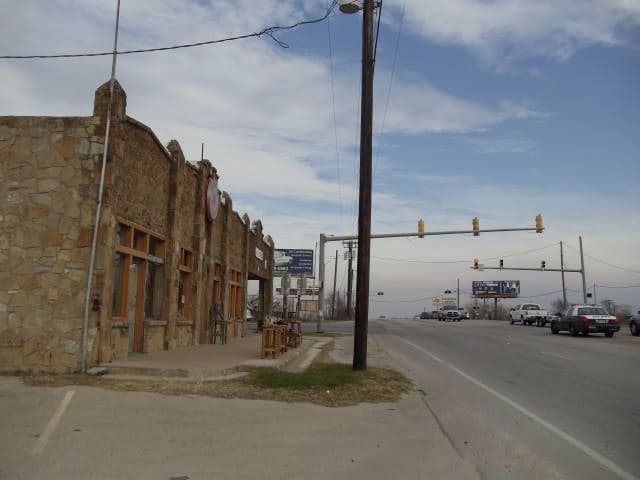
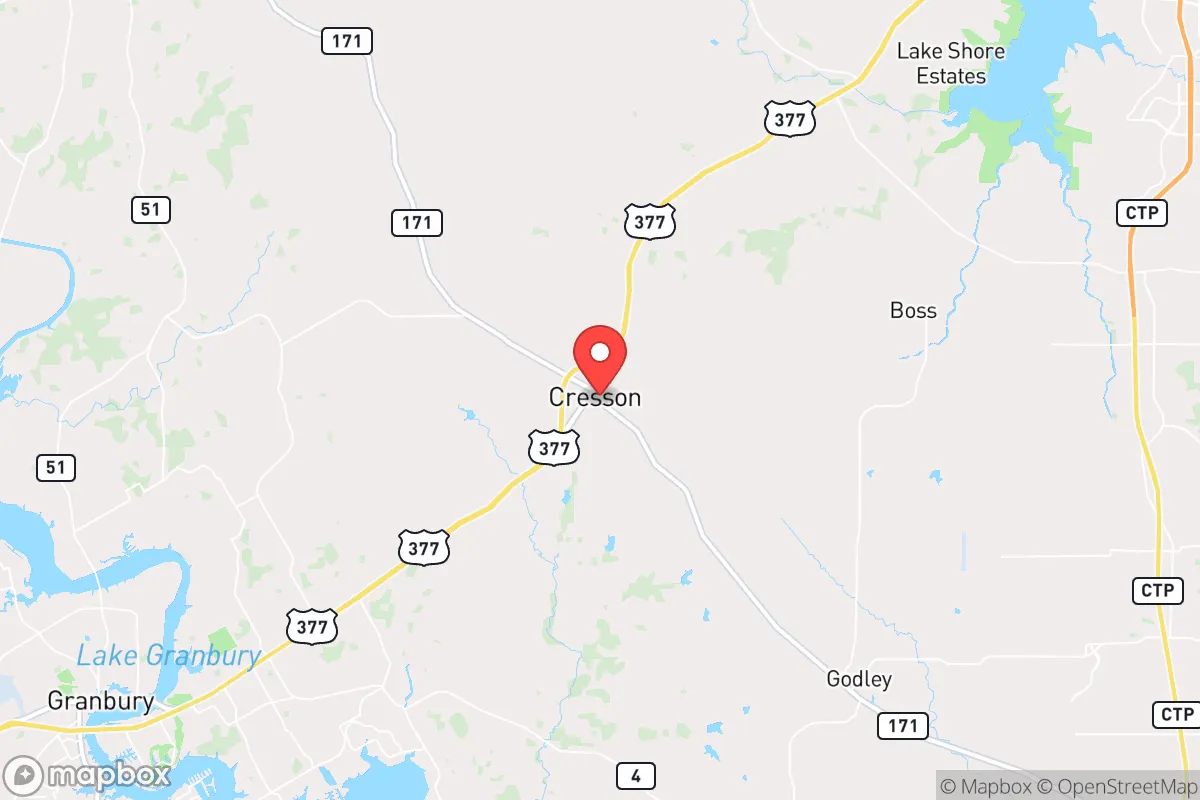
Photo: Wikipedia
Demographics of Cresson, TX
Affluence Level in Cresson, TX
A middle-class area roughly in line with national averages across income, home values, education, and employment.
People of Cresson, TX
The people of Cresson, Texas today number 1,556, forming a small, predominantly White community with a growing Hispanic minority and a notably low foreign-born population of just 0.4%. The city’s identity is rooted in its rural Parker and Hood County setting, with a population density that remains sparse and a character shaped by long-time Texas families and newer suburban arrivals seeking land and quiet. With 22.0% of adults holding a college degree, Cresson is less educated than the national average, reflecting its working-class and agricultural heritage. Distinct neighborhoods like the historic downtown core and newer subdivisions such as Pecan Plantation and DeCordova Bend Estates mark the contrast between old and new residents.
How the city was settled and grew
Cresson was founded in the late 19th century as a railroad stop along the Fort Worth and Rio Grande Railway, drawing its first permanent settlers—primarily Anglo-American farmers and ranchers—to the surrounding blackland prairie. The original population clustered around the depot in what is now Old Town Cresson, a small historic district along Highway 377, where general stores and cotton gins served the agricultural economy. A second wave arrived in the early 1900s as German and Czech families purchased land for wheat and cattle operations, settling in the Briar Oaks area south of the tracks. By 1950, Cresson remained a tiny crossroads hamlet of fewer than 300 residents, almost entirely White and native-born, with no significant immigrant influx. The post-World War II era saw little change until the 1970s, when the construction of nearby Lake Granbury began attracting weekenders and retirees.
Modern era (post-1965)
The 1965 Hart-Cellar Act had negligible impact on Cresson, as the city’s remote location and lack of industrial jobs drew virtually no international immigration. Instead, the modern population shift came from domestic in-migration starting in the 1990s, as Dallas-Fort Worth suburban sprawl pushed families and commuters south along Highway 377. New subdivisions like Pecan Plantation, a large master-planned community straddling the Hood County line, absorbed many of these arrivals—mostly White professionals and retirees seeking lakefront property and larger lots. Hispanic families began moving into Cresson in the 2000s, primarily for construction and service jobs in the expanding DFW exurbs, settling in the Lakewood Estates neighborhood and rental properties near the highway. Today, the city’s racial composition—66.8% White, 18.7% Hispanic, 5.5% Black, and 0.8% East/Southeast Asian—reflects a slow diversification driven entirely by domestic relocation, not foreign immigration. The Black population, though small, is concentrated in the Willow Creek area, a modest subdivision built in the early 2000s. The Indian subcontinent population is effectively zero, and the Asian community remains tiny, limited to a handful of families in Pecan Plantation.
The future
Cresson’s population is projected to grow steadily as DFW exurban development continues, but the city is likely to remain predominantly White and native-born for the foreseeable future. The foreign-born share, already negligible at 0.4%, shows no signs of rising, as the city lacks the rental housing stock, public transit, or ethnic institutions that attract immigrants. The Hispanic share may increase gradually through higher birth rates and continued domestic migration from Texas’s Rio Grande Valley, but these families are assimilating into existing neighborhoods rather than forming distinct enclaves. The East/Southeast Asian and Black populations are expected to plateau or grow only marginally, as Cresson offers few of the professional jobs or cultural amenities that draw these groups to larger suburbs. The city is homogenizing in terms of nativity—becoming more uniformly U.S.-born—while slowly diversifying in ethnicity through Hispanic growth. New developments like Cross Timbers Ranch, a luxury lot subdivision, are attracting wealthier White families from Tarrant County, reinforcing the city’s conservative, land-oriented character.
For someone moving in now, Cresson is becoming a quieter, more affordable alternative to the booming DFW suburbs, with a population that is overwhelmingly native-born, politically conservative, and family-oriented. The city offers a rural lifestyle with easy highway access, but newcomers should expect limited ethnic diversity and a community where long-time residents and recent arrivals are still negotiating shared identity. The next decade will likely see continued growth in the Pecan Plantation and Cross Timbers Ranch areas, while Old Town Cresson remains a historic anchor for the city’s small-town roots.

* Values derived from national, state, county, city and local statistics and may differ in a specific area. Last updated: 2026-04-28T20:26:09.000Z
Narrative content on this page is AI-generated and may contain mistakes. Verify any details that matter before acting on them.
ReloMaps may earn a commission from affiliate links at no extra cost to you.

