Photo: Wikipedia
Demographics of Crete, NE
Affluence Level in Crete, NE
A middle-class area roughly in line with national averages across income, home values, education, and employment.
People of Crete, NE
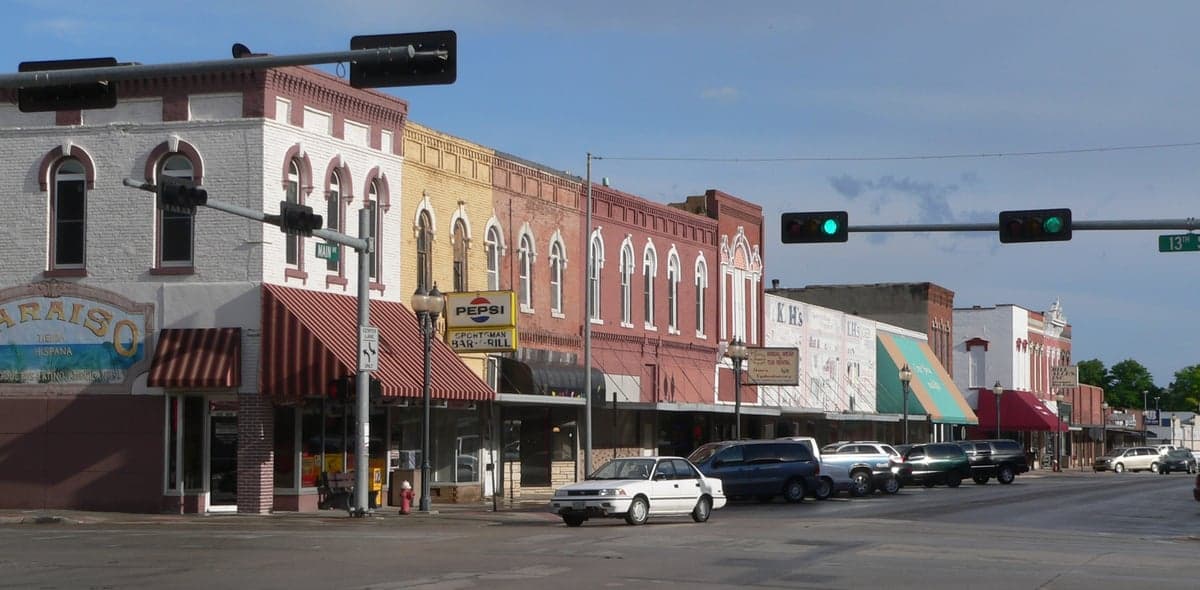
The people of Crete, Nebraska, today form a notably diverse community of 7,521 residents, characterized by a near-even split between White (48.8%) and Hispanic (44.1%) populations, with a significant East/Southeast Asian minority (4.6%) and a foreign-born share of 17.2%—roughly triple the Nebraska state average. This is a working-class, family-oriented town where manufacturing and agriculture anchor the economy, and where only 16.6% of adults hold a bachelor’s degree or higher, reflecting a blue-collar identity. Distinctive markers include a strong Hispanic cultural presence in the central and south-side neighborhoods, a historic Czech and German core in the older north end, and a small but established Vietnamese community concentrated near the industrial corridor along Highway 33.
How the city was settled and grew
Crete was founded in 1871 as a railroad town on the Burlington and Missouri River Railroad line, with the first wave of settlers being Anglo-American homesteaders drawn by the 1862 Homestead Act and the promise of fertile farmland in the Big Blue River valley. By the 1880s, Czech and German immigrants arrived in significant numbers, recruited by railroad land agents and attracted to the area’s agricultural potential and the availability of cheap land. These groups built the original residential core—the North Side Historic District around 10th and Main Streets—where many of the town’s oldest homes and the original Czech-language churches still stand. A smaller wave of Polish and Irish laborers followed in the 1890s, settling in the Railroad Addition neighborhood south of the tracks, which became the working-class heart of the town. The population grew steadily through the early 20th century, reaching 2,500 by 1920, driven by the expansion of Crete Mills (later part of ConAgra) and the Crete State Bank, which provided stable employment. The town’s character remained overwhelmingly White and Protestant through the 1950s, with the Czech and German communities largely assimilating into the broader Anglo culture by mid-century.
Modern era (post-1965)
The 1965 Hart-Cellar Act and subsequent immigration reforms triggered Crete’s most dramatic demographic shift. Starting in the late 1970s, Mexican and Central American immigrants began arriving to work in the town’s meatpacking plants—first at the Crete Packing Company (later part of Tyson Foods) and later at the nearby Lincoln Premium Poultry plant in Fremont. By the 1990s, the Hispanic population had grown to over 20% of the total, concentrated in the South Side neighborhood along South 10th Street and the West End near the industrial park, where affordable rental housing and proximity to plant jobs created a distinct enclave. A smaller wave of Vietnamese refugees arrived in the 1980s, resettled through church sponsorship programs, and established a tight-knit community in the East Side near the Crete Public Schools campus. The White population, meanwhile, began a slow decline as younger families moved to larger cities like Lincoln (25 miles north) for professional jobs, leaving an aging cohort in the North Side Historic District. By 2020, the Hispanic share had risen to 44.1%, while the White share fell to 48.8%, making Crete one of the most ethnically balanced small towns in Nebraska. The East/Southeast Asian population (4.6%) remains stable but small, with most second-generation Vietnamese families now living in the College Heights area near Doane University, reflecting upward mobility into the town’s more middle-class neighborhoods.
The future
Crete’s population is trending toward a continued Hispanic majority, driven by ongoing immigration and higher birth rates among Hispanic families, while the White population is projected to shrink further as out-migration to Lincoln and Omaha continues. The Hispanic community is not tribalizing into a permanent enclave; rather, it is gradually assimilating—second-generation Hispanics are increasingly moving into the North Side Historic District and College Heights, and bilingualism is becoming the norm in public schools, where over 40% of students are English Language Learners. The East/Southeast Asian community appears to be plateauing, with little new immigration from Vietnam or other Asian countries, and younger generations are dispersing to larger cities for college and careers. The foreign-born share (17.2%) is likely to remain high but may shift from Mexican to Central American origins as labor demand in meatpacking persists. Over the next 10-20 years, Crete will likely become a majority-Hispanic town with a significant White minority, a pattern already visible in similar Nebraska towns like Schuyler and Madison. For a conservative-leaning newcomer, this means moving into a community where traditional values (family, church, hard work) are strong across ethnic lines, but where English proficiency and cultural norms are in active transition—especially in the South Side and West End neighborhoods, where Spanish is heard as often as English.
Crete is becoming a working-class, Hispanic-majority town with a stable White minority and a small Asian presence—a place where demographic change is driven by economic opportunity in manufacturing and agriculture, not by gentrification or urban flight. For someone moving in now, the key consideration is whether they are comfortable in a community where cultural and linguistic diversity is the norm, particularly in the South Side and West End, while the North Side Historic District and College Heights offer more traditionally Anglo-American environments. The town’s future is one of gradual integration, not fragmentation, but the pace of change will continue to be shaped by the local labor market and the pull of larger cities for younger, college-bound residents.

* Values derived from national, state, county, city and local statistics and may differ in a specific area. Last updated: 2026-05-03T20:28:58.000Z
Narrative content on this page is AI-generated and may contain mistakes. Verify any details that matter before acting on them.
ReloMaps may earn a commission from affiliate links at no extra cost to you.

