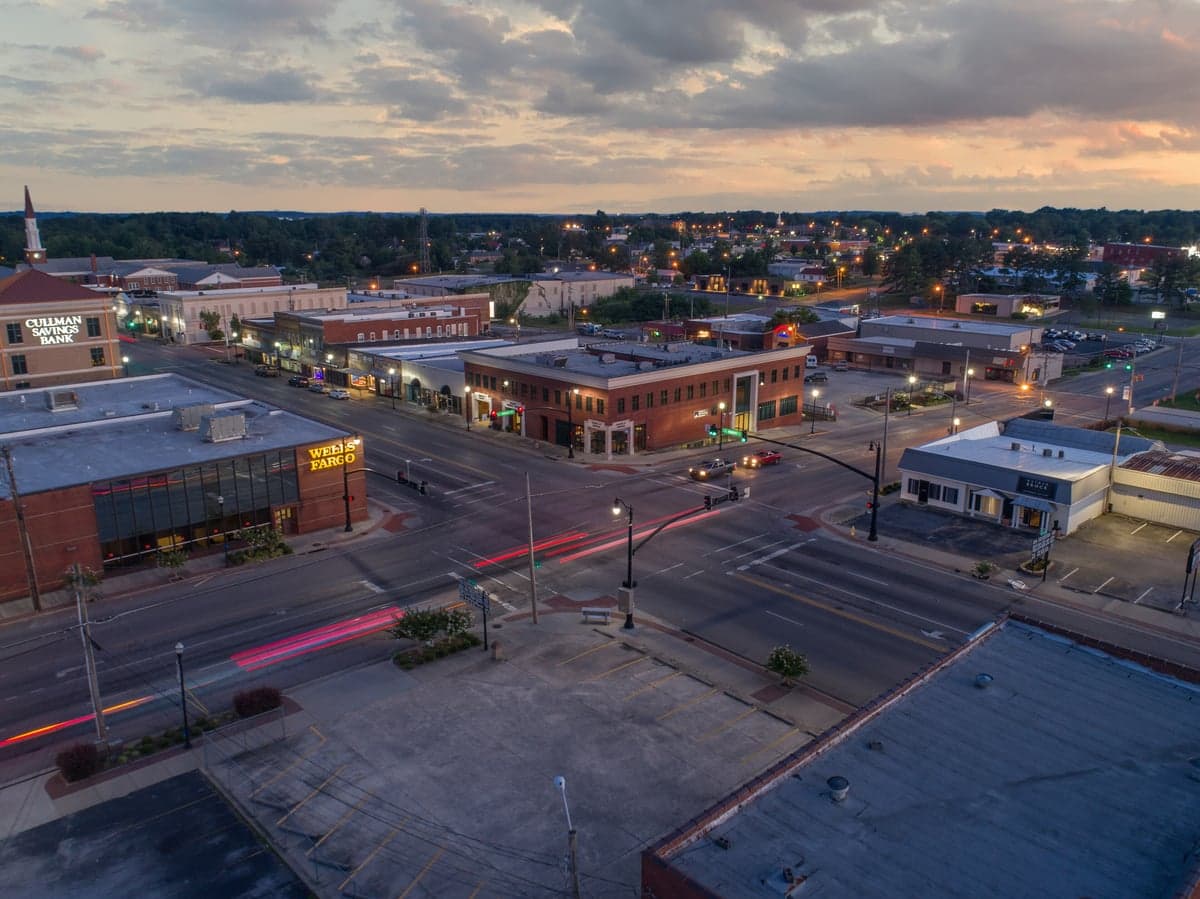
Photo: Wikipedia
Personal Sovereignty in Cullman, AL
Viable for self-reliance. Generally workable, though some barriers may limit total independence.
What does Personal Sovereignty tell us?
Personal Sovereignty measures your capacity for self-reliance and independence with minimal government friction. Higher scores mean fewer barriers between you and the way you want to live... but it assumes you have the space you need and good neighbors.
What does this tell us?
Personal Sovereignty measures your capacity for self-reliance and independence with minimal government friction. Higher scores mean fewer barriers between you and the way you want to live... but it assumes you have the space you need and good neighbors.
State Policy
Energy independence: Importer (45% of energy produced in-state)
Personal Liberty
Homesteading

Personal Liberty Analysis
Cullman, Alabama, offers a notably high degree of personal sovereignty compared to much of the United States, particularly for those who prioritize minimal government interference in daily life. The city and surrounding Cullman County operate within a state framework that consistently ranks among the most freedom-oriented in the nation, with no state-level income tax on wages, a strong preemption law that blocks local gun control ordinances, and a legal culture that generally favors individual rights over collective mandates. For the survivalist or prepper mindset, this translates into a legal environment where self-reliance is not just tolerated but actively protected by state statute, though local zoning and municipal codes in the city proper do impose some limits that require careful navigation.
Tax burden and regulatory posture in Cullman County
Alabama’s tax structure is a major draw for those seeking to maximize personal financial autonomy. The state has no income tax on wages, though it does tax interest, dividends, and capital gains at a flat 5% rate. Cullman County’s combined sales tax rate is 9.5% (4% state, 2% county, 3.5% city), which is moderate for the region. Property taxes are exceptionally low: the effective rate on owner-occupied homes in Cullman County is roughly 0.33% of assessed value, one of the lowest in the nation. This means a $200,000 home carries an annual tax bill around $660. The regulatory posture at the state level is deliberately light—Alabama is a right-to-work state with no state-level OSHA plan (federal OSHA covers private employers), minimal business licensing requirements, and no state-level environmental regulations that exceed federal minimums. For a prepper, this means fewer bureaucratic hurdles for building a workshop, storing supplies, or running a small-scale agricultural operation. However, the city of Cullman does enforce a building code and requires permits for structural changes, so rural county land is the better bet for those wanting to operate entirely off the grid.
Self-defense and gun law specifics in Alabama
Alabama is a constitutional carry state, meaning no permit is required to carry a concealed or open firearm for anyone legally allowed to possess one. Cullman County Sheriff’s Office issues permits for reciprocity purposes, but there is no legal requirement to obtain one. The state has a strong preemption law (Ala. Code § 11-80-14) that explicitly prohibits local governments from enacting any ordinance that regulates the ownership, possession, carrying, or storage of firearms or ammunition. This means Cullman city council cannot pass its own gun bans, magazine limits, or waiting periods—what the state allows, the city must allow. Stand-your-ground law is fully in effect, with no duty to retreat in any place where a person is lawfully present. Castle doctrine extends to vehicles and occupied structures. For the survivalist, this is about as clean as it gets: the legal framework assumes you are responsible for your own defense and will not penalize you for acting decisively in a life-threatening situation. The only practical consideration is that Alabama does not restrict magazine capacity or specific firearm features, so you can legally own standard-capacity magazines and AR-15 pattern rifles without state-level interference.
Self-reliance and homesteading viability in Cullman
Cullman County remains rural enough to support serious homesteading, but the city limits impose restrictions that matter. Inside Cullman city, minimum lot size is typically 6,000 to 8,000 square feet for residential zones, and keeping chickens is allowed only with a permit and limited to six hens (no roosters). Goats, pigs, and cattle are prohibited within city limits. Outside city limits in unincorporated Cullman County, zoning is minimal—no county-wide zoning ordinance exists, though subdivision regulations apply. Lot sizes in rural areas can be as small as one acre, but many parcels available for purchase are 5 to 40 acres, which is ideal for a self-sufficient setup. Off-grid feasibility is high: Alabama has no state law prohibiting rainwater collection, and many rural homes already rely on private wells and septic systems. Solar panels are legal and not subject to HOA restrictions in unincorporated areas, though the city of Cullman does have a building code that requires electrical work to be permitted. For a prepper wanting to go fully off-grid with solar, well water, and septic, the county is the clear choice. The Cullman County Commission does not require building permits for agricultural structures under 200 square feet, so a small shed or chicken coop can be built without paperwork. Larger dwellings do require state-adopted building code compliance, but enforcement in rural areas is less aggressive than in the city.
Personal liberties in Cullman: parental rights, medical autonomy, and property
Alabama has some of the strongest parental rights protections in the country. The state’s Parents’ Bill of Rights (Ala. Code § 16-1-49) gives parents explicit authority over their children’s education, healthcare, and moral upbringing, including the right to opt out of any school curriculum or activity without penalty. Cullman City Schools and Cullman County Schools both follow state law, meaning no mask mandates, no vaccine requirements for school attendance beyond state exemptions, and no gender ideology instruction without parental consent. Medical autonomy is similarly robust: Alabama has no state-level vaccine mandate for adults, and the state’s 2023 law (SB 9) prohibits any government entity from requiring a COVID-19 vaccine as a condition of employment or service. The Alabama Medical Cannabis Act allows limited medical marijuana use, but it is tightly controlled and not available for recreational use. Property rights are strongly protected by Alabama’s constitutional prohibition on eminent domain for private economic development (Amendment 1, 2005). This means the government cannot seize your land to give to a private developer, a key concern for preppers investing in rural acreage. Free speech is protected by the Alabama Constitution’s Article I, Section 4, which explicitly guarantees the right to speak, write, and publish freely, and the state has no hate speech laws that could be used to chill political or religious expression.
Overall, Cullman ranks among the top small cities in the Southeast for personal sovereignty, particularly for those who value gun rights, low taxes, and minimal government intrusion into family and medical decisions. The main trade-off is between the convenience of city services and the regulatory freedom of rural county land. For a prepper or survivalist, the county is the better bet: lower taxes, no zoning, and full off-grid potential. The city offers good schools and infrastructure but comes with building codes and animal restrictions. Compared to states like California, New York, or Illinois, Cullman is a refuge. Compared to other Alabama towns like Guntersville or Jasper, it is roughly equivalent in legal freedom but slightly more conservative in local culture. The bottom line: if you want to live your life without asking permission, Cullman County is a strong candidate, provided you stay outside the city limits.

* Values derived from national, state, county, city and local statistics and may differ in a specific area. Last updated: 2026-04-19T18:46:17.000Z
Narrative content on this page is AI-generated and may contain mistakes. Verify any details that matter before acting on them.
ReloMaps may earn a commission from affiliate links at no extra cost to you.

