Photo: Wikipedia
Demographics of Cullman, AL
Affluence Level in Cullman, AL
A middle-class area roughly in line with national averages across income, home values, education, and employment.
People of Cullman, AL
The people of Cullman, Alabama today number 18,894, forming a predominantly white (92.0%) community with a very low foreign-born share of just 1.3%. The city is characterized by its strong German-Catholic heritage, visible in local institutions like the Cullman County Museum and the annual Oktoberfest celebration, and a population density that feels small-town rather than suburban. Distinctive identity markers include a deeply rooted sense of place among multi-generational families and a demographic profile that has remained unusually stable compared to much of the Sun Belt.
How the city was settled and grew
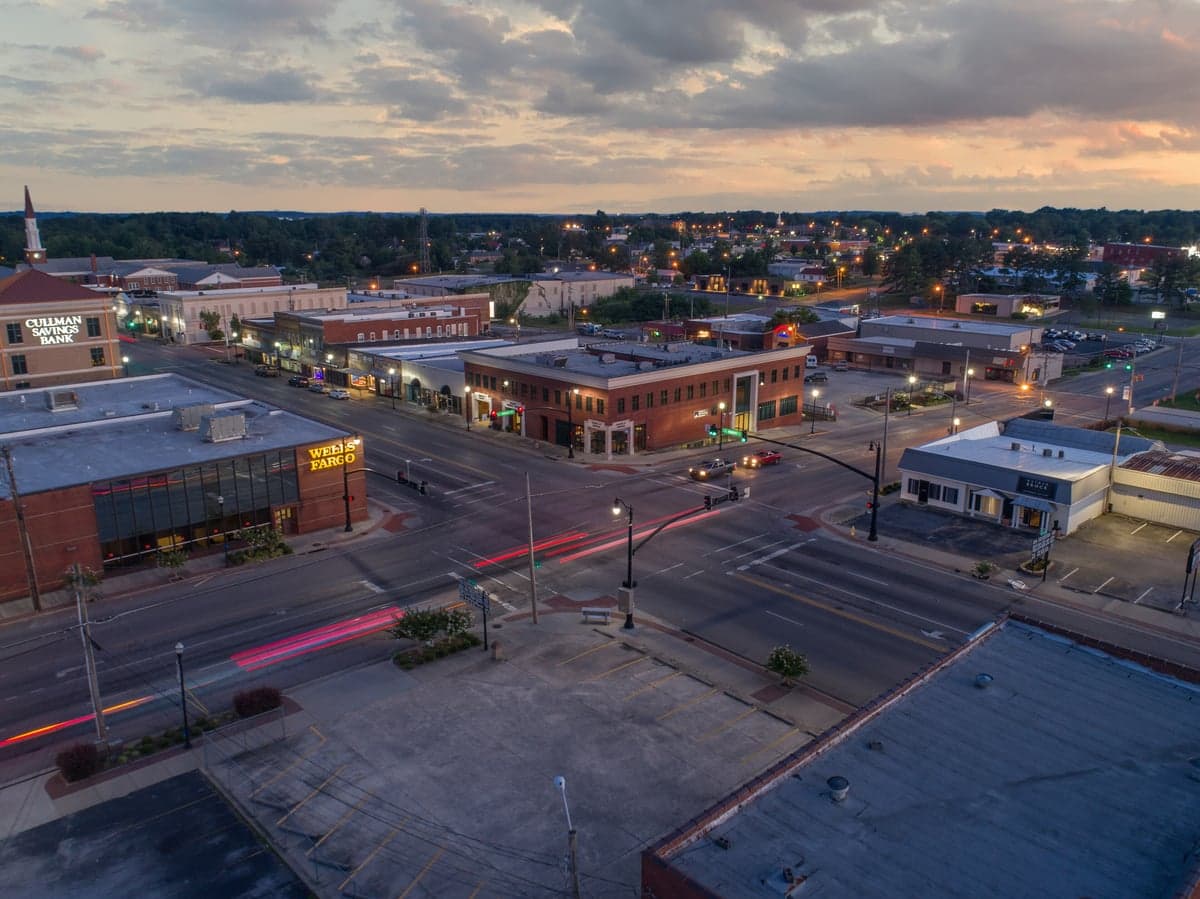
Cullman was founded in 1873 by German immigrant John G. Cullmann, who purchased 349,000 acres of land along the Louisville & Nashville Railroad to create a colony for German and Swiss immigrants. The original settlers were predominantly Catholic farmers and craftsmen from Baden, Württemberg, and Switzerland, drawn by the promise of affordable land and religious freedom in a region that was then overwhelmingly Anglo-Protestant. These early families built the core of what is now Historic Downtown Cullman, centered around Second Avenue, where many original brick storefronts still stand. The German-speaking population quickly established St. John's Evangelical Protestant Church (now St. John's United Church of Christ) and Sacred Heart Catholic Church, anchoring two distinct but overlapping communities. By the early 1900s, the city had grown to about 1,500 residents, with the German character so strong that German was still spoken in homes and some businesses. A second wave of settlers arrived in the 1910s and 1920s, drawn by the expanding timber and cotton industries; these were mostly native-born white Southerners from surrounding counties who settled in what became East Cullman, a working-class neighborhood near the railroad yards. The city's population reached 5,000 by 1940, with the German-descended families concentrated in the central wards and newer arrivals filling the eastern and southern edges.
Modern era (post-1965)
After the 1965 Immigration and Nationality Act, Cullman saw almost no new foreign immigration, unlike larger Alabama cities. The foreign-born share has remained below 2% for decades, and the city's growth since 1970 has come almost entirely from domestic in-migration of white families from rural North Alabama and from the broader Birmingham metro area. The 1980s and 1990s brought a wave of retirees and second-home buyers to the area around Smith Lake, a large reservoir created in 1961 that lies partly within Cullman's city limits; this lakefront development attracted wealthier newcomers who built homes in subdivisions like Crane Hill and Lakeview, shifting the city's demographic center slightly southward. The Hispanic population, now 2.5%, began growing in the 2000s, primarily with Mexican-origin families working in poultry processing and construction; they have concentrated in the West Cullman area near the industrial parks, though the numbers remain small. The Black population has actually declined from about 1.5% in 2000 to 0.9% today, reflecting a broader pattern of out-migration by African Americans from smaller Alabama towns to larger cities. East/Southeast Asian communities (0.1%) and Indian-subcontinent residents (0.0%) are essentially absent, making Cullman one of the least ethnically diverse cities of its size in the state. The college-educated share has risen to 31.5%, driven by professionals commuting to Huntsville (45 minutes north) and Birmingham (50 minutes south), but the city remains predominantly working-class and blue-collar in its economic base.
The future
The population is heading toward slow, steady homogenization rather than diversification. Cullman's growth rate has averaged about 0.5% annually over the past decade, and projections suggest the city will reach roughly 20,500 by 2035. The Hispanic share may rise to 3.5-4% as families already in the area have children and a small number of new arrivals come for poultry and logistics jobs, but the foreign-born share will likely remain below 3%. The white population will continue to dominate at 90% or higher, with the Black share possibly declining further as younger African Americans leave for Birmingham or Atlanta. The most notable demographic shift is the aging of the population: the median age has risen from 37 in 2010 to 41 in 2024, driven by retirees moving to Smith Lake and younger adults leaving for college and not returning. New subdivisions like Stonebridge and Briarwood are attracting some young families, but they are overwhelmingly white and native-born. The city is not tribalizing into distinct ethnic enclaves because there are too few minority residents to form them; instead, the divide is economic, with lakefront properties and newer subdivisions on the south side contrasting with older, more modest homes in North Cullman and the historic core.
For someone moving in now, Cullman offers a stable, culturally cohesive small city with a strong German-American identity, very low crime, and a cost of living about 15% below the national average. The trade-off is minimal ethnic diversity and a population that is aging and slowly shrinking in its younger cohorts. It is becoming a quieter, more retirement-oriented community, though the proximity to Huntsville's job growth provides an economic anchor that may keep it from declining like many other rural Alabama towns.

* Values derived from national, state, county, city and local statistics and may differ in a specific area. Last updated: 2026-04-19T18:46:17.000Z
Narrative content on this page is AI-generated and may contain mistakes. Verify any details that matter before acting on them.
ReloMaps may earn a commission from affiliate links at no extra cost to you.

