Photo: Wikipedia
Demographics of Cumberland, MD
Affluence Level in Cumberland, MD
A below-average socioeconomic profile. Incomes, home values, and educational attainment trail the U.S., with higher poverty and unemployment.
People of Cumberland, MD
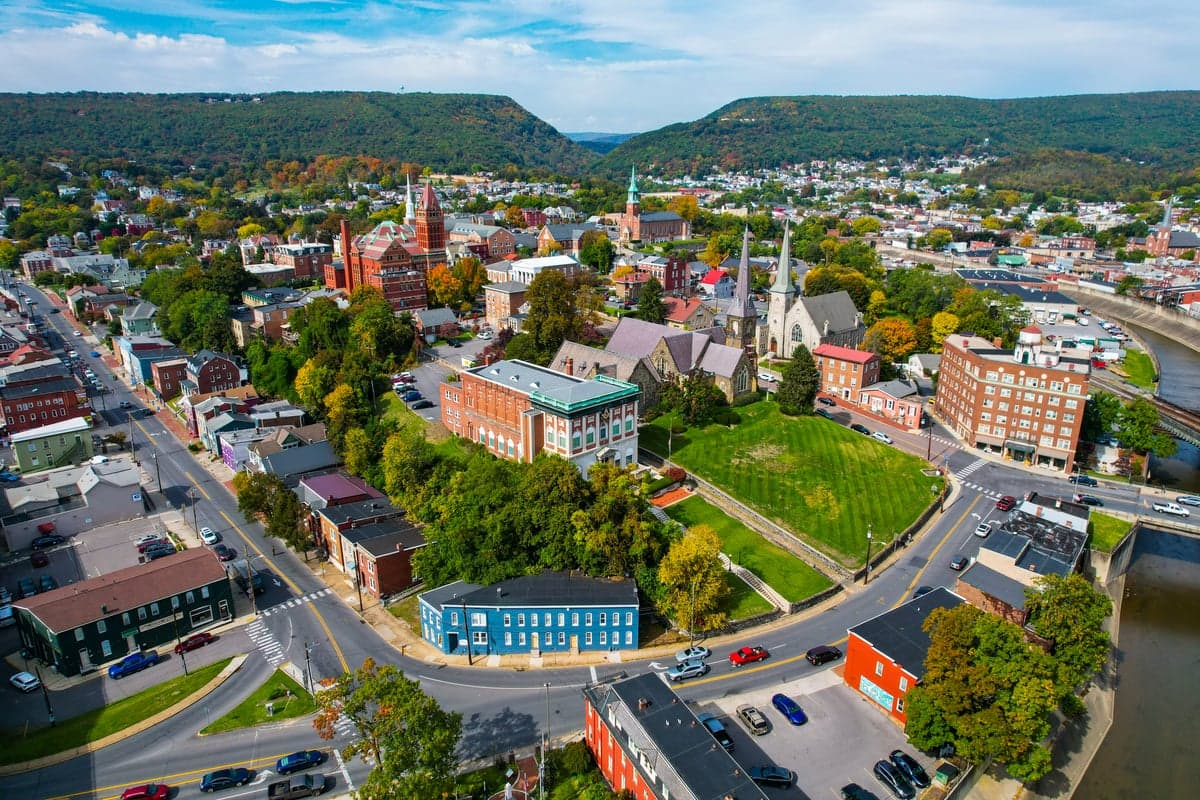
The people of Cumberland, Maryland today form a predominantly white, native-born population of 18,938 that is older and less diverse than the national average, with a strong sense of place rooted in Appalachian and industrial heritage. The city's character is shaped by its history as a railroad and manufacturing hub, a role that has faded, leaving a community that is 86.8% white, with a foreign-born share of just 0.5% — far below the U.S. average. Distinctive markers include a high proportion of long-term residents, a modest college attainment rate of 22.1%, and a quiet, family-oriented social fabric centered on neighborhoods like the historic Washington Street District and the more suburban LaVale area just outside city limits.
How the city was settled and grew
Cumberland's population story begins with its strategic location at the head of the Potomac River and the National Road, making it a natural gateway to the Ohio Valley. Founded in 1787, the city's first major growth wave came with the construction of the Chesapeake and Ohio Canal and later the Baltimore and Ohio Railroad in the mid-19th century. These industries drew a largely white, native-born workforce from surrounding Appalachian counties, along with a smaller influx of Irish and German immigrants who built the canal and rail lines. The Irish settled in the working-class South End near the rail yards, while German families concentrated in the West Side around the breweries and glass factories that emerged later. By the early 20th century, Cumberland's population peaked at over 39,000 in 1940, driven by the Kelly-Springfield Tire Company and other manufacturing plants that attracted rural migrants from Maryland and West Virginia. The East Side, with its rows of brick rowhouses, became home to many of these factory workers, creating a dense, walkable community that remains the city's most intact historic district.
Modern era (post-1965)
After the 1965 Hart-Cellar Act, Cumberland saw virtually no new immigration — the foreign-born share today is just 0.5%, and the city's small Black population (4.6%) and Hispanic population (2.1%) reflect modest, mostly domestic in-migration rather than international arrivals. The dominant demographic shift since the 1970s has been suburbanization and population loss. As manufacturing declined, many white families moved to the newer subdivisions of LaVale and Bowling Green outside city limits, leaving Cumberland's core neighborhoods like the South End and East Side with aging populations and higher vacancy rates. The city's small East/Southeast Asian community (0.2%) and Indian subcontinent community (0.3%) are concentrated in the Downtown area, often associated with the small medical and academic sectors at the local hospital and Allegany College of Maryland. The Hispanic population, though tiny, has grown slightly since 2000, with families settling in the West Side near the industrial parks. Overall, the modern era has been one of demographic stagnation and racial homogeneity, with the city losing over half its peak population and becoming whiter and older than the surrounding county.
The future
Cumberland's population is projected to continue its slow decline, with the city likely to remain overwhelmingly white and native-born for the foreseeable future. The foreign-born share is so low (0.5%) that even a modest increase would register as a significant percentage change, but no major immigrant gateway is emerging. The small Hispanic and Black communities are plateauing rather than growing rapidly, and the East/Southeast Asian and Indian populations are too small to form distinct enclaves. The most notable trend is the aging of the white population, with many younger adults leaving for Baltimore, Washington D.C., or other job centers, while retirees from the broader region move into the Washington Street Historic District for its walkability and historic character. The city is not tribalizing into ethnic enclaves but rather homogenizing into an older, whiter, and more economically stagnant community, with the most dynamic growth occurring in the suburban fringe of LaVale and Cresaptown outside city limits.
For someone moving in now, Cumberland offers a stable, low-cost, and culturally homogeneous environment where community ties run deep and the pace of life is slow. The city is becoming a retirement and lifestyle destination for those who value history and affordability over diversity and economic opportunity, with the downtown area seeing modest reinvestment but the overall population trend pointing toward continued contraction. A move here means joining a small, tight-knit community where nearly everyone is a multi-generation American, and where the biggest demographic change is the gradual shift from industrial past to post-industrial present.

* Values derived from national, state, county, city and local statistics and may differ in a specific area. Last updated: 2026-04-22T02:20:48.000Z
Narrative content on this page is AI-generated and may contain mistakes. Verify any details that matter before acting on them.
ReloMaps may earn a commission from affiliate links at no extra cost to you.

