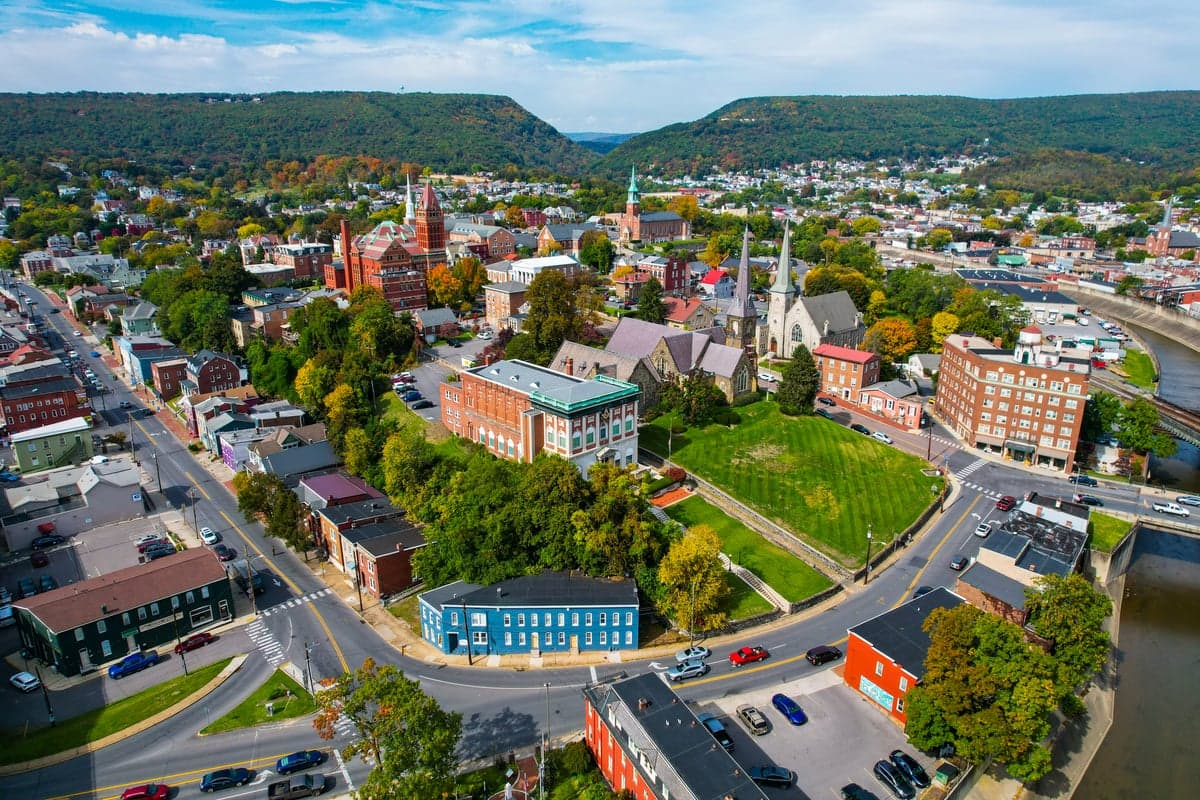
Photo: Wikipedia
Political ClimatePolitical Climate in Cumberland, MD
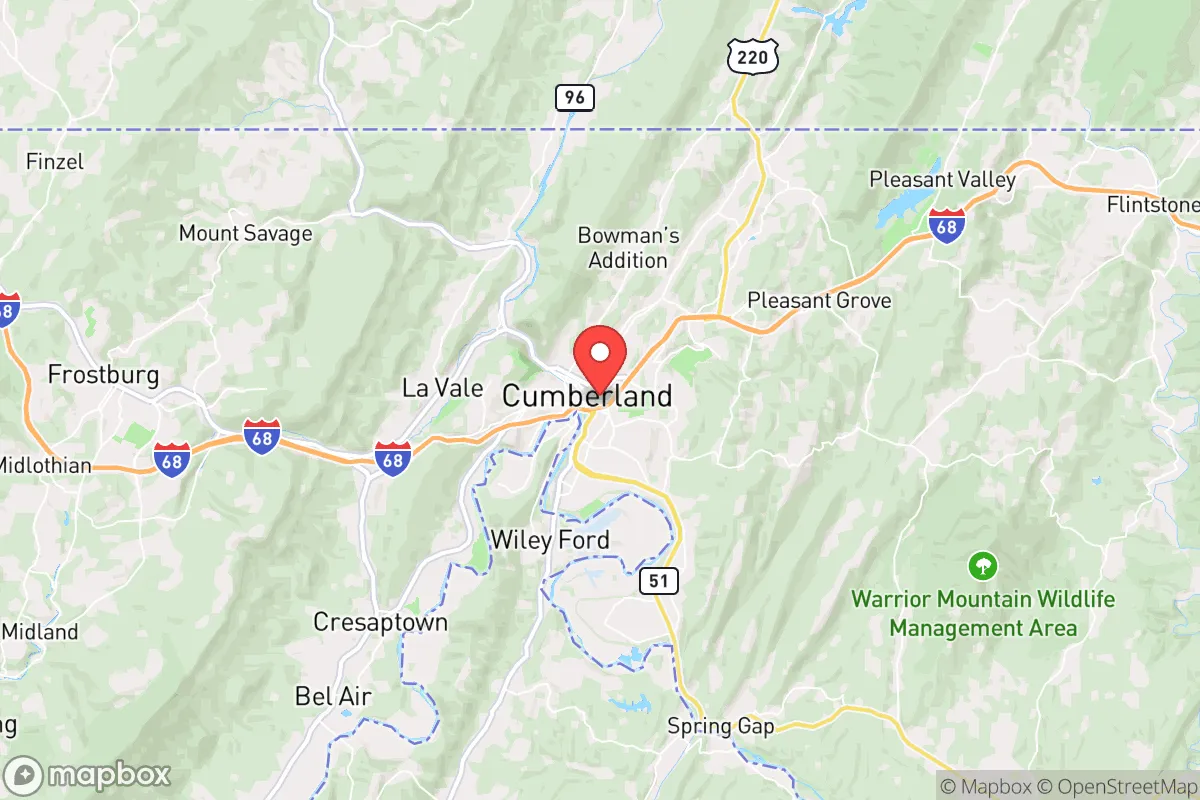
District shown is the primary district for this city’s centroid. Cities may span multiple districts.
Local Political AnalysisPolitical Analysis of Cumberland, MD
Cumberland, Maryland, sits in a unique political pocket. While the city itself leans slightly left, with a Cook PVI of D+3, the surrounding Allegany County is deeply conservative, and that tension defines the local climate. You can feel the shift when you drive five minutes out of town—places like Frostburg or LaVale vote much more like the rest of rural Western Maryland, which is solidly red. The city's Democratic lean is mostly a product of its older, union-rooted population and a few government-dependent households, but it's not a progressive stronghold by any stretch. In fact, many long-time residents here are wary of the direction things are heading, especially as national trends try to push their way into a community that values its independence.
How it compares
Compared to the rest of Maryland, Cumberland is an outlier. The state as a whole is reliably blue, driven by the D.C. suburbs and Baltimore, but out here in the mountains, it's a different world. Drive east to Hagerstown, and you'll find a more mixed political scene, but still with a stronger conservative base than Cumberland proper. Head west into West Virginia, just across the Potomac, and you're in deep red territory—places like Keyser or Romney vote Republican by huge margins. That contrast is stark. In Cumberland, you'll hear folks grumble about Annapolis and Baltimore running the show, imposing policies on a region that doesn't share their values. The city's D+3 rating feels like a relic of a bygone era when unions and factory jobs kept Democrats competitive here. Now, with those jobs gone, the political allegiance is fraying, and many locals are questioning whether the Democratic Party still represents their interests on issues like gun rights, energy policy, and local control.
What this means for residents
For someone living here, the political climate means you're constantly navigating two sets of rules. The city council might pass a resolution that feels out of step with the county's conservative majority, but the real power—zoning, law enforcement, school boards—is often at the county level, where Republicans hold sway. That creates a buffer against some of the more progressive overreaches you see in bigger cities. For example, while some Maryland counties have moved toward restrictive gun laws or energy mandates, Allegany County has pushed back, defending Second Amendment rights and opposing state-level climate regulations that would hammer local industry. Still, there's a growing concern among residents that the state government in Annapolis is chipping away at local autonomy. If you value personal freedoms—like the right to own property without excessive regulation, or the freedom to choose your own healthcare—Cumberland's city limits can feel like a warning sign of what's to come if progressive policies gain more traction.
Culturally, Cumberland is a town that prizes self-reliance and neighborly trust. You won't find the same activist energy or political signage you'd see in a college town like Frostburg. Instead, the political conversation here is quieter, more practical—about potholes, jobs, and keeping taxes low. The biggest policy distinction is the city's reliance on state and federal grants, which creates a subtle dependency that some locals find troubling. As one old-timer put it, "They keep sending us money, but they keep taking our say." That sums up the mood: a cautious, conservative-leaning community trying to hold onto its way of life while the rest of the state moves in a direction many here don't agree with. If you're thinking of moving to Cumberland, know that the city's politics are a mixed bag, but the surrounding county offers a strong conservative anchor—for now.

State Political ClimatePolitical Climate in Maryland
State Political AnalysisPolitical Environment in the State
Maryland has long been a solidly blue state, but its political landscape is far more nuanced than the statewide numbers suggest. Democrats hold a supermajority in the legislature and have won every presidential election here since 1992, but the margin has tightened in recent cycles — Joe Biden won by 33 points in 2020, down from Hillary Clinton’s 26-point win in 2016. The real story is a growing urban-suburban vs. rural divide, with the state’s deep-blue core in the Washington, D.C. suburbs and Baltimore metro area increasingly clashing with conservative-leaning western and eastern shores. For a conservative considering relocation, Maryland offers pockets of genuine freedom, but the state-level trend is unmistakably toward progressive consolidation.
Urban vs. rural divide
The political map of Maryland is a tale of two states. The D.C. suburbs — Montgomery County and Prince George’s County — are the engine of Democratic dominance, delivering roughly 40% of the state’s total Democratic vote. These counties are among the wealthiest and most educated in the nation, and they vote overwhelmingly for progressive candidates on issues like gun control, abortion rights, and climate policy. Baltimore City and its inner suburbs (Baltimore County, Howard County) add another deep-blue layer. Meanwhile, the rest of the state is a different world. Garrett County in the far west voted +48 for Trump in 2020, and Allegany County (Cumberland) was +37. On the Eastern Shore, Worcester County (Ocean City) and Queen Anne’s County are reliably red. The Frederick County suburbs, once a swing area, have been trending blue as D.C. commuters push north, but the city of Frederick itself remains a purple-to-red enclave. The key takeaway: if you want a conservative community, you’re looking at the western mountains, the Eastern Shore, or the rural northern tier — not the I-95 corridor.
Policy environment
Maryland’s policy environment is a mixed bag for conservatives. The state has a progressive income tax structure with rates from 2% to 5.75%, plus local county taxes that can push the combined rate above 8% in high-tax jurisdictions like Montgomery County. Property taxes are moderate but vary wildly — Carroll County keeps them low, while Baltimore City’s are among the highest in the nation. The state has a strict regulatory posture on business, with a minimum wage of $15.00 (indexed to inflation) and a paid family leave program launching in 2025. Education policy is dominated by the Blueprint for Maryland’s Future, a massive funding increase for K-12 that includes universal pre-K and teacher salary hikes — popular with parents but expensive. On election law, Maryland has no-excuse mail-in voting and same-day registration, which conservatives view as ripe for fraud. The state also has a sanctuary policy limiting cooperation with ICE, and it passed the Trans Health Equity Act in 2023, requiring Medicaid to cover gender transition procedures for minors. For a conservative, the policy environment feels like a slow, steady march toward European-style social democracy.
Trajectory & freedom
Maryland is becoming less free by any conservative measure. The Firearm Safety Act of 2013 banned assault weapons and limited magazine capacity to 10 rounds, and in 2023 the legislature passed a concealed carry “sensitive places” law that effectively bans guns in most public spaces — a direct response to the Bruen decision. The state also has a red flag law and requires a state police-issued permit for handgun purchases. On parental rights, the Healthy Youth Act mandates comprehensive sex education in public schools, and the Trans Health Equity Act allows minors to access gender transition care without parental consent in some cases. Medical freedom took a hit with strict COVID-19 mandates that lasted longer than most states, and the state still has a vaccine mandate for healthcare workers. Property rights are constrained by strict zoning laws in the D.C. suburbs, making it hard to build new housing. The one bright spot: tax competition from Virginia and Pennsylvania has kept the state from raising income taxes further, but the trajectory is clearly toward more government control, not less.
Civil unrest & political movements
Maryland has seen its share of political flashpoints. The 2020 George Floyd protests in Baltimore and D.C. suburbs were large and occasionally violent, with property damage in Baltimore’s Inner Harbor. The state’s sanctuary policies have been a constant source of tension, with Republican counties like Harford and Carroll passing resolutions to declare themselves “Second Amendment sanctuaries” and “ICE-friendly” zones. The 2022 election integrity debate was heated, with the state’s automatic voter registration and mail-in ballot system drawing criticism from conservatives who point to the 2020 Baltimore mail-in ballot scandal (where a contractor was charged with ballot fraud). The Maryland Citizens’ Defense League is an active gun-rights group that holds rallies in Annapolis. On the left, Progressive Maryland and Our Revolution push for single-payer healthcare and rent control. Immigration politics are especially charged in Prince George’s County, where a large immigrant population has led to clashes over sanctuary policies. A new resident would notice the political divide most acutely in the Frederick and Hagerstown areas, where Trump flags and Biden signs coexist uneasily.
Projection
Over the next 5-10 years, Maryland will likely become more progressive, not less. The D.C. suburbs are growing faster than the rest of the state, and in-migration from blue states like New York and California is accelerating. The 2020 census showed that Montgomery and Prince George’s counties gained population while rural counties like Garrett and Allegany lost residents. The 2026 gubernatorial election will be a test — if a moderate Democrat like Wes Moore (current governor) wins re-election, the progressive agenda will continue. If a Republican wins, it will be a temporary brake, not a reversal. The state’s aging population in rural areas means those conservative strongholds will shrink. The Blueprint for Maryland’s Future will lock in higher education spending for a decade, and the paid family leave program will expand the welfare state. For a conservative moving in now, expect to see more gun restrictions, higher taxes, and a growing cultural divide between the D.C. suburbs and the rest of the state. The best bet for long-term conservative living is the Eastern Shore or Western Maryland, but even those areas are seeing an influx of remote workers from D.C.
Bottom line for a new resident: If you’re a conservative, Maryland is a state where you can find a like-minded community — but you’ll be fighting the state government every step of the way. The taxes are high, the gun laws are restrictive, and the cultural tide is against you. The best places to land are Carroll County (Westminster), Harford County (Bel Air), Frederick County (the city itself is purple, the rural areas are red), or the Eastern Shore (Easton, Salisbury). Avoid Montgomery and Prince George’s counties unless you’re okay with progressive policies. Maryland is a beautiful state with great schools and natural amenities, but it’s not a freedom-friendly state — and it’s getting less so every year.
* Values derived from national, state, county, city and local statistics and may differ in a specific area. Last updated: 2026-04-22T02:20:48.000Z
Narrative content on this page is AI-generated and may contain mistakes. Verify any details that matter before acting on them.
ReloMaps may earn a commission from affiliate links at no extra cost to you.

