
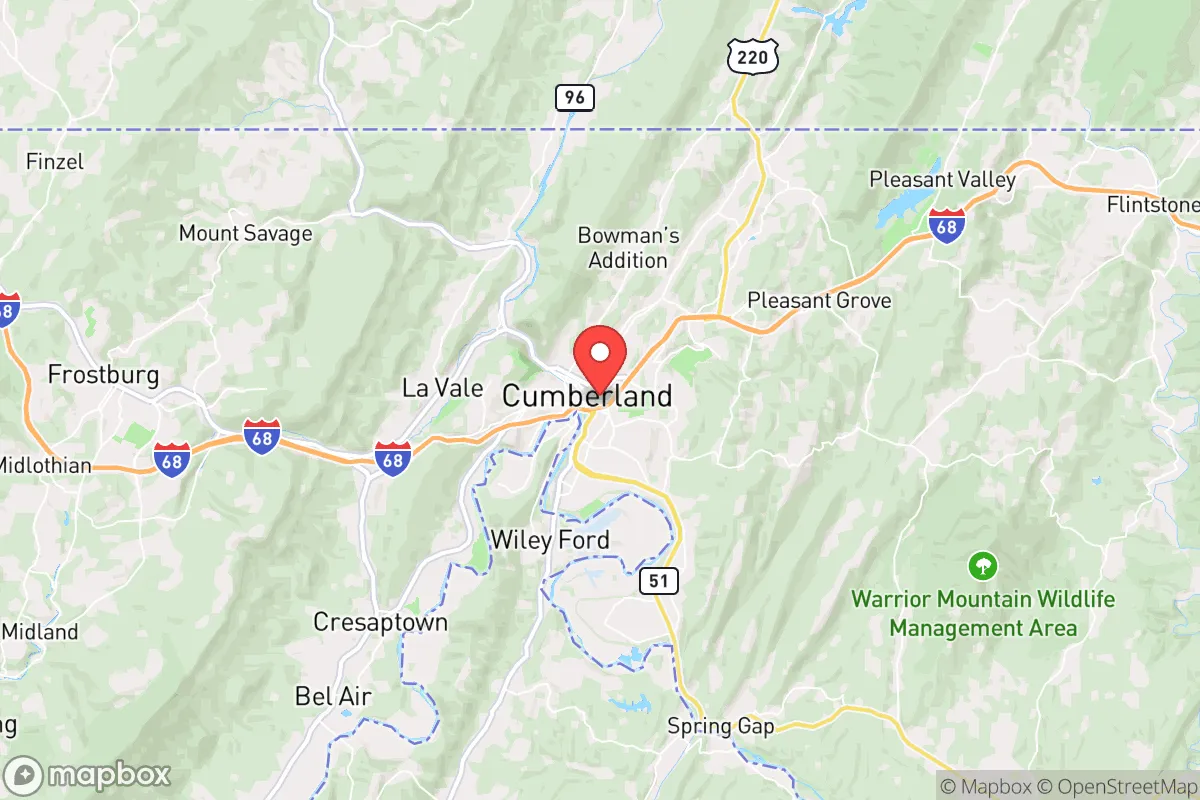
Photo: Wikipedia
Personal Sovereignty in Cumberland, MD
Viable for self-reliance. Generally workable, though some barriers may limit total independence.
What does Personal Sovereignty tell us?
Personal Sovereignty measures your capacity for self-reliance and independence with minimal government friction. Higher scores mean fewer barriers between you and the way you want to live... but it assumes you have the space you need and good neighbors.
What does this tell us?
Personal Sovereignty measures your capacity for self-reliance and independence with minimal government friction. Higher scores mean fewer barriers between you and the way you want to live... but it assumes you have the space you need and good neighbors.
State Policy
Energy independence: Importer (8% of energy produced in-state)
Personal Liberty
Homesteading

Personal Liberty Analysis
Cumberland, Maryland, offers a notably high degree of personal sovereignty relative to the Mid-Atlantic region, functioning as a practical enclave for those seeking to minimize government friction in daily life. Nestled in the Appalachian foothills, this small city of roughly 19,000 residents operates under a light-touch local governance structure that, when combined with Maryland’s statewide legal framework, creates a mixed but generally favorable environment for individual autonomy. For the survivalist or prepper, the key trade-off is clear: you get a low-cost, low-regulation local lifestyle with strong property rights and gun protections, but you must navigate a state-level tax and regulatory apparatus that is more intrusive than in the Deep South or Mountain West. The net result is a sovereignty score that ranks above most of the Northeast corridor but below the most libertarian-leaning states.
Tax burden and regulatory posture in Allegany County
Maryland’s tax burden is among the highest in the nation, ranking 6th overall according to the Tax Foundation, and Cumberland residents feel this at the state level. The state income tax ranges from 2% to 5.75%, and the sales tax is 6%, with no local add-ons in Allegany County. However, the local property tax rate in Cumberland is a relatively modest 0.87% of assessed value, well below the Maryland average of 1.05%, and the median home value of around $85,000 means annual property taxes often sit under $800. This low property tax burden is a major draw for those seeking to own land outright without oppressive annual costs. On the regulatory side, Allegany County is a stark contrast to the Washington D.C. suburbs. Zoning is permissive, building permits are straightforward, and there is no county-level business licensing overlay that strangles small-scale operations. The local government has a hands-off ethos, particularly regarding home-based businesses and small-scale agriculture. For the prepper, this means you can run a generator, store supplies, and maintain a workshop without the constant threat of code enforcement visits that plague more regulated jurisdictions. The state’s energy regulations, however, do impose some friction—Maryland’s Renewable Portfolio Standard adds about 2-3% to electricity costs, and the state’s environmental permitting can slow larger land-use projects.
Self-defense and gun law specifics in Maryland
Maryland is a “may-issue” state for concealed carry, but the 2022 Supreme Court decision in New York State Rifle & Pistol Association v. Bruen forced the state to adopt a “shall-issue” standard. As of 2026, the Maryland State Police must issue a wear-and-carry permit to any qualified applicant who passes a background check and completes a 16-hour training course. This is a significant improvement, but the process remains more burdensome than in constitutional carry states. The state maintains a ban on “assault weapons” as defined by Maryland law, which includes many popular AR-15 and AK-pattern rifles, and magazines over 10 rounds are prohibited for purchase. However, rifles and shotguns purchased before October 1, 2013, are grandfathered, and private transfers of long guns between individuals are legal without a background check, though handgun transfers must go through a licensed dealer. Cumberland’s local law enforcement, the Allegany County Sheriff’s Office, is known for being pro-Second Amendment in practice. Deputies generally do not harass legal gun owners, and the county has a strong culture of hunting and sport shooting. The nearest public range is at the Cumberland Rifle and Pistol Club, which offers 100- and 200-yard ranges. For the survivalist, the key limitation is the magazine capacity ban and the assault weapons prohibition, which restrict the types of defensive firearms you can legally acquire new. But if you already own standard-capacity magazines and rifles, you are effectively grandfathered in, and enforcement is minimal in this rural county.
Self-reliance and homesteading viability in the region
Cumberland is a strong candidate for those pursuing a self-reliant lifestyle, primarily due to affordable land and permissive zoning. Within the city limits, standard residential lots range from 0.1 to 0.5 acres, but just outside town in Allegany County, you can find 2- to 10-acre parcels for $10,000 to $30,000. Zoning in the county is largely agricultural-residential, which allows for keeping chickens, goats, and up to two horses on parcels of two acres or more. There are no county-level restrictions on rainwater collection, and the state does not regulate private wells for single-family homes. Off-grid feasibility is high: the area receives about 4.5 peak sun hours per day, making solar panels viable, and wood heat is a common primary heating source. The Maryland Department of the Environment does require permits for septic systems, but the process is straightforward and costs around $1,500 to $3,000. One notable advantage is the absence of a county-wide building code for agricultural structures—you can erect a barn or shed without a permit as long as it is under 200 square feet. For the prepper, the biggest constraint is Maryland’s stormwater management regulations, which require a permit for any land disturbance over 5,000 square feet. This can complicate larger earthworks like berms or underground shelters, but many residents simply work around it by keeping projects under the threshold. The local food system is robust: there are three year-round farmers’ markets in the county, and the growing season runs from April to October, with hardiness zone 6b allowing for a wide variety of vegetables and fruit trees.
Personal liberties: parental rights, medical autonomy, speech, and property
Maryland’s state-level policies on parental rights and medical autonomy are a mixed bag, but local enforcement in Cumberland tends to be more aligned with conservative values. The state has a mandatory vaccination law for school attendance, with only medical exemptions allowed—no religious or philosophical exemptions. This is a significant concern for parents who prioritize medical autonomy. However, homeschooling is legal and lightly regulated: parents must submit a one-time notice of intent and provide a portfolio review annually, but there are no standardized testing requirements or curriculum mandates. The state also has a “medical aid in dying” law, which some conservatives view as a slippery slope, but it has no practical impact on daily life in Cumberland. On free speech, Maryland has no state-level hate speech law that criminalizes protected speech, and the local government does not restrict political expression. Property rights are strong: Maryland is a “Dillon’s Rule” state, meaning local governments only have powers explicitly granted by the state, but Allegany County has not used this to impose restrictive land-use controls. Eminent domain is rarely used, and the county has no rent control or landlord licensing schemes. For the survivalist, the most relevant liberty is the right to store and use fuel: there are no state-level limits on storing gasoline or propane for personal use, though local fire codes may apply to quantities over 50 gallons. The overall legal environment in Cumberland allows for a high degree of personal discretion in how you live, raise your family, and prepare for emergencies, as long as you stay within the broad state-level guardrails.
In the broader context of personal sovereignty, Cumberland, MD, occupies a strategic middle ground. It offers the low cost of living, permissive local governance, and strong property rights of a rural Appalachian town, while being subject to Maryland’s higher state taxes and more restrictive gun and medical autonomy laws. For the conservative prepper or survivalist, the calculus is straightforward: if you can tolerate a state income tax and a magazine capacity limit, you gain access to some of the most affordable land on the East Coast, a community that largely minds its own business, and a local government that does not actively work against self-reliance. Compared to nearby areas like Morgantown, WV, or Chambersburg, PA, Cumberland has a slightly heavier state hand, but it compensates with lower property taxes and a more established infrastructure for off-grid living. For those willing to navigate the state-level friction, this is a viable base for building a sovereign life without the extreme isolation of deeper rural areas.

* Values derived from national, state, county, city and local statistics and may differ in a specific area. Last updated: 2026-04-22T02:20:48.000Z
Narrative content on this page is AI-generated and may contain mistakes. Verify any details that matter before acting on them.
ReloMaps may earn a commission from affiliate links at no extra cost to you.

