
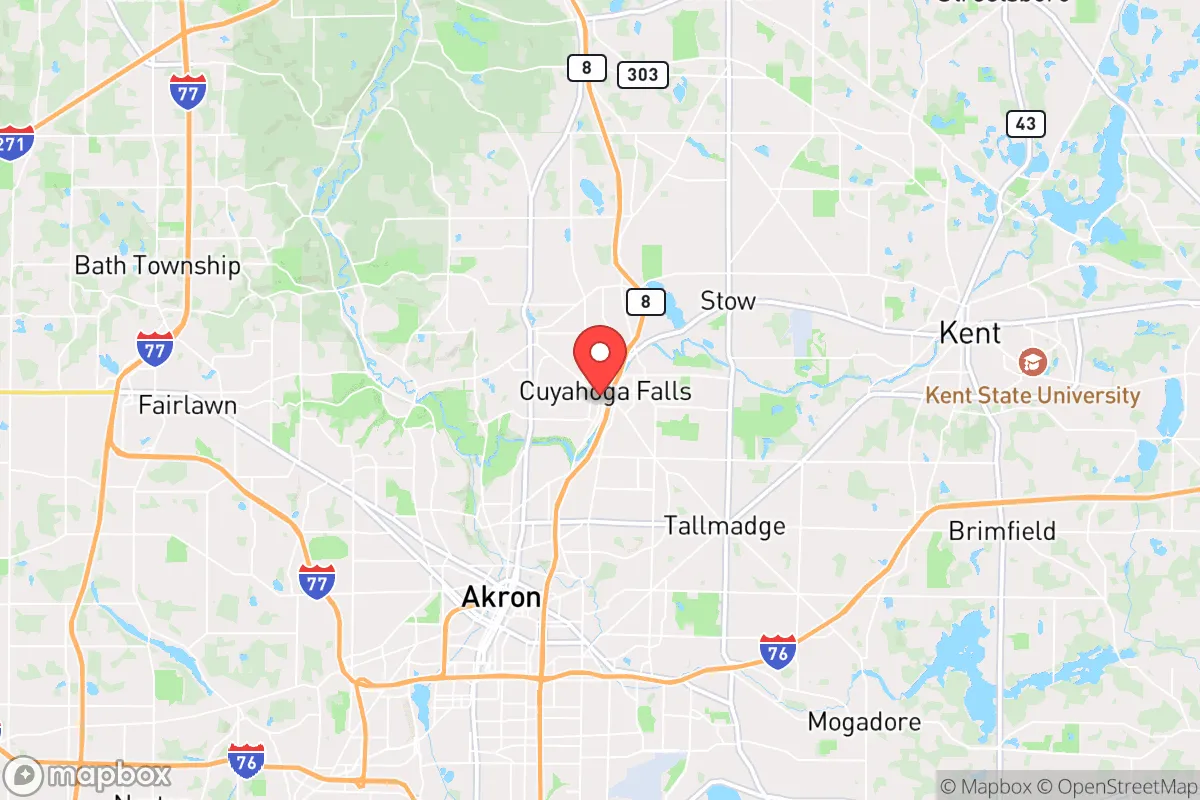
Photo: Wikipedia
Personal Sovereignty in Cuyahoga Falls, OH
Viable for self-reliance. Generally workable, though some barriers may limit total independence.
What does Personal Sovereignty tell us?
Personal Sovereignty measures your capacity for self-reliance and independence with minimal government friction. Higher scores mean fewer barriers between you and the way you want to live... but it assumes you have the space you need and good neighbors.
What does this tell us?
Personal Sovereignty measures your capacity for self-reliance and independence with minimal government friction. Higher scores mean fewer barriers between you and the way you want to live... but it assumes you have the space you need and good neighbors.
State Policy
Energy independence: Importer (40% of energy produced in-state)
Personal Liberty
Homesteading

Personal Liberty Analysis
Cuyahoga Falls, Ohio, offers a mixed bag for those prioritizing personal sovereignty, with the city's local governance leaning moderately permissive while operating under the broader constraints of Summit County and Ohio state law. For a survivalist or prepper mindset, the key takeaway is that while you won't face the extreme overreach of coastal blue states, you're still navigating a system where property taxes are notable and certain regulatory hurdles exist. The real autonomy here comes from strategic property selection and understanding the specific legal landscape, particularly around self-defense and property rights, which are more favorable than in many neighboring states but less so than in the deep South or Mountain West.
Tax burden and regulatory posture: How much does the state take?
Ohio's tax structure is a double-edged sword for those seeking to keep more of their own resources. The state income tax is a flat 3.5% as of 2025, which is moderate but not negligible, and Cuyahoga Falls adds a 2% municipal income tax on residents and those working within city limits. This combined 5.5% bite on earned income is a real consideration for anyone trying to maximize savings for supplies, land, or independent ventures. Property taxes in Summit County are notably high, averaging around 2.1% of assessed value, which is well above the national median. For a $250,000 home, that's over $5,000 annually—money that could otherwise go toward a solar array or food storage. On the regulatory front, Ohio is generally business-friendly with right-to-work laws, but the city enforces standard building codes and zoning that can complicate off-grid modifications. The state's regulatory environment is not aggressively hostile, but it's not the "leave me alone" ideal either; expect to file permits for major structural changes and pay your share of property tax without much room for negotiation.
Self-defense and gun law specifics: Can you keep and bear arms without hassle?
Ohio is a constitutional carry state as of 2022, meaning you can carry a concealed firearm without a permit—a solid win for personal sovereignty. Cuyahoga Falls does not have its own additional gun restrictions beyond state law, so you're not dealing with the kind of local ordinances you'd find in Columbus or Cleveland. However, there are still limitations: firearms are prohibited in certain "sensitive places" like schools, government buildings, and airports, and the state has a "duty to retreat" law outside your home or vehicle, meaning you can't use deadly force in self-defense if you can safely escape. This is a significant constraint for the prepper mindset, as it limits your ability to stand your ground in public confrontations. Stand Your Ground laws are not in effect here, so legal self-defense outside your property requires proving you had no means of retreat. For home defense, the Castle Doctrine applies, giving you legal protection if you use force against an intruder. Overall, the gun laws are decent but not ideal for those who want maximum autonomy in self-defense decisions.
Self-reliance and homesteading viability: Lot sizes, zoning, and off-grid feasibility
For anyone looking to live off the land or reduce dependency on the grid, Cuyahoga Falls presents challenges. The city is a dense suburban area with typical lot sizes ranging from 0.15 to 0.5 acres in most neighborhoods, making large-scale gardening or livestock impractical. Zoning regulations are restrictive: chickens are allowed only with a permit and limited to hens (no roosters), and larger livestock like goats or pigs are prohibited within city limits. Off-grid living is effectively illegal here—the city requires connection to municipal water and sewer systems, and solar panels are allowed but must comply with building codes and HOA rules if applicable. Rainwater collection is legal in Ohio but limited to 2,500 gallons per property, and you'll need a permit for any system that captures water from your roof. The real opportunity for self-reliance lies in the surrounding rural areas of Summit County, like Bath Township or Boston Township, where you can find 1-5 acre lots with fewer restrictions. Within the city, you're better off focusing on container gardening, food preservation, and building a resilient home network rather than full homesteading.
Personal liberties: Parental rights, medical autonomy, speech, and property
Ohio has strong parental rights protections, including a law that requires schools to notify parents of any changes in a student's health or well-being, which aligns with conservative values on family autonomy. Medical autonomy is a mixed bag: the state has no vaccine mandate for adults, but school vaccine requirements are standard, and there's no broad religious exemption for medical procedures. The COVID-era emergency powers were controversial, but Ohio has since passed laws limiting the governor's ability to issue indefinite health orders without legislative approval. Free speech is protected under the First Amendment, and Cuyahoga Falls has not enacted any local ordinances restricting public assembly or expression beyond standard time-place-manner rules. Property rights are generally respected, but the city's zoning board has significant authority over land use, and eminent domain is a theoretical risk for large infrastructure projects. The biggest concern for sovereignty-minded individuals is the lack of a strong property rights protection law like those in Texas or Idaho; you're at the mercy of local planning commissions for major changes to your property.
Overall, Cuyahoga Falls offers a baseline level of personal sovereignty that's better than many urban areas in blue states but falls short of the libertarian-friendly enclaves in the South or West. The tax burden is moderate to high, self-defense laws are decent but not ideal, and homesteading is largely impractical within city limits. For a survivalist or prepper, the best strategy is to use Cuyahoga Falls as a base for employment and community while securing a secondary property in a more rural part of Ohio or a neighboring state like West Virginia or Kentucky for true autonomy. The city itself won't fight you on your personal choices, but it won't actively protect them either—you'll need to stay informed and engaged with local politics to preserve the freedoms you have.

* Values derived from national, state, county, city and local statistics and may differ in a specific area. Last updated: 2026-04-19T05:04:40.000Z
Narrative content on this page is AI-generated and may contain mistakes. Verify any details that matter before acting on them.
ReloMaps may earn a commission from affiliate links at no extra cost to you.

