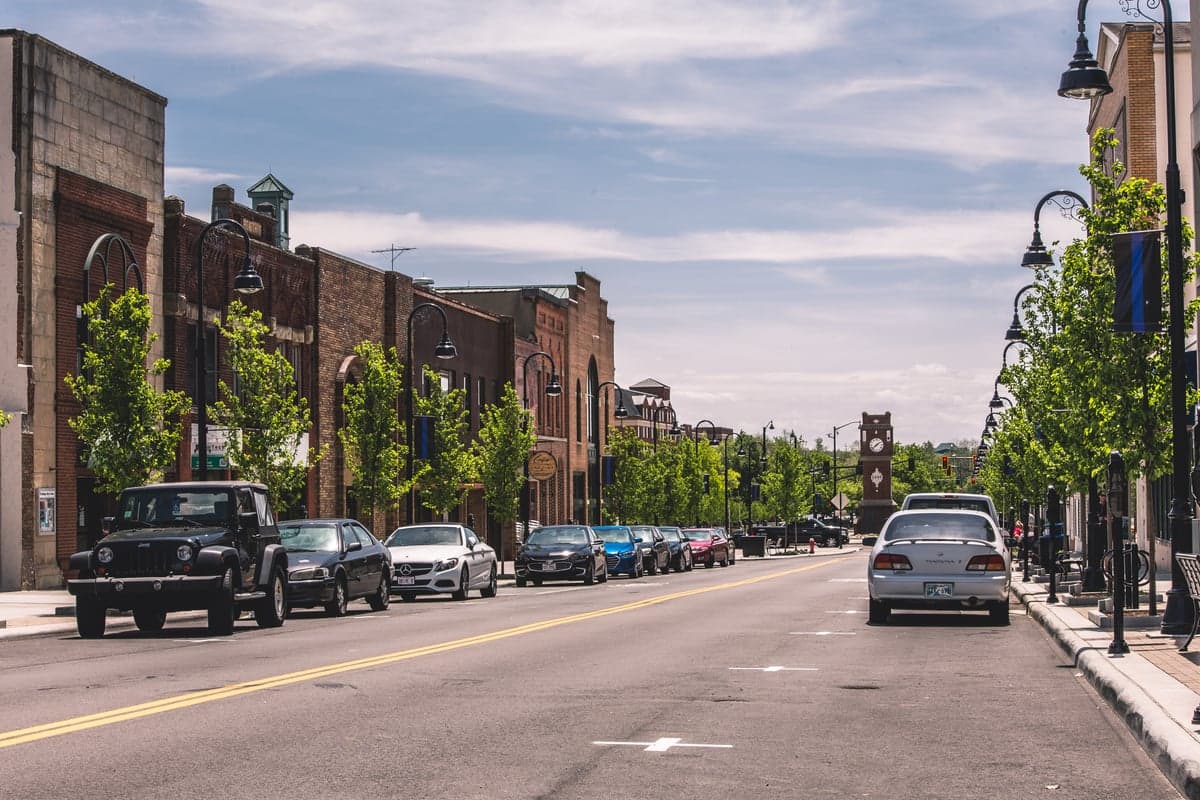
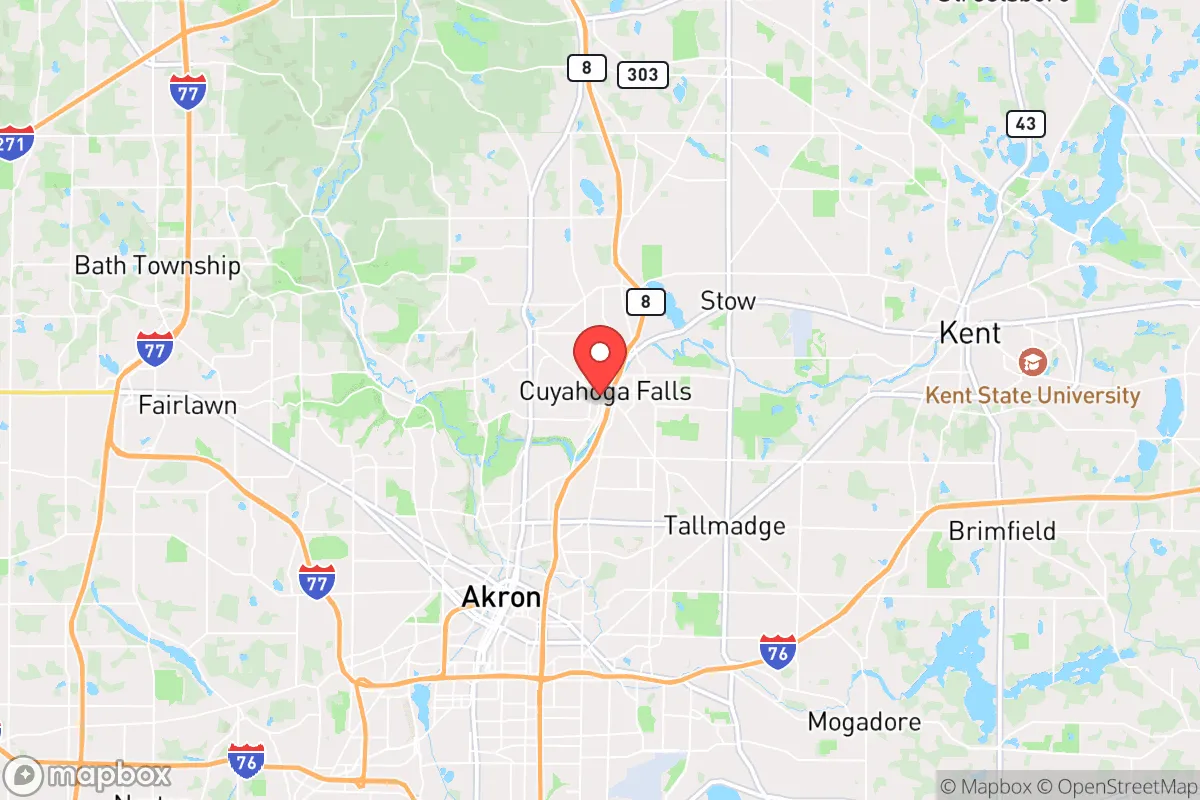
Photo: Wikipedia
Demographics of Cuyahoga Falls, OH
Affluence Level in Cuyahoga Falls, OH
A middle-class area roughly in line with national averages across income, home values, education, and employment.
People of Cuyahoga Falls, OH
The people of Cuyahoga Falls, Ohio, today number 50,864 and form a predominantly white, middle-class community with a strong sense of local identity rooted in its industrial past and suburban present. The city is notably more diverse than its immediate surroundings, with a foreign-born population of 3.1% and significant Indian-subcontinent (3.3%) and East/Southeast Asian (2.1%) communities, alongside a Black population of 4.6% and a Hispanic population of 2.3%. With 37.5% of adults holding a college degree, the population is moderately educated, reflecting a blend of longtime working-class families and newer professional residents drawn by the city’s affordability and proximity to Akron. Distinctive markers include a proud river-town heritage along the Cuyahoga River, a historic downtown that has resisted complete suburban homogenization, and a political landscape that leans conservative relative to Summit County as a whole.
How the city was settled and grew
Cuyahoga Falls was founded in 1812 by William Wetmore, who was drawn to the water power potential of the Cuyahoga River falls. The original settlers were primarily Yankee migrants from New England and New York, seeking farmland and mill sites. The first major population wave came with the construction of the Ohio & Erie Canal in the 1820s and 1830s, which connected the village to Lake Erie and the Ohio River. This canal brought Irish immigrant laborers who settled in the Front Street area near the river, building the first ethnic enclave. By the mid-19th century, German immigrants arrived to work in the growing woolen mills and paper mills, establishing a lasting presence in the North Hill neighborhood, where German Lutheran churches and social halls still stand. The city’s industrial boom peaked in the late 19th and early 20th centuries with the rise of the rubber and chemical industries in nearby Akron. This drew a wave of Italian and Eastern European immigrants—Poles, Slovaks, and Hungarians—who settled in the South Side and Downtown districts, building dense, walkable neighborhoods of two-story frame houses. By 1930, Cuyahoga Falls had grown to over 19,000 residents, a mix of native-born Yankees and European immigrants, with a small Black population employed in domestic service and the rubber factories.
Modern era (post-1965)
The post-1965 era brought significant demographic change, driven by the Immigration and Nationality Act and the broader suburbanization of Akron’s population. The most notable shift has been the growth of the Indian-subcontinent community, which now stands at 3.3% of the population. This wave began in the 1990s and accelerated in the 2000s, as professionals in healthcare, information technology, and engineering—many employed at Akron Children’s Hospital, Summa Health, and the University of Akron—chose Cuyahoga Falls for its good schools and affordable housing. This community is concentrated in the Portage Trail and State Road corridors, where Indian grocery stores and restaurants have opened. The East/Southeast Asian population (2.1%) arrived in a similar pattern, with Chinese, Korean, and Filipino families settling in the Silver Lake area and the newer subdivisions near Graham Road. The Black population (4.6%) grew modestly from a very small base, primarily through domestic migration from Akron and other Rust Belt cities, settling in the Downtown and South Side neighborhoods. The Hispanic population (2.3%) is smaller and more dispersed, with no single concentrated enclave. White flight from Akron in the 1970s and 1980s brought many middle-class white families to Cuyahoga Falls, reinforcing its majority-white character even as the city became more diverse than surrounding communities like Stow or Hudson. The city’s population peaked at around 50,000 in the 1970s and has remained stable since, with slow growth from new housing developments on the city’s western edge.
The future
The population of Cuyahoga Falls is likely to remain stable in size but continue a slow diversification over the next 10-20 years. The Indian-subcontinent community is the fastest-growing ethnic group, driven by professional recruitment and chain migration, and is expected to reach 5-6% of the population by 2040. This growth is concentrated in the Portage Trail corridor and is creating a visible ethnic enclave that is assimilating economically while maintaining cultural institutions. The East/Southeast Asian population is growing more slowly, plateauing as second-generation families move to larger suburban homes in Hudson or Solon. The Black and Hispanic populations are expected to grow modestly through domestic migration from Akron and Cleveland, but Cuyahoga Falls lacks the large affordable housing stock or public transit connections that would drive rapid growth. The white population is aging and declining slightly, as younger white families often move to newer exurban developments in Medina or Portage counties. The city is not tribalizing into distinct, segregated enclaves; rather, it is experiencing a gradual, market-driven diversification where new immigrant groups cluster in specific corridors but integrate into the broader community through schools and employment. The college-educated share (37.5%) is likely to rise as more professionals replace retiring factory workers, but the city will remain a middle-class, family-oriented suburb rather than a high-cost, high-amenity hub.
For someone moving in now, Cuyahoga Falls is becoming a moderately diverse, stable suburb where the dominant white working-class and middle-class culture is slowly giving way to a more varied, professional population. The city offers a conservative-leaning, family-friendly environment with good schools and affordable housing, but the demographic future is one of gradual diversification, not rapid change. New residents, particularly those from Indian and East/Southeast Asian backgrounds, will find established communities and institutions, while white families will continue to find a familiar, safe suburban setting with a historic downtown that retains its character.

* Values derived from national, state, county, city and local statistics and may differ in a specific area. Last updated: 2026-04-19T05:04:40.000Z
Narrative content on this page is AI-generated and may contain mistakes. Verify any details that matter before acting on them.
ReloMaps may earn a commission from affiliate links at no extra cost to you.

