
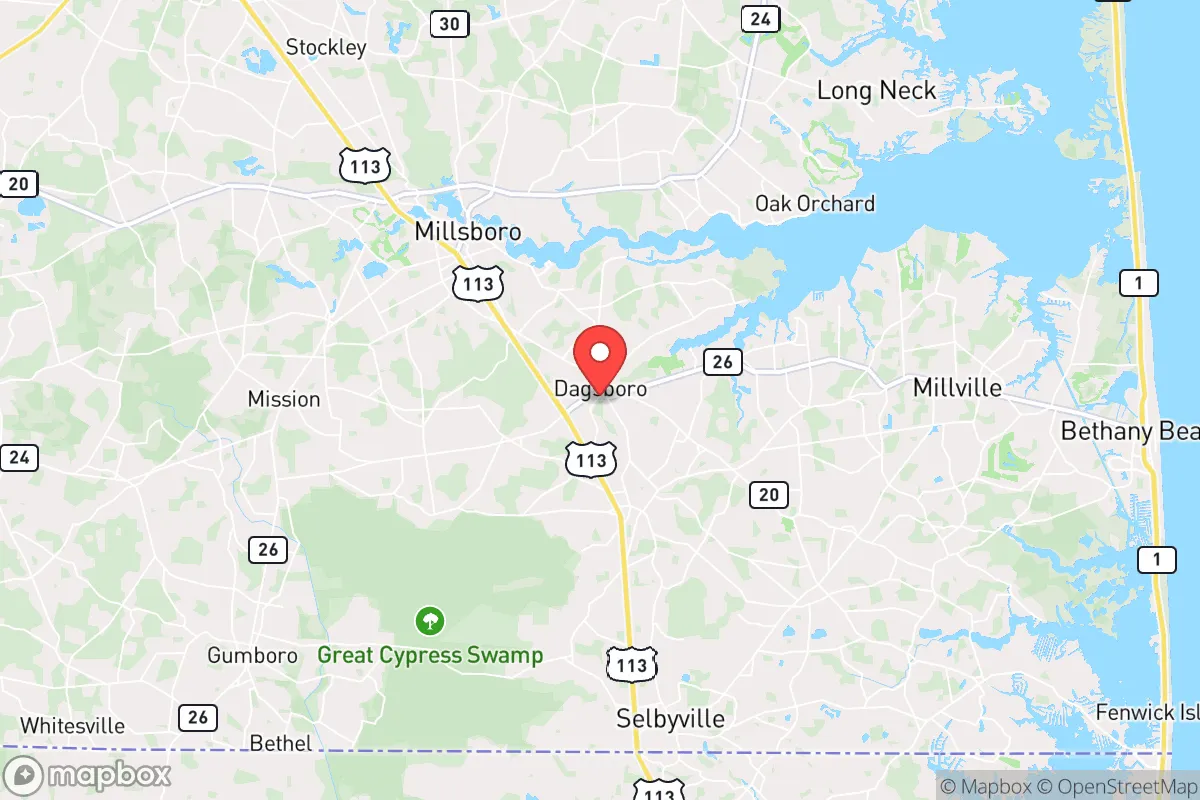
Photo: Wikipedia
Personal Sovereignty in Dagsboro, DE
Viable for self-reliance. Generally workable, though some barriers may limit total independence.
What does Personal Sovereignty tell us?
Personal Sovereignty measures your capacity for self-reliance and independence with minimal government friction. Higher scores mean fewer barriers between you and the way you want to live... but it assumes you have the space you need and good neighbors.
What does this tell us?
Personal Sovereignty measures your capacity for self-reliance and independence with minimal government friction. Higher scores mean fewer barriers between you and the way you want to live... but it assumes you have the space you need and good neighbors.
State Policy
Energy independence: Importer (2% of energy produced in-state)
Personal Liberty
Homesteading

Personal Liberty Analysis
Dagsboro, Delaware, offers a notably high degree of personal sovereignty relative to much of the Mid-Atlantic, largely because it sits in a state that, while not perfect, maintains a lighter regulatory touch than its neighbors to the north and west. For the individual or family operating from a survivalist or prepper mindset, the key takeaway is that Sussex County—where Dagsboro is located—is the most conservative and liberty-minded corner of the state, providing a buffer against the more restrictive policies seen in New Castle County or nearby Maryland. The town itself is small, with a population under 1,000, meaning local governance is minimal and community ties are strong, which translates into fewer layers of bureaucracy between you and your daily life. However, Delaware is not a free-for-all; state-level taxes and certain regulations still apply, so understanding the specific balance of freedom and constraint here is critical before making a move.
Tax burden and regulatory posture: How Delaware compares to neighboring states
Delaware’s tax structure is a mixed bag for those seeking maximum financial autonomy. On the plus side, there is no state or local sales tax, which is a significant advantage for preppers stocking up on supplies, gear, and bulk goods—every dollar you spend goes further. Property taxes in Sussex County are among the lowest in the region, typically ranging from 0.5% to 0.7% of assessed value, which is far less than what you’d pay in Maryland or Pennsylvania. However, Delaware does have a progressive income tax with rates from 2.2% to 6.6%, and while it’s not as punishing as New York or New Jersey, it’s higher than states like Florida or Texas. For a single individual or family, the lack of sales tax often offsets the income tax burden, especially if you’re strategic about where you earn and spend. The regulatory posture in Dagsboro is generally business-friendly; Sussex County has a reputation for permitting flexibility, especially for agricultural and light industrial uses, which matters if you plan to run a home-based enterprise or maintain a workshop. That said, Delaware’s environmental regulations—particularly around wetlands and coastal zones—can be a hurdle if you’re looking to develop raw land, so always check zoning before buying.
Self-defense and gun law specifics: What you can and cannot do in Dagsboro
For the liberty-minded individual, Delaware’s gun laws are a point of concern but not a dealbreaker—provided you know the rules. As of 2026, Delaware requires a permit to purchase a handgun, which involves a background check, fingerprinting, and a 10-day waiting period. This is a clear infringement on the Second Amendment compared to constitutional carry states, but it’s still less restrictive than Maryland or New Jersey. Open carry is legal without a permit, and concealed carry requires a permit that is shall-issue for residents, meaning as long as you pass a background check and complete a training course, you will get it. Magazine capacity is not restricted at the state level, which is a win for preppers who want standard-capacity magazines for defensive rifles. Dagsboro itself is in a rural area where law enforcement response times can be 15-20 minutes, so the practical reality is that self-defense is largely your own responsibility. Stand-your-ground laws apply in Delaware, meaning you have no duty to retreat if you are in a place you have a legal right to be. However, the state does have a red-flag law (Extreme Risk Protection Order) that allows authorities to temporarily seize firearms based on a court order, which is a tool that can be abused by overreach—so staying low-profile and avoiding any legal entanglements is wise.
Self-reliance and homesteading viability: Lot sizes, zoning, and off-grid feasibility
Dagsboro’s rural character makes it a strong candidate for homesteading and self-reliance. Minimum lot sizes in unincorporated Sussex County are typically 1 acre, but many parcels in and around Dagsboro are 2 to 5 acres, giving you room for a substantial garden, small livestock, and even a workshop or storage building. Zoning is generally permissive for agricultural uses; you can keep chickens, goats, and even a few head of cattle without special permits, as long as you’re not in a subdivision with HOA restrictions—so avoid HOAs at all costs. Off-grid feasibility is moderate: Delaware has no state law prohibiting rainwater collection, and well water is common in the area, though you’ll need to drill a well (costing $5,000–$10,000). Solar panels are allowed, and net metering is available through the local utility, Delmarva Power, but the state’s renewable portfolio standards mean you can’t fully disconnect from the grid without jumping through bureaucratic hoops. For the serious prepper, the biggest limitation is that Delaware is not a remote wilderness; you’re within an hour of the coast and major highways, so privacy is relative. Still, compared to the dense suburbs of the Northeast, Dagsboro offers a realistic path to semi-self-sufficiency without being completely isolated.
Personal liberties: Parental rights, medical autonomy, speech, and property
On the spectrum of personal freedoms, Delaware leans moderately conservative on some issues and frustratingly progressive on others. Parental rights are relatively strong in Sussex County; the state does not have a universal vaccine mandate for schoolchildren, and parents can opt out of sex education or other curricula with a written request. However, Delaware has a broad anti-discrimination law that includes sexual orientation and gender identity, which some conservative parents view as overreach into school policies. Medical autonomy is a mixed bag: the state has legalized recreational marijuana, which may be a plus or minus depending on your views, but it also has strict prescription drug monitoring and no right-to-try law for terminally ill patients. Speech is protected under the First Amendment, and Dagsboro’s small-town atmosphere means you’re unlikely to face the kind of censorship seen in urban areas. Property rights are generally respected; Delaware has no statewide rent control, and eminent domain is rarely used for private development. The biggest threat to property sovereignty is the state’s coastal zone regulations, which can restrict development near waterways—so if you’re buying land, check the Coastal Zone Act maps. Overall, the local culture in Dagsboro is live-and-let-live, with neighbors who mind their own business, which is the best environment for preserving personal liberties.
In the broader context of the Mid-Atlantic, Dagsboro stands out as a pocket of relative sovereignty for the survivalist-minded individual. It lacks the extreme freedoms of a place like rural Texas or Idaho, but it also avoids the heavy-handed governance of New York, New Jersey, or Maryland. The combination of low property taxes, no sales tax, permissive zoning for homesteading, and a conservative local culture makes it a viable option for those who want to build a self-reliant life without moving across the country. The trade-offs—a handgun purchase permit, a red-flag law, and moderate income taxes—are manageable if you’re strategic and keep a low profile. For a single person or family looking to escape the creeping overreach of more restrictive states, Dagsboro offers a realistic middle ground: enough freedom to live on your own terms, but close enough to civilization to access supplies and markets when needed. Just be sure to vet any property for HOA covenants and coastal zone restrictions before you commit, and you’ll find a solid base for personal sovereignty.

* Values derived from national, state, county, city and local statistics and may differ in a specific area. Last updated: 2026-04-22T07:05:58.000Z
Narrative content on this page is AI-generated and may contain mistakes. Verify any details that matter before acting on them.
ReloMaps may earn a commission from affiliate links at no extra cost to you.

