
Photo: Wikipedia
Political ClimatePolitical Climate in Dagsboro, DE
District shown is the primary district for this city’s centroid. Cities may span multiple districts.
Inherited from parent state — no local data available.
Local Political AnalysisPolitical Analysis of Dagsboro, DE
Dagsboro, Delaware, sits in a political landscape that's been shifting under our feet, and not in a direction that sits well with folks who value personal freedom and limited government. The area now carries a Cook PVI of D+8, meaning it leans significantly more Democratic than the national average—a far cry from the independent, live-and-let-live spirit that used to define this part of Sussex County. You can feel the change in the air, from the way local ordinances are creeping into everyday life to the kind of candidates who get traction around here.
How it compares
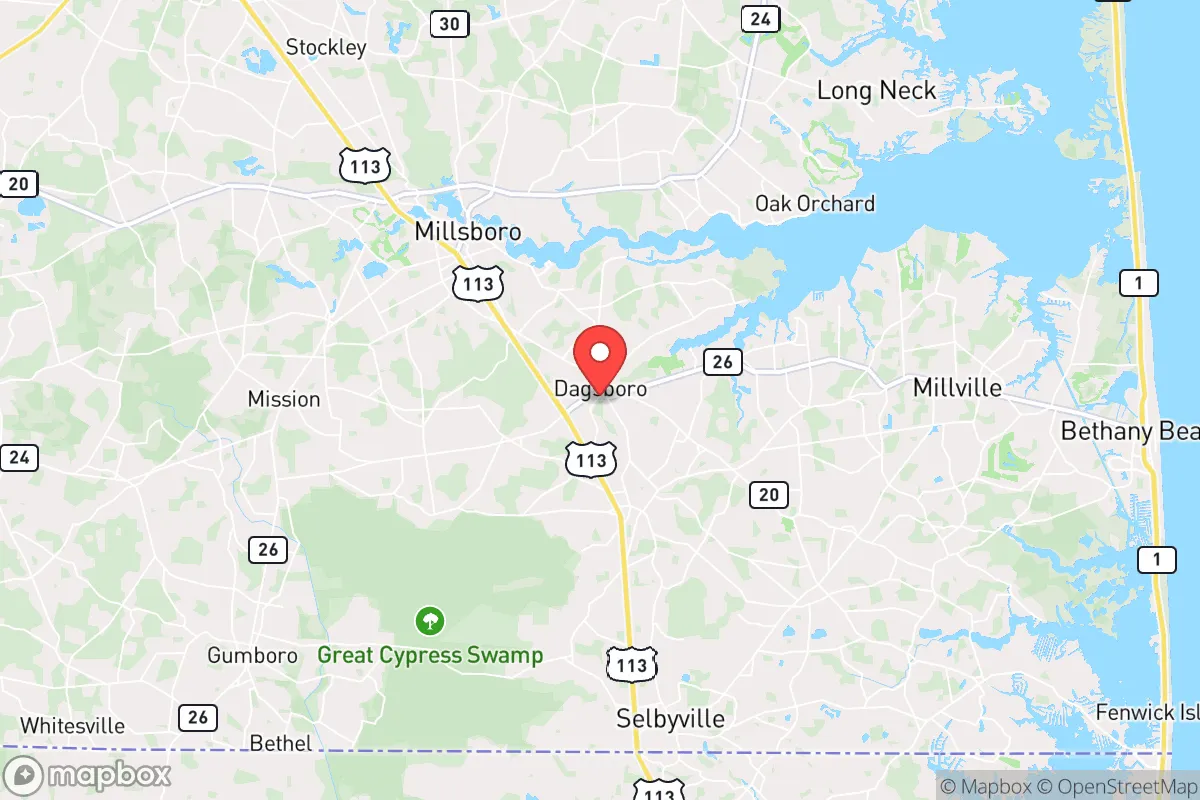
To understand Dagsboro's political drift, you have to look at the towns around it. Head north toward Georgetown, and you'll find a more traditional, conservative-leaning community where folks still wave the Gadsden flag and push back on zoning overreach. But Dagsboro itself is increasingly mirroring the coastal influence of places like Bethany Beach and Rehoboth, where progressive policies on land use, taxation, and social issues have taken root. The contrast is stark: while nearby Millsboro still votes reliably red, Dagsboro's precincts have been trending blue for the last three cycles. It's a classic story of suburbanization—newcomers from upstate or out of state bring their big-government ideas with them, and suddenly you've got more regulations on everything from short-term rentals to how you can use your own property.
What this means for residents
For those of us who've been here a while, the practical effects are hard to ignore. The county council and local boards are increasingly populated by folks who see government as a tool to manage behavior rather than protect rights. You're seeing more noise about "climate action plans" that could restrict building and land use, and there's a growing push for higher property taxes to fund programs that sound good on paper but eat into your wallet and your freedom to do what you want with your land. The school board has also gotten more progressive, with curriculum changes that raise eyebrows among parents who want their kids taught how to think, not what to think. It's not a full-blown crisis yet, but the trajectory is concerning—each election brings a tighter squeeze on the personal liberties that made this area a great place to raise a family.
One cultural distinction that stands out is the shift in how local law enforcement and public safety are handled. Dagsboro used to have a "mind your own business" ethos, but now there's more talk of "equity" initiatives and community oversight boards that sound like they're designed to solve problems that don't exist. The annual town events, once a celebration of small-town independence, now come with more permits, fees, and bureaucratic hoops. If you're looking for a place where you can still live without a government official looking over your shoulder, Dagsboro is slipping away from that ideal. The next few election cycles will be critical—if the trend continues, this little town could become a textbook example of how progressive overreach quietly erodes the freedoms that made rural Delaware special.

State Political ClimatePolitical Climate in Delaware
State Political AnalysisPolitical Environment in the State
Delaware has long been a blue state in presidential elections, but its political climate is far more nuanced than the statewide vote totals suggest. The state’s dominant coalition is a mix of progressive New Castle County suburbs and a shrinking but resilient conservative base in Kent and Sussex counties. Over the past 20 years, the state has shifted leftward on social and economic issues, driven by in-migration from the Northeast and the growth of the Wilmington metro area, but the rural southern counties have pushed back, creating a sharp urban-rural divide that defines local politics.
Urban vs. rural divide
The political map of Delaware is essentially a tale of three counties. New Castle County, home to Wilmington and its affluent suburbs like Greenville and Hockessin, is the engine of Democratic dominance. These areas vote 65-70% Democratic, powered by corporate professionals, government employees, and a growing population of out-of-state transplants. Kent County, anchored by Dover, is a swing region—Dover itself leans Democratic due to state government workers and the historically Black community, but the surrounding farmland and small towns like Smyrna and Milford vote reliably Republican. Sussex County is the conservative stronghold, with beach towns like Rehoboth Beach and Lewes trending purple due to retirees and LGBTQ+ communities, while inland areas like Georgetown and Seaford remain deeply red. The divide is stark: in 2024, Sussex County voted +12 for Trump, while New Castle went +28 for Biden.
Policy environment
Delaware’s policy environment is a mixed bag for conservatives. On taxes, the state has no sales tax—a major plus—but personal income tax rates top out at 6.6%, and property taxes are moderate. The regulatory posture is business-friendly in name, but the state’s corporate law dominance (over 60% of Fortune 500 companies are incorporated here) creates a pro-business tilt that sometimes clashes with progressive social policies. Education policy is a flashpoint: the state has no school choice program and a powerful teachers union, though charter schools exist in Wilmington and Newark. Healthcare is heavily regulated, with the state expanding Medicaid under Obamacare and imposing strict insurance mandates. Election laws are a concern for conservatives: Delaware has no voter ID requirement, same-day registration, and universal mail-in voting (permanently adopted in 2022 via HB 38). This has led to persistent integrity concerns among right-leaning residents, especially after the 2020 election saw a surge in absentee ballots.
Trajectory & freedom
Delaware is trending less free on multiple fronts. The most alarming recent legislation for conservatives is HB 450 (2023), which banned the sale of "assault weapons" and high-capacity magazines, effectively ending new purchases of AR-15s and similar rifles. This was passed despite a state constitutional right to bear arms. On parental rights, the state passed HB 322 (2024), which prohibits schools from notifying parents if a child changes their gender identity or pronouns—a direct blow to family autonomy. Medical freedom took a hit with SB 203 (2023), which mandated COVID-19 vaccines for healthcare workers and allowed broad employer mandates. Property rights are under pressure from the Delaware Land Use Act, which gives the state veto power over large developments, effectively limiting rural growth. On the positive side, the state has no estate tax and no inheritance tax, and the Delaware Economic Development Office offers tax credits for small businesses. But the overall trajectory is toward more government control, especially in the areas of guns, education, and health.
Civil unrest & political movements
Delaware has seen relatively low levels of civil unrest compared to neighboring states, but flashpoints exist. In 2020, Wilmington experienced several nights of protests and looting following George Floyd’s death, with businesses on Market Street damaged. The Delaware State Police were criticized for a heavy-handed response, but no major riots occurred. On the right, the Delaware Republican Party has been energized by grassroots groups like the Delaware Family Policy Council and the Sussex County Tea Party, which hold regular rallies in Georgetown and Dover. Immigration politics are muted—Delaware is not a border state, but it is a sanctuary state in practice, with state law prohibiting local police from cooperating with ICE detainers (HB 200, 2021). Election integrity remains a hot-button issue: the 2022 gubernatorial race saw Republican candidate Julianne Murray lose by 20 points, but many conservatives point to the lack of voter ID and mail-in ballot security as reasons for distrust. The most visible flashpoint for a new resident would be the gun debate—gun rights activists hold annual "Second Amendment Day" rallies at the state capitol in Dover, drawing hundreds.
Projection
Over the next 5-10 years, Delaware will likely continue its leftward drift, but the pace may slow. The key demographic shift is the influx of retirees and remote workers from New York and New Jersey, who are moving to Sussex County’s beach towns and driving up home prices. These newcomers tend to be fiscally conservative but socially liberal, which could push Sussex County from red to purple. Meanwhile, New Castle County’s growth is fueled by corporate relocations and the expansion of the University of Delaware in Newark, which reinforces the progressive tilt. The state’s Republican Party is struggling to adapt—it’s dominated by rural conservatives who have little appeal in the suburbs. A realistic projection: by 2030, Delaware will be a solidly blue state with a Republican base confined to inland Sussex and parts of Kent. The state will likely pass more gun control, expand paid family leave (already on the table), and possibly implement a carbon tax. For a conservative moving in now, expect to live in a state where your vote for president won’t matter, but local races in Sussex or Kent could still be competitive.
Bottom line for a new resident: If you’re a conservative looking for a low-tax, business-friendly environment, Delaware still offers advantages—no sales tax, low property taxes, and a pro-corporate legal system. But you’ll be living in a state where your values on guns, education, and parental rights are increasingly under assault. The best bet is to settle in Sussex County, where local government is still conservative, and prepare for a long-term fight to preserve the freedoms that made Delaware attractive in the first place. The state is not yet a lost cause, but the trend lines are concerning.
* Values derived from national, state, county, city and local statistics and may differ in a specific area. Last updated: 2026-04-22T07:05:58.000Z
Narrative content on this page is AI-generated and may contain mistakes. Verify any details that matter before acting on them.
ReloMaps may earn a commission from affiliate links at no extra cost to you.

