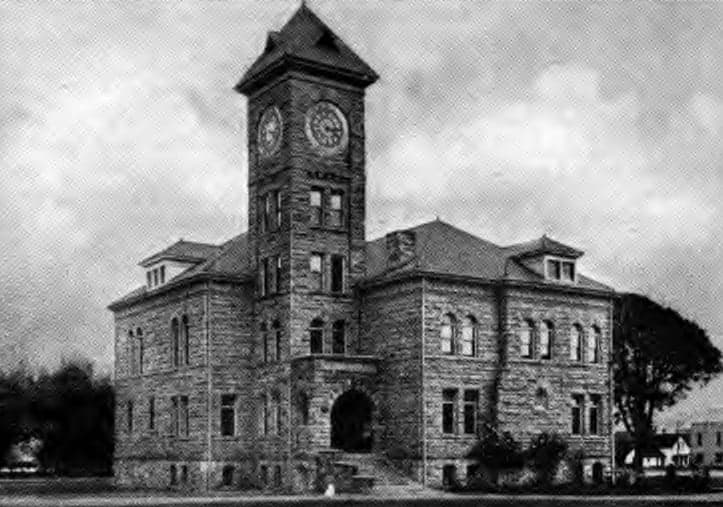
Photo: Wikipedia
Demographics of Dallas, OR
Affluence Level in Dallas, OR
A below-average socioeconomic profile. Incomes, home values, and educational attainment trail the U.S., with higher poverty and unemployment.
People of Dallas, OR
The people of Dallas, Oregon, today number 17,214, forming a predominantly white (79.8%) and politically conservative community with a small but growing Hispanic population (10.7%). The city retains a distinct small-town, family-oriented character, with a lower-than-average college attainment rate (22.9%) and a very low foreign-born share (1.7%), reflecting a population rooted in multi-generational local ties rather than recent international migration. Residents often describe Dallas as a place where "everyone knows your name," and the city's identity is closely tied to its agricultural heritage and role as a quieter, more affordable alternative to nearby Salem and Portland.
How the city was settled and grew
Dallas was founded in the 1840s as a supply stop along the Oregon Trail, with the first white settlers arriving via the 1843 land claims that opened the Willamette Valley to American homesteaders. The original population was overwhelmingly of Northern European stock—primarily English, Irish, and German farmers—who established the town as the Polk County seat in 1856. The arrival of the Oregon and California Railroad in the 1880s spurred a second wave, bringing merchants and tradesmen who built out the historic downtown core around Main Street and the Oak Park neighborhood, where many of the original Victorian homes still stand. By the early 20th century, Dallas had become a regional hub for timber and agriculture, drawing a small number of Italian and Scandinavian laborers who settled in the West Dallas area near the mill sites. The population remained overwhelmingly white and native-born through the mid-20th century, with the 1950 census recording a 99.2% white share.
Modern era (post-1965)
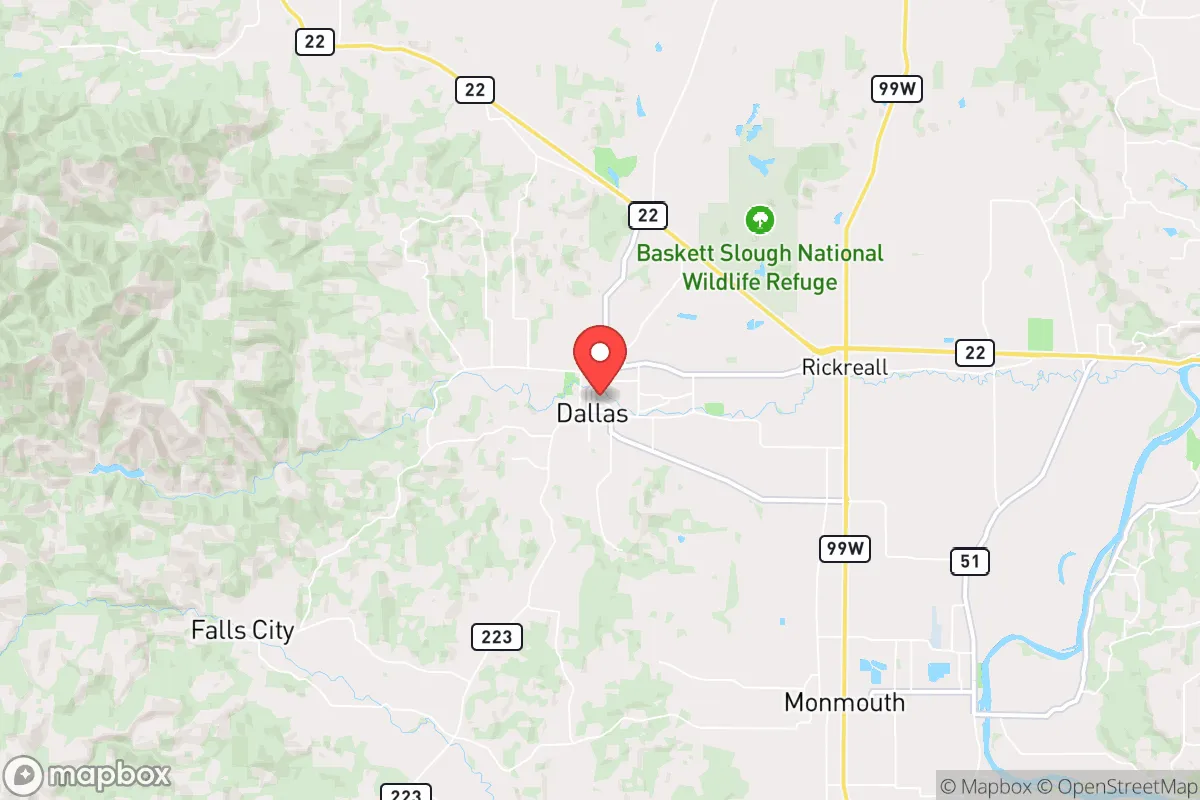
After the 1965 Hart-Cellar Act, Dallas saw virtually no increase in foreign-born residents—the foreign-born share today is just 1.7%, far below the national average. Instead, the city's modern growth has come from domestic in-migration: families and retirees leaving the Portland metro area for lower housing costs and a slower pace. This wave, accelerating after 2000, has filled the La Creole Acres subdivision and the newer East Dallas developments with white, middle-class households, many with school-age children. The Hispanic population, which was negligible before 1990, has grown to 10.7% as agricultural labor needs in the surrounding berry and nursery farms drew Mexican-origin families into the South Dallas area near Highway 99W. The Black population remains minimal at 1.0%, and East/Southeast Asian residents account for only 0.2%, with no measurable Indian-subcontinent community. The city's racial and ethnic landscape is thus a story of a white-majority core absorbing a modest Hispanic influx, with little diversification beyond that.
The future
Dallas is likely to continue its slow, steady growth as a bedroom community for Salem and Portland, with the population projected to reach roughly 20,000 by 2035 based on current annexation plans. The white share will likely decline gradually—from 79.8% to perhaps 75%—as the Hispanic population grows through higher birth rates and continued agricultural migration, concentrating further in South Dallas and the Oak Park rental stock. The city shows no signs of tribalizing into distinct ethnic enclaves; instead, it is slowly homogenizing into a younger, more diverse version of itself, with second-generation Hispanic families increasingly integrating into the broader community. The foreign-born share is expected to remain below 3%, as Dallas lacks the industrial or tech job base to attract significant international migration. For a conservative-leaning family or individual moving in now, this means joining a community that is stable, predominantly white, and culturally traditional, with a gradual Hispanic integration that is unlikely to disrupt the city's character in the near term.
Dallas is becoming a slightly more diverse, still overwhelmingly white small city where the primary demographic story is domestic in-migration from the Portland metro, not international immigration. For a conservative-leaning mover, this represents a place where the population is stable, family-oriented, and likely to remain so for the next decade, with the main change being a slow, organic growth in the Hispanic share rather than any rapid or disruptive shift.

* Values derived from national, state, county, city and local statistics and may differ in a specific area. Last updated: 2026-05-01T04:41:56.000Z
Narrative content on this page is AI-generated and may contain mistakes. Verify any details that matter before acting on them.
ReloMaps may earn a commission from affiliate links at no extra cost to you.

