Photo: Wikipedia
Demographics of Del Rio, TX
Affluence Level in Del Rio, TX
A below-average socioeconomic profile. Incomes, home values, and educational attainment trail the U.S., with higher poverty and unemployment.
People of Del Rio, TX
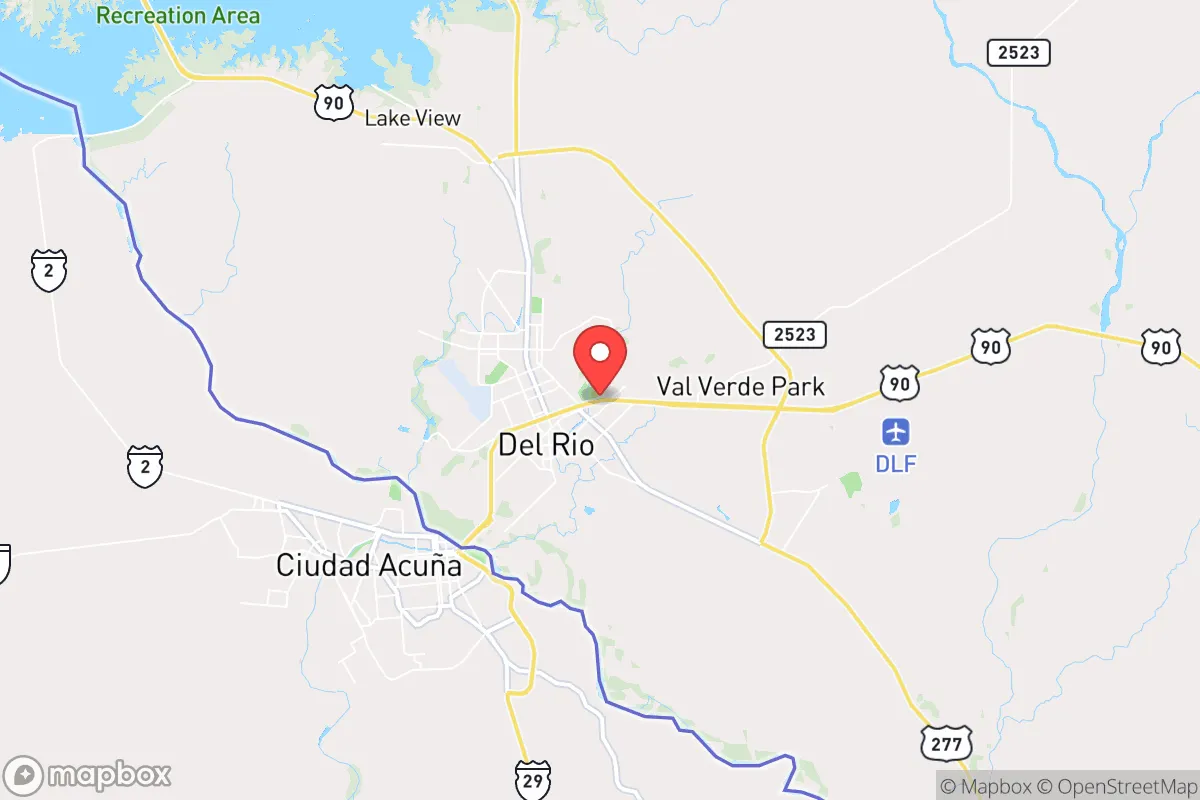
Del Rio today is a predominantly Hispanic city of 34,638 residents, where 85.9% of the population identifies as Hispanic or Latino, giving it a strong borderlands character that blends Mexican and American cultural traditions. The city’s identity is shaped by its location on the Rio Grande opposite Ciudad Acuña, Mexico, creating a binational community where cross-border family ties, commerce, and daily commutes are routine. With a foreign-born population of 9.8% and a college-educated rate of 20.8%, Del Rio is a working-class city with deep roots in ranching, military service (via Laughlin Air Force Base), and cross-border retail. The population is notably less diverse in racial terms than the national average — White non-Hispanic residents make up 11.7%, Black residents 0.6%, and East/Southeast Asian residents 0.2% — reflecting a community that has been overwhelmingly Mexican-American for generations.
How the city was settled and grew
Del Rio’s population history begins with the 1883 arrival of the Galveston, Harrisburg and San Antonio Railway, which transformed a sparse ranching outpost into a commercial hub. The original Anglo settlers were ranchers and merchants drawn by land grants and the promise of rail access to markets. They established the San Felipe neighborhood along the river, the city’s oldest residential district, where early adobe homes and the historic San Felipe Springs area still mark the original settlement core. By the 1910s, Mexican laborers arrived to work on the railroad, in agriculture, and in the construction of the international bridge, settling in what became Barrio Chihuahua and Barrio San Antonio, neighborhoods just south of downtown that remain predominantly Hispanic today. The 1930s brought a wave of Dust Bowl refugees from Oklahoma and Texas’s Panhandle, who settled in the North Heights area, adding a small Anglo working-class presence. Laughlin Air Force Base opened in 1943, drawing military families and civilian contractors, many of whom settled in the Laughlin Estates neighborhood near the base’s main gate. By 1950, Del Rio’s population had reached roughly 14,000, with a roughly 60-40 split between Hispanic and Anglo residents, though segregation was informal but real — Anglos concentrated north of the railroad tracks, while Mexican-Americans lived in the southern barrios.
Modern era (post-1965)
The post-1965 period saw Del Rio become overwhelmingly Hispanic, driven by continued immigration from Mexico and higher birth rates among Mexican-American families. The 1965 Immigration and Nationality Act eliminated national-origin quotas, but for Del Rio, the more immediate driver was the 1970s oil boom and the expansion of cross-border commerce, which drew new Mexican immigrants into the Las Brisas and Villa de la Fuente subdivisions, newer neighborhoods on the city’s west side. The Anglo population, which had peaked at roughly 40% in the 1960s, began a steady decline as younger generations left for larger Texas cities and as the base’s officer corps became more transient. By 1990, the Hispanic share had risen to 75%; by 2020, it reached 85.9%. The Black population has remained tiny (0.6%), concentrated among military families stationed at Laughlin, with no distinct Black neighborhood. The East/Southeast Asian population (0.2%) is almost entirely composed of Filipino-American military families living in Laughlin Estates or base housing. The Indian-subcontinent population is effectively zero. The White non-Hispanic population (11.7%) is now concentrated in the North Heights and Sunset Park neighborhoods, as well as among retirees in the Amistad Village area near the lake. The city’s overall population has been flat to slightly declining since 2010, as out-migration of younger residents to San Antonio and Austin offsets natural increase.
The future
Del Rio’s population is likely to become slightly more diverse in the coming decade, but only marginally. The Hispanic share is projected to remain above 85%, with growth driven by natural increase rather than new immigration, as border enforcement has reduced cross-border settlement. The White non-Hispanic population will continue to shrink as older residents age out and younger Anglos leave for college and careers elsewhere. The military presence at Laughlin Air Force Base provides the main source of non-Hispanic in-migration, bringing small numbers of Black, Filipino, and other military families, but these groups are transient and do not form permanent communities. New residential development is concentrated in the Villa de la Fuente and Las Brisas areas on the west side, where newer subdivisions are attracting middle-class Hispanic families moving up from older barrios. The San Felipe historic district is seeing modest gentrification as remote workers and retirees buy riverfront properties, but this remains a small trend. The city’s cultural identity is solidifying as a bicultural, Spanish-fluent community with strong ties to Ciudad Acuña, and the population is aging slightly — the median age has risen from 28 in 2000 to 32 in 2020.
For someone moving to Del Rio now, the city offers a stable, family-oriented community where Spanish and English mix freely, where the cost of living is low, and where the dominant culture is Mexican-American with a strong military presence. The population is not growing rapidly, and the demographic trend is toward greater homogeneity rather than diversity. New arrivals — whether military, remote workers, or retirees — will find a welcoming but insular community where long-established families and cross-border ties define social life. The city is becoming more suburban in its newer neighborhoods, but the historic barrios and the riverfront remain the heart of Del Rio’s identity.

* Values derived from national, state, county, city and local statistics and may differ in a specific area. Last updated: 2026-08-04T15:33:28.000Z
Narrative content on this page is AI-generated and may contain mistakes. Verify any details that matter before acting on them.
ReloMaps may earn a commission from affiliate links at no extra cost to you.

