Photo: Wikipedia
Demographics of Delta Junction, AK
Affluence Level in Delta Junction, AK
A middle-class area roughly in line with national averages across income, home values, education, and employment.
People of Delta Junction, AK
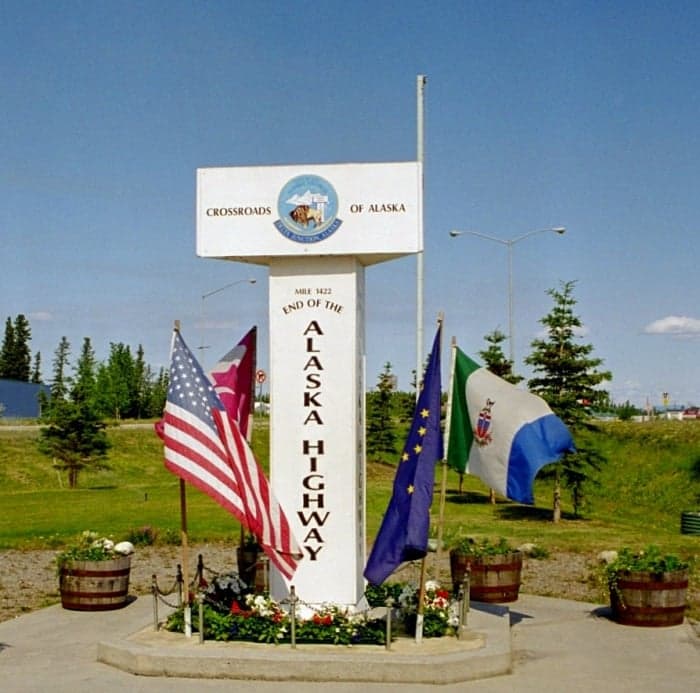
Delta Junction, Alaska, is a small, tight-knit community of 1,154 residents characterized by its frontier independence and strong military and agricultural roots. The population is predominantly White (79.1%) with a notable Hispanic minority (10.3%), a very small foreign-born share (2.3%), and a lower-than-average college attainment rate (23.8%). The town’s identity is shaped by its location at the junction of the Richardson and Alaska Highways, serving as a service hub for nearby Fort Greely and the surrounding farming region.
How the city was settled and grew
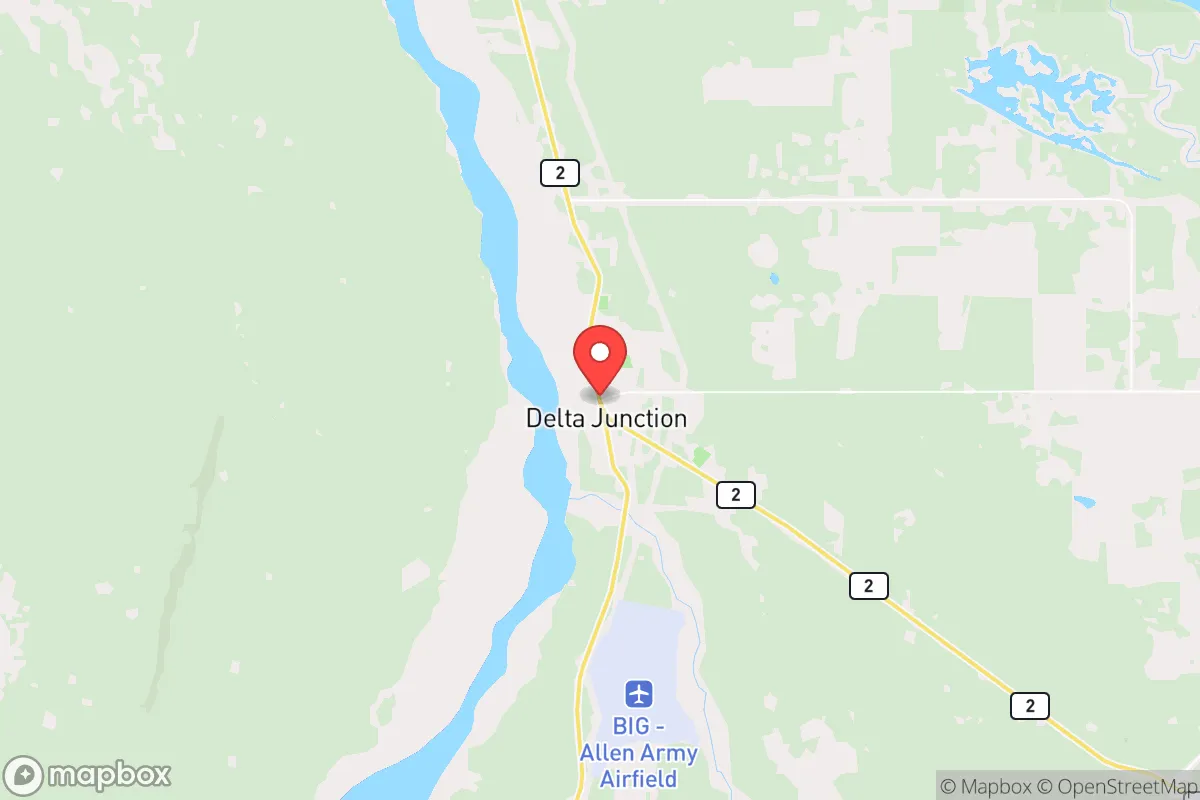
Delta Junction’s human history begins not with a gold rush but with a road. The area was originally inhabited by Athabascan peoples, but the modern settlement dates to the construction of the Richardson Highway in the 1910s, which connected Valdez to Fairbanks. The town’s name comes from the Delta River, which meets the Tanana River nearby. The first permanent non-Native settlers were homesteaders drawn by the 1940s Delta Agricultural Project, a federal land-grant program that offered 160-acre parcels to veterans and families willing to farm in subarctic conditions. These early homesteaders, mostly of Northern European descent, built the original core of what is now Old Town Delta Junction, concentrated along the Richardson Highway near the Tanana River bridge. A second wave arrived in the 1950s with the construction of Fort Greely (10 miles south), bringing military personnel and civilian contractors who settled in the Fort Greely Housing Area and the adjacent Clearwater subdivision. The 1970s construction of the Trans-Alaska Pipeline brought a third wave of transient workers, many of whom stayed and established small businesses along the Alaska Highway corridor, creating the commercial strip that defines the town today.
Modern era (post-1965)
After the 1965 Immigration Act, Delta Junction saw little direct impact from new international migration due to its remote location and limited economic base. The foreign-born population remains very low at 2.3%, and the Asian and Indian subcontinent populations are effectively zero. The most significant demographic shift since the 1970s has been the growth of the Hispanic population, now at 10.3%. This is largely driven by seasonal agricultural workers in the region’s barley and potato farms, many of whom settled permanently in the Buffalo Center area near the junction of the Richardson and Alaska Highways. The White population, while still dominant, has aged as younger residents leave for Fairbanks or Anchorage for education and employment. The Tanana Loop neighborhood, developed in the 1990s, attracted a mix of retired military and state employees, while the Delta Junction City Center remains a commercial and civic hub with a stable, mostly White and older demographic. The Black population (0.4%) is negligible and primarily associated with transient military assignments at Fort Greely.
The future
Delta Junction’s population is projected to remain stable or decline slightly, as the town lacks the economic diversification to attract large new waves of residents. The Hispanic community, concentrated in the Buffalo Center and farm-adjacent areas, is the only segment showing organic growth, driven by family reunification and continued agricultural labor demand. The White population is aging and slowly shrinking, with younger generations moving to urban centers. The town is not tribalizing into distinct ethnic enclaves; rather, it is homogenizing into a predominantly White and Hispanic rural community. The closure or downsizing of Fort Greely could accelerate population loss, while any expansion of the military base or new resource extraction projects (e.g., mining or oil) could bring a temporary influx of workers. For the next 10-20 years, Delta Junction will likely remain a small, stable, conservative-leaning community with a modest Hispanic minority and little racial or ethnic diversification beyond that.
For someone moving in now, Delta Junction offers a low-crime, family-oriented environment with strong community ties and a self-reliant ethos. The population is not growing or diversifying rapidly, so newcomers should expect a homogeneous social landscape centered on outdoor recreation, agriculture, and military-related employment. The town is best suited for those seeking a quiet, rural lifestyle with access to Alaska’s wilderness, rather than those looking for urban amenities or a multicultural environment.

* Values derived from national, state, county, city and local statistics and may differ in a specific area. Last updated: 2026-04-19T19:17:54.000Z
Narrative content on this page is AI-generated and may contain mistakes. Verify any details that matter before acting on them.
ReloMaps may earn a commission from affiliate links at no extra cost to you.

