 Popular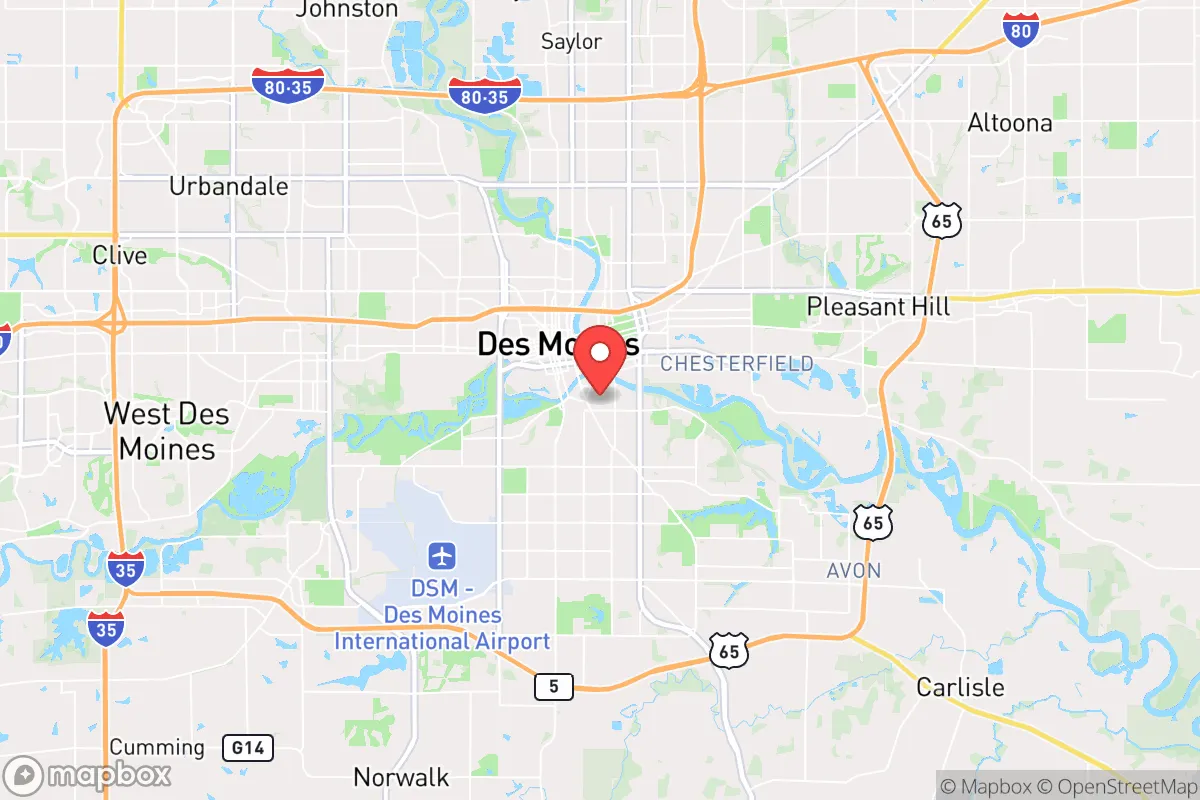
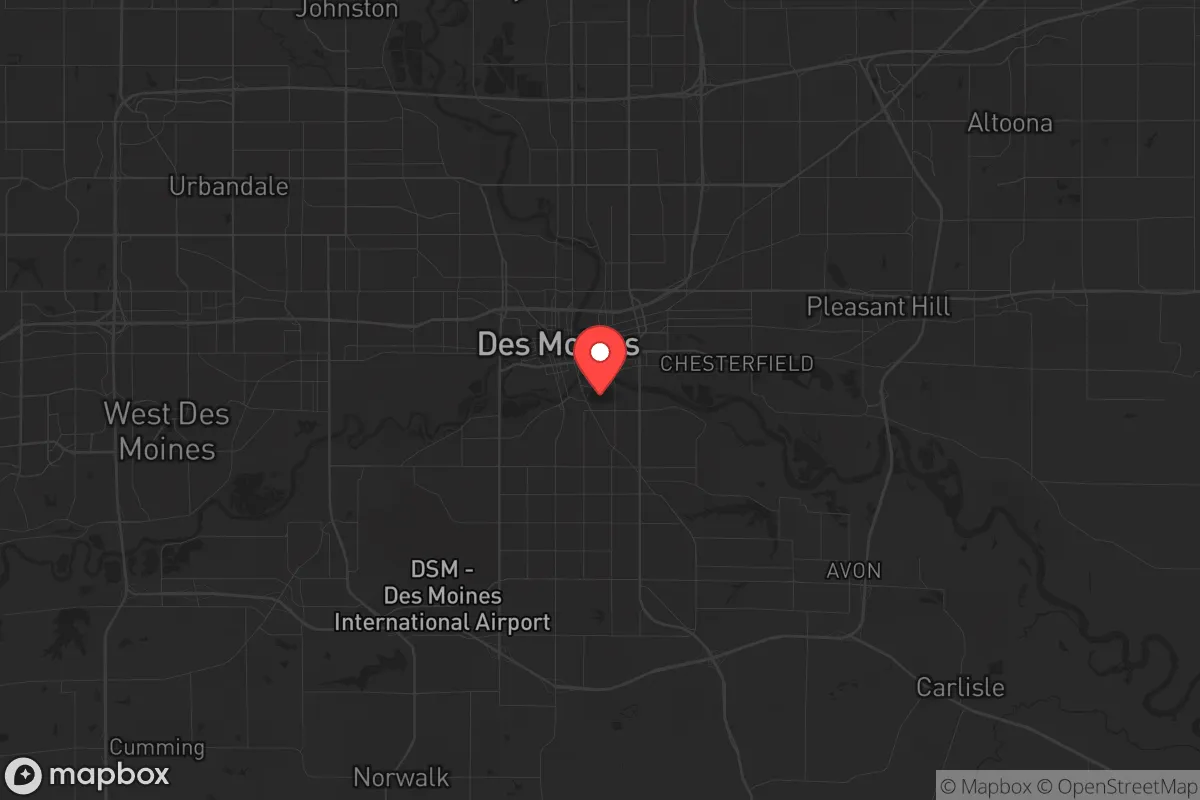
Photo: Wikipedia
Strategic Assessment of Des Moines, IA
Meaningful friction. Expect exposure to either population pressure, blast zones, or natural disaster risk. Consider buying a retreat property.
What does the Strategic Assessment tell us?
Our Strategic Assessment grades tactical survivability of an area. Major population centers, military targets, fallout zones, natural disasters, and border exposure all drive risk — lower exposure means a more defensible position in a crisis.
This is heavily inspired by Joel Skousen's Strategic Relocation book. Highly recommended you checkout the book ($)What does this tell us?
Our Strategic Assessment grades tactical survivability of an area. Major population centers, military targets, fallout zones, natural disasters, and border exposure all drive risk — lower exposure means a more defensible position in a crisis.
This is heavily inspired by Joel Skousen's Strategic Relocation book. Highly recommended you checkout the book ($)Strategic Pillars

Key Distances
Regional Safe Places
Below is our recommended "safe zones" in Iowa and the surrounding area based on our strategic heuristics. For most people, it's unrealistic to live in a “safe zone” full-time due to work, family or other personal reasons. They tend to be more rural. However, many of these areas are perfect for second homes and retreat properties that double as a vacation home or even a short-term rental.
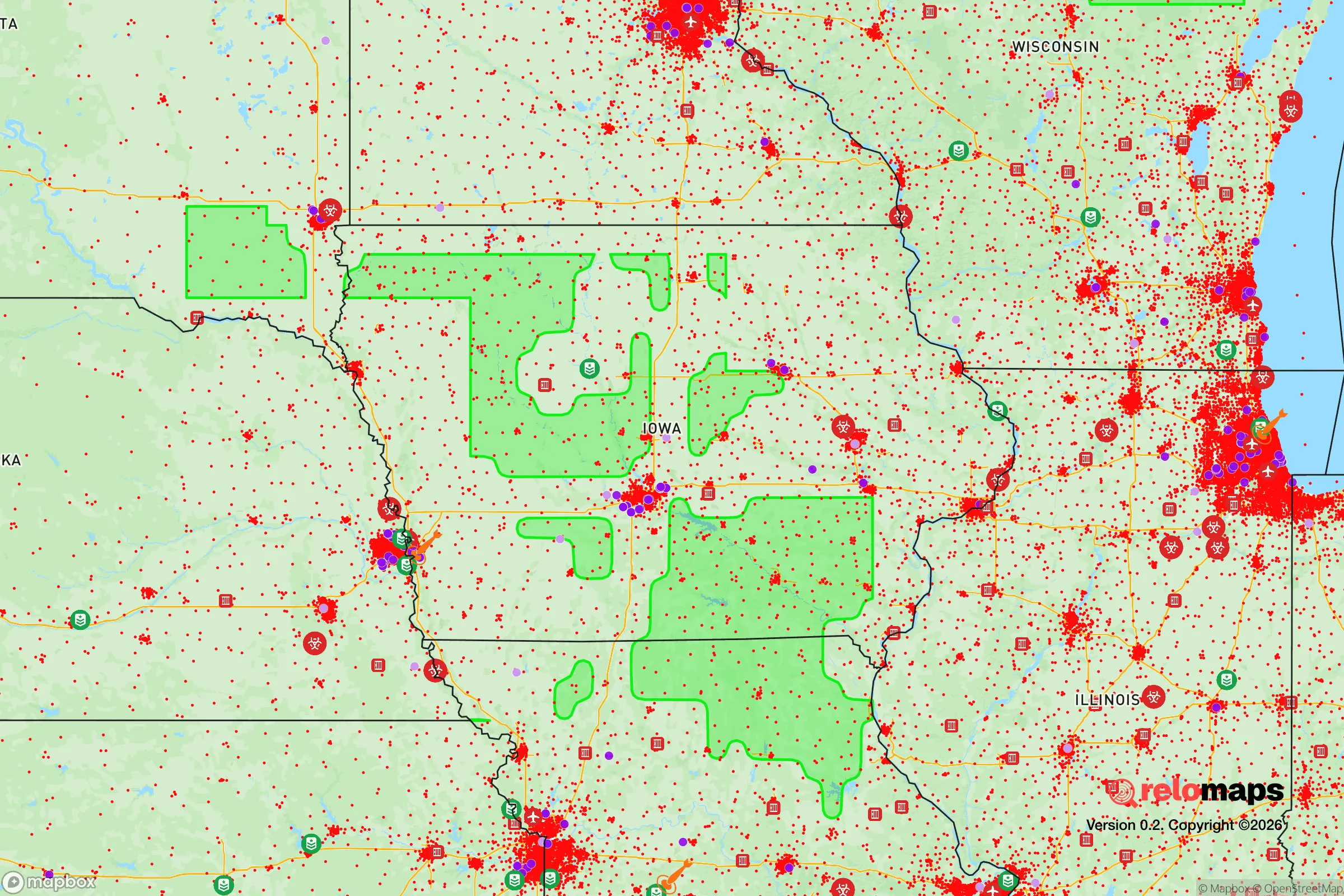
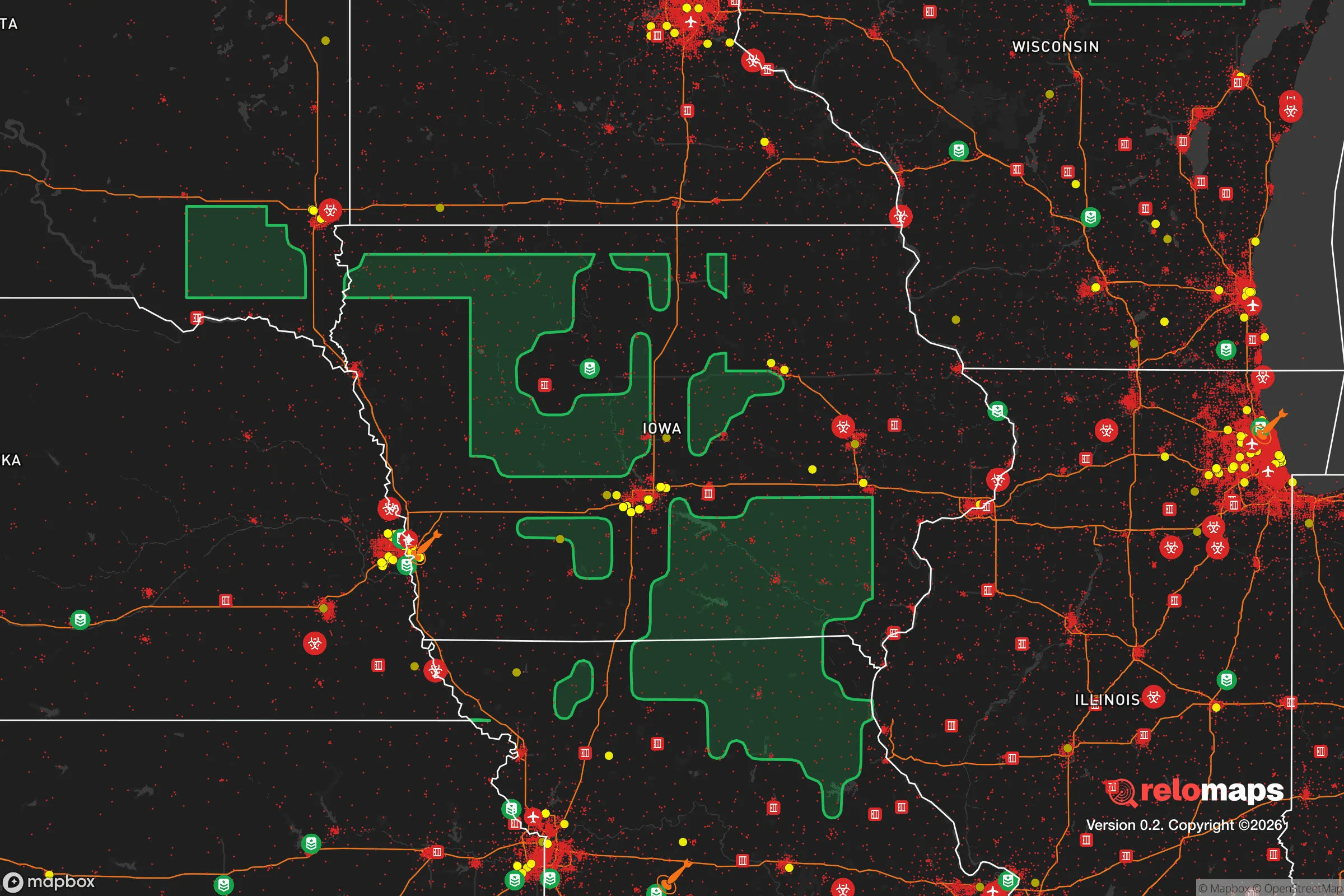


Important Note: For informational purposes only. This does not mean nothing bad ever happens in the green zones. Please use common sense. This is based on public data and modeled with AI. We tried to take a conservative approach but mistakes happen. We update this regularly as new information becomes available.
Solar Generator Recommendations
Backup power matters more here than in safer locations. We've picked three solar generators across budgets and capacity tiers — start with the budget unit if you only need a few essentials, or step up if you want to run a fridge and HVAC for days at a time.

Jackery Portable Power Station Explorer 300
Budget OptionPower on the Go: Weighing only 11 lbs, it's convenient to set up and store with book-sized foldable solar panels

BLUETTI Portable Power Station AC180
Designed for both indoor and outdoor scenarios, AC180 is highly capable as it has a robost capacity and continuous output power.

EF ECOFLOW DELTA Pro Ultra Power Station
Upgraded PickEcoFlow DELTA Pro Ultra is a whole-home energy system designed to grow with your family. Integrated with the Smart Home Panel 2, it scales to meet your evolving energy needs — keeping your home powered, intelligent, and secure through every stage of life.
We earn a commission, at no additional cost to you.
Strategic Assessment Analysis
Des Moines, Iowa, occupies a strategic sweet spot that few other Midwestern hubs can match: it’s far enough from the coasts to avoid the worst of a cascading national crisis, yet close enough to major supply chains and agricultural output to sustain itself when things go sideways. The city’s resilience isn’t accidental—it’s built on a bedrock of stable governance, a diversified economy that isn’t solely dependent on federal handouts, and a geographic position that puts it outside the blast radius of most high-value targets. For a relocator thinking in terms of decades, not election cycles, Des Moines offers a rare combination of isolation and connectivity that makes it a credible long-term hold.
Geographic position and natural advantages for long-term stability
Des Moines sits in the heart of the Corn Belt, which is another way of saying it’s surrounded by the most productive farmland on the planet. Within a 100-mile radius, you’ve got enough caloric output to feed millions, and the city itself is a major hub for agricultural processing and distribution. The Raccoon and Des Moines Rivers provide a reliable freshwater source, and the region’s aquifer—the Jordan Aquifer—is deep, protected, and not subject to the same depletion pressures as the Ogallala further west. The terrain is gently rolling, not mountainous, which means road networks remain passable in most weather, and the lack of major fault lines or hurricane corridors eliminates two of the biggest natural-disaster headaches. Winters are cold, yes, but that cold is a natural preservative for food stores and a deterrent for the kind of civil unrest that flares up in warmer climates. The city’s position at the intersection of Interstates 35 and 80 also means it’s a logistical node: supplies can move north-south and east-west without relying on coastal ports that could be compromised in a crisis.
Risks, exposures, and proximity to fallout-relevant landmarks
No place is a fortress, and Des Moines has its share of vulnerabilities. The most obvious is the presence of the Des Moines International Airport and the city’s role as a regional transportation hub—any major disruption to air travel or interstate commerce would ripple through the local economy. More concerning from a prepper perspective is the proximity to Offutt Air Force Base in Omaha (about 130 miles west), which houses U.S. Strategic Command. In a major conflict, Offutt is a Tier-1 target, and while Des Moines is outside the immediate blast zone, fallout patterns from a ground burst could drift eastward depending on wind direction. The same logic applies to the Army’s Iowa Army Ammunition Plant in Middletown (about 100 miles southeast), which produces large-caliber munitions. A strike there would be catastrophic for the immediate area, but Des Moines is far enough away to avoid direct effects. More mundane but more likely: the city’s reliance on a single major water treatment plant (the Des Moines Water Works) means a targeted cyberattack or physical sabotage could disrupt water supply for the entire metro. Flooding along the Raccoon and Des Moines Rivers is a recurring issue—major floods in 1993, 2008, and 2018 caused billions in damage—so any property below the 500-year floodplain is a hard pass. Finally, the city’s growing population (now over 700,000 in the metro) means that in a prolonged crisis, the urban core could become a net consumer of resources rather than a producer, especially if supply chains break down.
Practical resilience for a relocator: food, water, energy, and defensibility
For a single individual or family looking to hunker down, Des Moines offers a surprisingly workable foundation. Food security is the strongest card: the city is ringed by farms producing corn, soybeans, and livestock, and the local farmers’ markets and co-ops (like the Downtown Farmers’ Market, one of the largest in the Midwest) provide direct access to fresh produce. For long-term storage, the Hy-Vee and Fareway grocery chains have deep supply chains, and bulk-buying clubs like Costco and Sam’s Club are well-stocked. Water is the weak link: the Des Moines Water Works draws from the Raccoon and Des Moines Rivers, which are vulnerable to agricultural runoff and upstream contamination. A well on your own property—even a shallow one—is a smart investment if you’re outside city limits. The city’s electrical grid is part of the Midcontinent Independent System Operator (MISO), which has a mixed record on reliability; ice storms in 2020 and 2021 caused widespread outages. Solar panels with battery backup are a practical hedge, and the state’s net metering policies are favorable. Defensibility is decent but not exceptional: the city’s layout is a classic grid, with residential neighborhoods radiating outward from the downtown core. The western suburbs (West Des Moines, Waukee, Urbandale) are newer, with cul-de-sacs and limited entry points that make them easier to secure. The eastern side (Pleasant Hill, Altoona) is more open and less defensible. The presence of the Iowa National Guard’s Camp Dodge in Johnston (just north of the city) is a double-edged sword—it provides a potential security asset in a crisis, but it also makes the area a target. For a relocator, the smart play is to buy land 20–30 miles outside the metro, in a small town like Adel, Winterset, or Indianola, where you can have acreage, a well, and a septic system while still being a 30-minute drive from Des Moines’ hospitals and supply lines.
The overall strategic picture for Des Moines is one of cautious optimism. It’s not a bunker—it’s a base of operations. The city’s strengths—agricultural abundance, freshwater access, logistical connectivity, and a relatively stable political climate in a state that leans conservative—make it a viable option for someone who wants to be prepared without living off-grid in the mountains. The weaknesses—proximity to military targets, flood risk, and a centralized water system—are manageable with proper planning and property selection. For a relocator who values community, economic opportunity, and the ability to ride out a crisis without becoming a refugee, Des Moines deserves a serious look. Just don’t buy in the floodplain, and make sure you’ve got a way to pump your own water.

* Values derived from national, state, county, city and local statistics and may differ in a specific area. Last updated: 2026-04-23T04:20:56.000Z
Narrative content on this page is AI-generated and may contain mistakes. Verify any details that matter before acting on them.
ReloMaps may earn a commission from affiliate links at no extra cost to you.

