Quality of Life in DeSoto, TX
Above-average quality of iife. The area offers a reasonable cost of living, decent mobility, and a mix of neighborhood amenities.
What does Quality of Life tell us?
Quality of Life blends cost of living, nearby amenities, socioeconomic signals, and neighborhood character. City-level scores represent the whole municipality; individual neighborhoods can differ.
What does this tell us?
Quality of Life blends cost of living, nearby amenities, socioeconomic signals, and neighborhood character. City-level scores represent the whole municipality; individual neighborhoods can differ.
Cost of Living
16% above national average
The Real Cost of Living in DeSoto, TX for 2026
| Tier | Individual | Family (4) |
|---|---|---|
| Survival | $24k | $44k |
| Comfortable | $55k | $81k |
| Luxury | $128k+ | $199k+ |
| Elite (Top 5%) | $151k+ | $234k+ |
103%
The Area Signal
A metric tracking the socioeconomic signals of the area.


Hobbies
Explore the areaGroceries
8 within 10 miles
Gas
20 within 10 miles
Hospital
20 within 20 miles
Airport
DFW — Dallas/Fort Worth International
Post Office
USPS — 229 South Hampton Road, DeSoto
Critical Amenities
Quality-of-Life Analysis
DeSoto, Texas, presents a quality of life defined by solidly middle-to-upper-middle-class affluence, attracting a predominantly Black and African American professional and family-oriented population. With a cost of living index of 116 (16% above the U.S. average), the city offers a suburban lifestyle that balances proximity to Dallas with a distinct, self-contained community identity. The typical resident is a homeowner, a commuter, and someone who values established neighborhoods, good schools, and a slower pace than the urban core provides.
Cost of living, housing, and affordability compared to nearby suburbs
DeSoto’s cost of living is notably higher than the national average, driven primarily by housing. The median home value sits at $282,600, which is significantly more affordable than neighboring Duncanville (median ~$310,000) or the Dallas city average (~$340,000), but pricier than Lancaster (~$240,000) to the south. Renters face a median monthly rent of $1,478, which is competitive with the broader Dallas-Fort Worth metro area but roughly $200–$300 higher than in nearby Cedar Hill or Glenn Heights. The trade-off for these costs is access to larger lot sizes, newer construction in many subdivisions, and a lower property tax rate than some Dallas County suburbs, though Texas’s overall property tax burden remains high. For a family earning the area’s median household income of roughly $75,000, housing is manageable but not cheap; for a single professional, renting a one-bedroom apartment typically consumes about 28–30% of gross income, aligning with national affordability benchmarks.
What daily life is like: amenities, schools, and commute realities
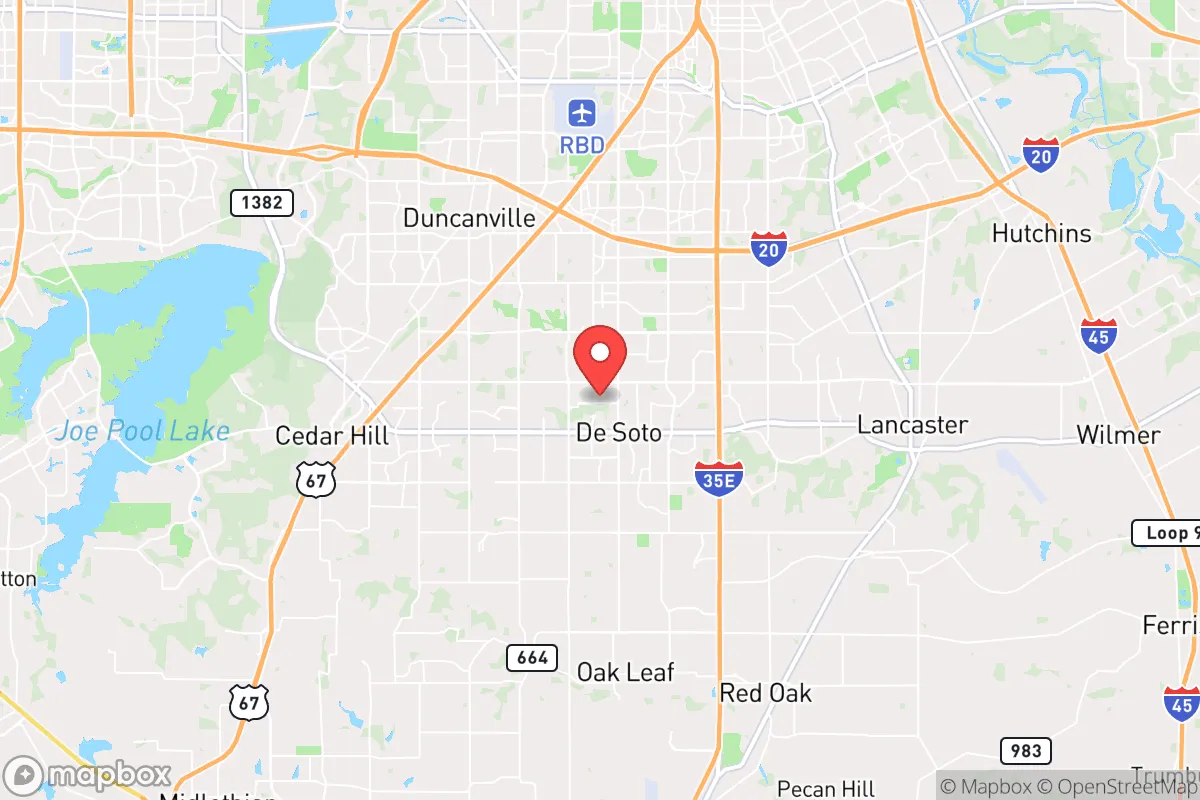
Daily life in DeSoto revolves around its well-regarded DeSoto Independent School District, which includes DeSoto High School (known for strong athletics and a robust fine arts program) and several elementary schools rated above state averages. The city’s park system is a standout, with 15 parks, the DeSoto Civic Center, and the sprawling 100-acre Grimes Park offering sports fields, walking trails, and a splash pad. The average commute of 30.8 minutes is a defining feature: most residents drive to jobs in Dallas (20–25 minutes via I-35E or U.S. 67), Irving, or the telecom corridor in Richardson. This commute is longer than the national average (26 minutes) but shorter than many outer-ring suburbs like Forney or Midlothian. Retail and dining are concentrated along the I-35E corridor, with national chains like Target and Walmart, plus local staples like the DeSoto Farmers Market. For entertainment, residents often head to the nearby Dallas Zoo, the Bishop Arts District, or the AT&T Performing Arts Center, all within a 20-minute drive. The city’s rhythm is distinctly family-oriented: weekend mornings see packed soccer fields and church parking lots, while evenings are quiet, with little nightlife beyond a few sports bars and a bowling alley.
DeSoto is best suited for families and professionals who prioritize good schools, a strong sense of community, and a suburban setting with a short commute to Dallas. Singles seeking a vibrant nightlife or young renters looking for walkable urban density will find the city too quiet and car-dependent. Retirees may appreciate the affordability relative to Dallas and the access to healthcare via nearby Methodist Charlton Medical Center, but the lack of age-restricted communities and the property tax burden are drawbacks. Ultimately, DeSoto delivers a stable, middle-class quality of life for those who value space, safety, and a community that feels both established and welcoming.

Crime in DeSoto, TX
Generally safer than 57% of comparable U.S. locations.
Violent CrimeViolent Crime Analysis
Property CrimeProperty Crime Analysis
Crime Analysis
DeSoto, Texas, reports a violent crime rate of 285 incidents per 100,000 residents and a property crime rate of 1,581.3 per 100,000, placing it in a middle tier for safety within the Dallas-Fort Worth metroplex. While these figures are lower than some neighboring cities, the overall safety picture is complicated by the jurisdiction’s location within Dallas County, where progressive district attorneys and judges have implemented policies that prioritize offender rehabilitation over incarceration. This judicial philosophy, while well-intentioned, has been linked to higher recidivism rates and reduced deterrence, meaning residents face a tangible risk of encountering repeat offenders who cycle through the system without meaningful accountability.
Crime in context
DeSoto’s violent crime rate of 285 per 100K is roughly 20% below the national average of 380 per 100K, but its property crime rate of 1,581.3 per 100K is nearly 30% above the national average of 1,200 per 100K. Compared to the state of Texas, which reports a violent crime rate of 447 per 100K and a property crime rate of 2,350 per 100K, DeSoto fares better overall. However, these comparisons mask a critical local dynamic: Dallas County’s elected officials, including District Attorney John Creuzot, have championed bail reform, reduced sentencing guidelines, and diversion programs for property offenses. For DeSoto residents, this means that a burglary or car theft is more likely to result in a citation or short-term probation than a jail sentence, emboldening property criminals and undermining public confidence in the justice system.
What residents experience
Daily life in DeSoto involves a heightened awareness of property crime, particularly vehicle break-ins, package theft, and residential burglaries. Neighborhood watch programs are active, but residents report that police response times can lag for non-violent incidents due to the department’s limited resources. The progressive judicial environment in Dallas County means that even when suspects are arrested, they often receive deferred adjudication or are released on personal recognizance bonds, leading to a revolving-door effect that frustrates victims. For example, a 2024 analysis by the Dallas County District Attorney’s office showed that over 40% of property crime arrestees in suburban cities like DeSoto had prior charges dismissed or reduced under progressive policies. This creates a sense of impunity among offenders and a feeling of helplessness among law-abiding residents.
Neighborhood-level variation is significant. The southern and eastern parts of DeSoto, closer to the city’s border with Lancaster and the I-35 corridor, see higher concentrations of property crime, while the gated communities and newer developments near the northern edge (closer to Dallas) report lower incident rates. Residents in older subdivisions, such as those around Hampton Road, should invest in security systems and participate in local crime watch groups. Ultimately, while DeSoto is not a high-crime city by national metrics, the progressive judicial policies of Dallas County create a structural vulnerability that residents must actively manage through vigilance and community organization.
* Values derived from national, state, county, city and local statistics and may differ in a specific area. Last updated: 2026-07-20T01:36:54.000Z
Narrative content on this page is AI-generated and may contain mistakes. Verify any details that matter before acting on them.
ReloMaps may earn a commission from affiliate links at no extra cost to you.

